
Get all your news in one place.
100's of premium titles.
One app.
Start reading
InsideEVs
InsideEVs
Technology
Suvrat Kothari

Inside The Texas Factory Racing To Break China’s Grip On EV Magnets

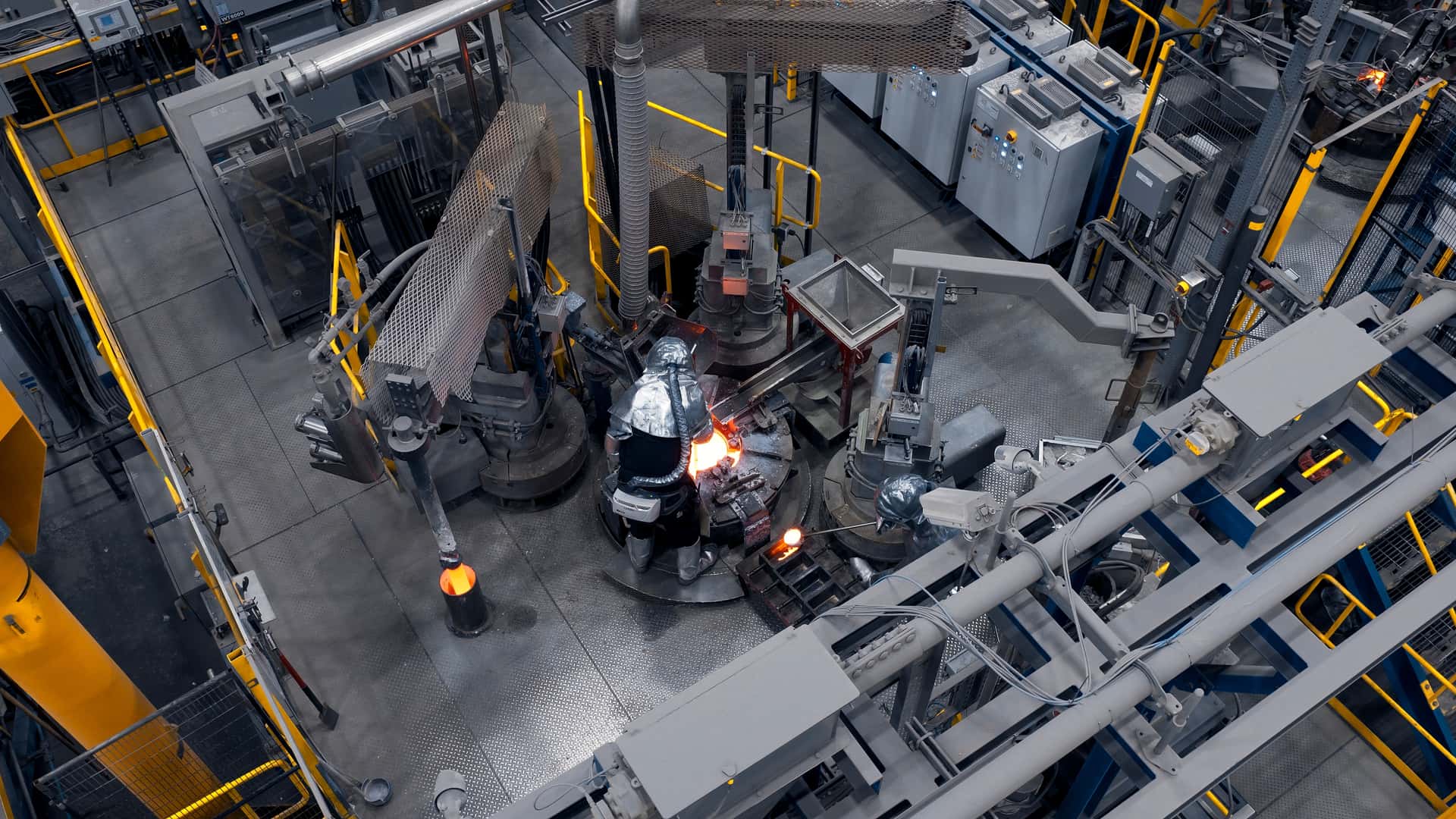
Inside MP Materials' "Independence" factory in Fort Worth, Texas, items that look like gum strips, corn flakes, and crushed pepper are laid out on a table. A giant U.S. flag hangs from the ceiling, and employees wearing protective thermal suits work near equipment where temperatures surpass 1,000 degrees Celsius. Under bright white lights, a shiny red Cadillac Vistiq gleams with its electric motor ripped open on a table, revealing what's inside: rare earth magnets.

The magnets are tiny, roughly equivalent to a miniature Hershey's candy. They feel robust and solid to hold, with smooth texture and sharp edges. Above all, their importance is hard to overstate. They're used in everything from military weapons and fighter jets to medical devices, iPhones, and electric vehicles.

There’s just one big elephant in the room: China dominates the production of rare earth magnets. The country has the largest known rare earth reserves in the world, accounting for 49% of global supply, according to the International Energy Agency. Virtually all the rare earths used in the U.S. currently are sourced from overseas, giving Beijing incredibly strong leverage against its trading partners.

After the Trump administration announced sweeping tariffs on Chinese goods last year, China retaliated with export controls on rare earth magnets, sending U.S. companies that depend on them scrambling to secure supply. Ford even suspended production of the Explorer SUV for a week because a supplier ran out of magnets. The U.S. eventually caved to Chinese pressure by trimming the tariff percentages, although China’s reduced export controls are still in effect.

Now American rare earths specialist MP Materials is attempting something that hasn’t been done in decades: resuscitate the rare earths supply chain in the U.S. It owns and operates Mountain Pass in Southern California’s Mojave Desert, the only rare earth mine and refining facility in the Western hemisphere and the largest of its kind outside China, according to the company.

The Mountain Pass mine in Southern California, about 45 miles west of Las Vegas.

Its Independence factory in Fort Worth turns the raw material from that mine into automotive-grade magnets for electric motors. In a boost to that effort, General Motors is partnering with MP Materials to source EV magnets domestically and protect itself from policy swings and tariff chaos. It’s part of GM’s vision of localizing its EV supply chain, a mission that’s looking more urgent by the day.

[Full Disclosure: General Motors invited me to tour the Independence factory in Texas. It paid for travel and accommodations.]

Why EVs Need Rare Earth Magnets

The buttery-smooth acceleration in EVs, the instant torque, and the excellent energy conversion efficiency compared to combustion engines—all this has a strong connection to the quality of the rare earth magnets used in traction motors.

Induction motors, which don't rely on rare earths, are also common in EVs, but permanent magnet motors are more power dense, deliver higher torque, and are more efficient in converting electricity into forward motion for the vehicle. The majority of EVs on sale today use permanent magnet motors or a mix of permanent magnet and induction motors, depending on the vehicle and its drivetrain. GM said in its crossovers like the Equinox EV, induction motors primarily exist for all-wheel drive assist, whereas the permanent magnet motor is the primary workhorse.

To understand the role of rare earth magnets in EVs, it helps to break down the electric motor itself. Each one contains two key subcomponents: a rotor and a stator. The stator holds copper coils, draws energy from the battery, and generates a magnetic field. The rotor, which houses the rare earth magnets, interacts with that magnetic field, and the resulting motion spins the shaft and turns the wheels.

The magnet at the center of all this is neodymium-iron-boron, or NdFeB, one of 17 rare earth elements and among the most valuable because it carries the strongest magnetic properties. GM said each large rotor contains 192 of these neodymium magnets, while a smaller version of the rotor uses 128.

It's one of the tiniest components in an EV, but it's central to what makes driving one feel so good. Because its production is so heavily concentrated in China, it’s often the subject of trade wars between the world's superpowers.

How GM Picked MP Materials

The vast majority of all rare earths used by the auto industry come from China, but it is gradually exploring alternative supply chains. It mirrors a similar shift in the battery business, where automakers are now trying to source more cells from local plants instead of purely relying on Chinese suppliers. Regulation is pushing them in that direction, too.

Shilpan Amin, the global chief supply chain and procurement officer at GM, said the bet on the U.S.-made magnets predates last year's export controls by several years. The global semiconductor shortage of 2021 pushed GM to list the critical materials in its supply chain most exposed to shortages and geopolitics. Lithium-ion batteries, rare earth magnets, and chips were chief among them. That same year, GM signed an offtake agreement with MP Materials to purchase rare earths from the Independence facility, which only had a pilot line back then.

“We changed our strategy to buy where you build,” Amin said during a media roundtable at the Independence plant.

MP Materials owns Mountain Pass, which it claims was the world's second most productive rare earths mine in 2025, accounting for 13% of global production. Last year, MP was still shipping tens of thousands of tonnes of raw material from the mine to China for processing. It stopped after China's export controls hit. (Chinese mining company Shenghe Resources holds a minority stake in MP Materials. Its largest shareholder is the U.S. Department of War, after the two struck a multibillion-dollar supply deal last year.)

Now the U.S. is on the verge of onshoring that processing capability. The Independence plant, which has been five years in the making, is only weeks away from supplying fully U.S.-made, automotive-grade neodymium magnets to GM, the company claimed. GM said all its EVs in North America will eventually use MP magnets, though how quickly, and how cost-effectively, remains an open question. GM is also testing prototype magnets at its Pontiac Engineering Center in Michigan. It’s expected to receive the first production-grade batch by the end of this year, but it didn’t reveal the exact timeline of when EVs equipped with the MP magnets will head to customers.

Amin didn't mince words when asked how the American-made magnets stack up on cost against China's. "It is premium today," he said. “Being a low volume startup producer has inefficiencies built in,” he added. However, bringing the costs down is a matter of scaling up, Amin said. “When operations are running at high utilization that brings you down the affordability curve to get competitive. On a fair and level playing field, this will beat anything else in the world.”

The Fascinating History Of Mountain Pass

MP Materials was founded in 2017, but the history of the Mountain Pass mine goes decades back. It was discovered in 1949—on geological terrain that's 1.7 billion years old—when independent prospectors were looking for uranium but found a rich deposit of rare earths instead.

Between 1965 and 1995, Mountain Pass actually supplied the vast majority of the world's rare earths, including a material for early television sets that enabled a red tint, MP Materials said. What the U.S. is seeking to onshore today is something it was dominant in decades ago.

“When you give up manufacturing, you give up the technology,” Alan Lund, the executive vice president of magnetics at MP Materials said.

Some of the key refining processes were invented in America, too. Solvent extraction, the process used to separate raw material from the rare earths inside it, was invented at Mountain Pass and later exported to China, officials said.

The neodymium-iron-boron magnet itself came much later, invented in 1982, and its roots trace back to General Motors. Japanese engineer Masato Sagawa and American metallurgist John Croat developed it independently in Japan and the U.S., then surprised each other by revealing the same discovery at a 1983 Pittsburgh conference. Croat was working at GM Research Laboratories at the time.

It's another eerily similar case of a critical technology developed in the U.S. that ended up scaling in China instead. Both the lithium-ion battery and the low-cost lithium-iron-phosphate (LFP) chemistry used in affordable EVs were also invented stateside. LFP is now the dominant chemistry in China, and Chinese battery makers produce the world's most advanced LFP cells. The U.S. is now trying to onshore LFP production, too.

Ownership of Mountain Pass changed hands repeatedly over the years, including a brief stint under Chevron. MP Materials said previous owners underinvested in the site for years, a time when China cemented its lead in the rare earths production. When the mine neared bankruptcy under former owner Molycorp, it went up for auction, and MP Materials bought it for $20.5 million.

The company says Mountain Pass holds one of the world's richest deposits of neodymium and praseodymium oxide, or NdPr oxide, the key feedstock for the magnets that end up in EV motors, electronics, defense equipment, and more.

How The Magnets Are Actually Made

NdPr oxide is the raw, powder-like material extracted from the mine in California. An on-site refining plant separates out what actually needs to be transported to the Independence factory for processing. It's a complex process that demands deep material science and metallurgy expertise, the company said, along with a tightly controlled manufacturing line, since the quality of the magnet directly affects the performance and efficiency of the motor it ends up in.

The Independence plant looks nothing like a battery factory or a vehicle assembly line, but it's no less impressive. Some of the steps involved go by names like "grain boundary diffusion" and "hydrogen decrepitation," which should give you a sense of how advanced the manufacturing really is.

In simple terms, the soil-like NdPr oxide raw material from the mine is compressed into metallic bricks. Those bricks then get broken down into pieces that look like metal corn flakes, which are converted again into a fine neodymium-iron-boron powder and compressed into dense magnetic blocks. Those blocks are then cut, shaped, and coated into finished magnets. In a finished magnet, rare earths account for only about 25-30% of the material, with the rest of it simply being iron, the company said. Many of the advanced manufacturing tools on the floor carried a "safely made in the U.S." label, though officials said some are also sourced from Germany and Italy.

MP Materials plans to produce one million magnets a day at the 250,000-square-foot facility, which is fully dedicated to the GM supply deal. That deal, MP Materials said, paved the path for two more massive orders that nearly total a billion dollars: one from Apple and one from the U.S. Department of War for use in weapons manufacturing.

Apple has pledged $500 million for magnets made from recycled rare earth materials, to be produced at an expanded facility at the same Independence plant. Apple said it already uses 100% recycled rare earth elements across its devices, but now wants to process them domestically too. For the DoW, MP Materials is building a new plant five times the size of Independence in Northlake, Texas. The 1.2-million-square-foot facility is expected to come online in 2028.

“Last spring, the [export controls] crisis was extremely acute,” MP Materials Founder and CEO James Litinsky said. “We were kind of on edge and the mandate from the president was, ‘solve the rare earth magnet issue immediately’.”

A Long Way To Go

For all the momentum, the numbers say the U.S. isn't close to catching up to China anytime soon. Despite these localization efforts, the country, and much of the rest of the world, is expected to remain reliant on Chinese rare earths well into the next decade, according to research firm Benchmark Mineral Intelligence.

Gallery: MP Materials Independence Magnet Factory

By 2030, the U.S. is projected to account for just 5% of global rare earth supply, while China is estimated to reach 86%. The International Energy Agency said the U.S. is also the most at risk from supply shocks, as nearly half the known rare earth reserves are concentrated in China.

MP Materials' role is real, but breaking away from China at scale would take a lot more than one company and one mine. That’s why the DoW has also struck multi-billion dollar deals with other companies in the business like USA Rare Earth and Vulcan Elements. It would require a concerted effort over several years to reduce America’s reliance on foreign supply chains and derisk it from trade shocks.

“We think of this as that long-term commitment,” Amin said. “What we’re trying to do now is encourage others to scale this business,” he added.

Sign up to read this article
Read news from 100's of titles, curated specifically for you.
Already a member? Sign in here
Related Stories
Top stories on inkl right now
One subscription that gives you access to news from hundreds of sites
Already a member? Sign in here
Our Picks
Fourteen days free
Download the app
One app. One membership.
100+ trusted global sources.