Stanford Political Science Prof. Andy Hall, a colleague of mine at Hoover, has this very interesting post at his new Free Systems Substack. An excerpt:
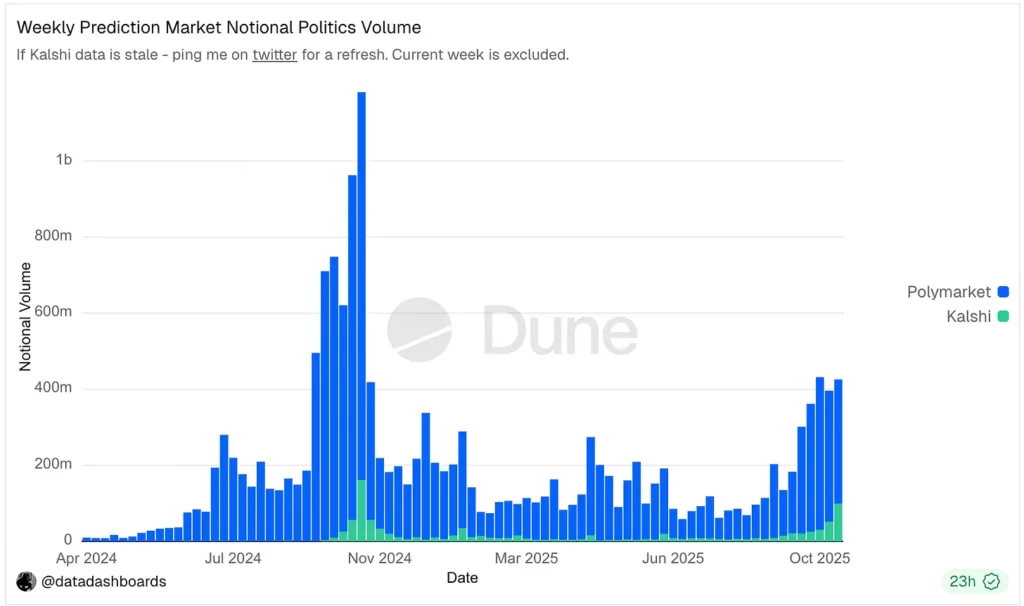
I've studied political prediction markets for years, and their early history is full of clever designs and unrealized promise. But what's happening now is fundamentally different. The scale, the liquidity, and the attention these markets are attracting represent a break from efforts of the past.
My broader project is to understand how we preserve liberty in an increasingly algorithmic world. Prediction markets are a fascinating case where individuals, freely pursuing their own incentives and acting on their own information, can generate a public good for the digital era: a clearer shared picture of a highly complex political environment. At the same time, they can also create strange feedback loops that require careful governance. So they're well worth studying.
To learn more, I decided to see them up close. Two weeks ago, I flew to New York City for election night and joined a group of academics, technologists, and prediction-market traders to run a real-time experiment betting on actual elections.
Over the course of the night, I witnessed a technology that has incredible potential to make us smarter and more informed about politics and the world—and which raises profound questions about what politics looks like in a world of live probability feeds where truth is often contested and frictionless information overwhelms our narrow attention spans….
Three questions that will make or break prediction markets for politics