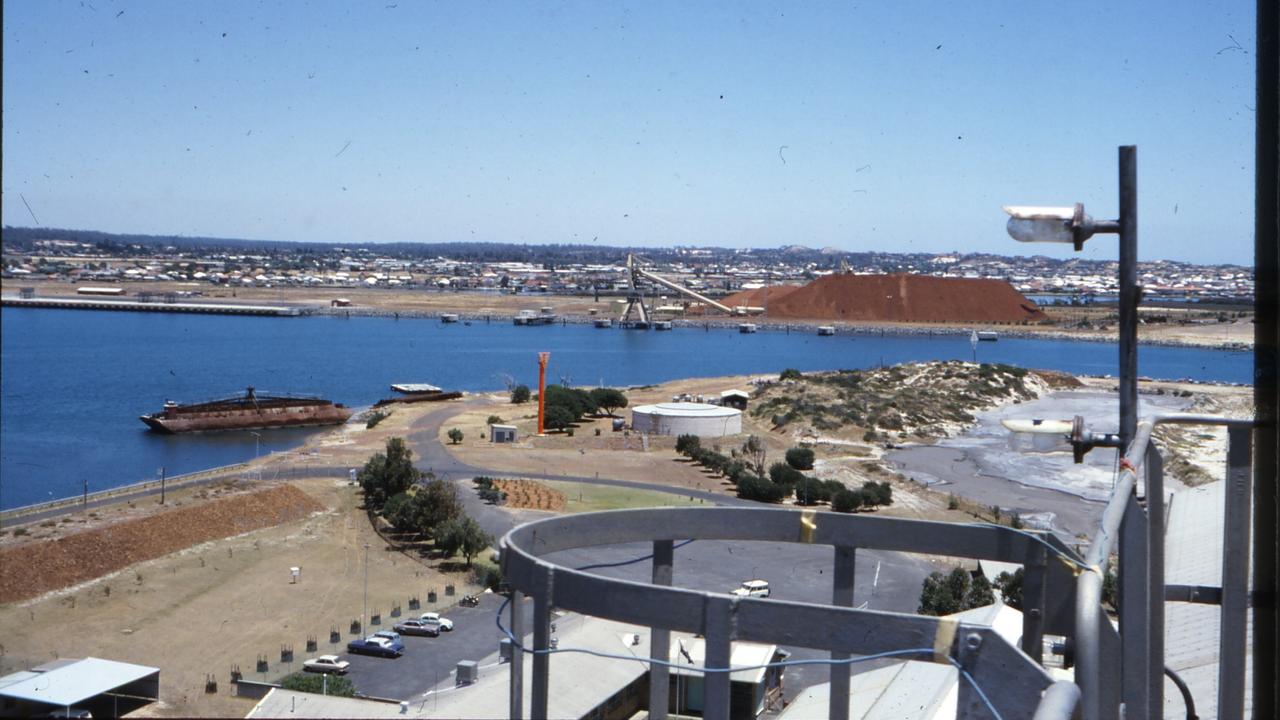
A sabotage bomb shatters the pre-dawn quiet of a coastal town in one of Australia's first acts of eco-terrorism.
Two men would be convicted of the attack, one who would twice escape custody and come to be regarded as a hero by many and a public enemy by others.

The massive blast, in Bunbury, Western Australia on July 19, 1976, tore through the town's port, rattling windows and nerves in a community that had never imagined itself a target.
"It was really, really loud and we thought someone had either hit our house or blown our house up," Glenda Miller tells AAP.
"We jumped up and ran outside."
In the darkness, neighbours spilled onto the street in their pyjamas, baffled by the blast, which was heard up to 20 km away.
Across town, a bomb hidden at a woodchip export berth had just detonated.
Metal shards were hurled toward the town, damaging homes and smashing windows 500 metres away.
Miraculously, no one was hurt.
"None of us had any idea what the hell had happened," says Mrs Miller who was 23 at the time.
"But the fact all of us had ended up in the street, it was obviously something pretty big."
The bombing is considered one of the nation's first acts of conservation-inspired violence aimed at influencing policy.
However, few people outside Bunbury, located about two hours south of Perth, have ever heard of the attack.
"It was unprecedented," criminologist Kate O'Donnell tells AAP.
"Nothing had occurred like this before in Australia."
Police would later reveal that two masked men had planted three homemade bombs made from part of a cache of 363 kilograms of stolen gelignite at the port but only one detonated.
"If they'd gone off, it would have wiped Bunbury out," Ms Miller says.
"It was basically a terrorist attack; in those days, nothing like that ever happened."
The convicted bombers, Michael David Haabjoern, then 28, and John Robert Chester, then 27, were fuelled by concerns over the logging and chipping of old-growth forests and capitalism.
They hoped the blasts would stop woodchip exports for several years, which they viewed as long enough to generate a groundswell of opposition.
"It was an insane time in WA," Dr O'Donnell says.
"There was a hotbed of environmental activism."
Hooded and armed with a military-style .303 rifle, the men cut through a fence at the port, tied up and abducted night watchman Trevor Morritt at gunpoint before setting the explosives.
"He was fearful for his life and fearful for his family," Dr O'Donnell says.
Years later, Mr Morritt described Chester as: "Very agitated and a loose cannon".
"But Haabjoern was fairly cool and calm," he said.
The exploded bomb was set at the base of a huge gantry-like structure called a stacker and caused about $300,000 in damage, a sizeable sum in the 1970s.
"It was a tremendous explosion and it definitely shook the house," Brad Repacholi, then 15, recalls.
"I remember mum and dad and myself running out of the house and the whole street was out looking, wondering what was going on," he says.
Fused wires prevented the other charges from detonating and were defused by a police bomb expert.
They had been placed at the base of the main target of the attack - the woodchip loading gantry, in a bid to topple it into Bunbury Harbour.
"They were very careful about making sure there was no injury to people, but they didn't care about the destruction of the infrastructure," Dr O'Donnell says.
The bombs' failure saved the berth from extensive damage and wood chip exports continued largely unhindered.
The pro-development WA premier at the time, Sir Charles Court, labelled the incident "a gross act of terrorism", invoking a strong political narrative backed by industry.
"He was facing an election and this was an important industry," Dr O'Donnell says.
Media reported the event as an act of criminality or sabotage, often characterising the men as bumbling fools who botched the bombing.
"The WA police didn't view it as a terrorist act, although that would probably be the case now," Dr O'Donnell says.
"It was considered a very serious crime."
Terrorism wasn't defined in Australia's criminal law until 2002.
Despite this, Dr O'Donnell's research has found ASIO had files on Haabjoern and Chester.
One of them was recorded as being a member of Ananda Marga, a religious sect with alleged links to the deadly and unsolved 1978 Hilton Hotel bombing in Sydney - described as Australia's first domestic terrorist incident.
Detectives tracked Haabjoern and Chester to a nearby town deep in WA's towering Jarrah and Karri forests and arrested them a week after the Bunbury explosion.
"They were genuinely motivated by wanting to protect forests and yet the dichotomy is that they committed these heinous crimes to do that," Dr O'Donnell says.
The bombing triggered mixed responses from the environmental movement. Some were sympathetic but others denounced it as illegal, violent and detrimental to the cause.
"They were not part of that broader movement, which was very well organised," Dr O'Donnell says.
"They were lone wolves."
The incident heightened the intensity of debate about woodchipping and some in the industry used it to characterise all conservationists and protesters as violent extremists.
"People in town were angry but there were also people thinking that maybe we shouldn't be doing the woodchipping," Ms Miller says.
Haabjoern and Chester pleaded guilty to four charges each, including causing an explosion likely to cause serious injury to property.
Their lawyer told the WA Supreme Court the bombers were courageous men of principle and preservers, not destroyers.
Justice Robert Jones was impressed by the men's devotion to their cause. They were each sentenced to seven years' imprisonment, with parole eligibility after 10 months.
But that was increased on appeal to a minimum term of three years and six months amid outrage over the leniency.
Chester escaped from Geraldton Regional Prison, 425km north of Perth, in early 1978 and made his way south back to the forests, where he's spent most of his life.
He was re-arrested about six weeks later when police raided a commune, but bolted again five hours later while waiting to appear in a local court after smashing his way through a toilet ceiling.
Detectives named Chester as a possible suspect when a terrorist bomb exploded in February of that year outside the Sydney Hilton Hotel, killing two.
Media reports from 1978 suggested Chester was a "hero for scores of young people" and stated he had evaded searchers, broken out of a police cordon, and "would have no problem finding a commune where he could lie low".
A Bulletin magazine article in April 1978 went further, calling him "the Robin Hood of the 20th century", a martyr and an outlaw protected by WA's forest people.
Chester made death threats against Mr Court and billionaire Gina Rinehart's father, Lang Hancock, during an interview with a journalist while on the run.
He also said he "might even blow up a woodchip train" and that it was "God's will to destroy those who destroy the Earth".
Fast forward five decades and Bunbury is one of the largest regional ports in the nation.
Despite the events of 1976, it now exports 780,000 tonnes of sustainable woodchips to Asia each year, mainly targeting the international paper market.
Large-scale commercial logging of native hardwood forests has significantly declined in Australia over the past half century due to environmental campaigns and the expansion of plantation timber.
Conservationists continue their fight to protect them in WA, however, commercial logging in state forests has been banned.
Haabjoern, Chester and Mr Morritt have all passed on.