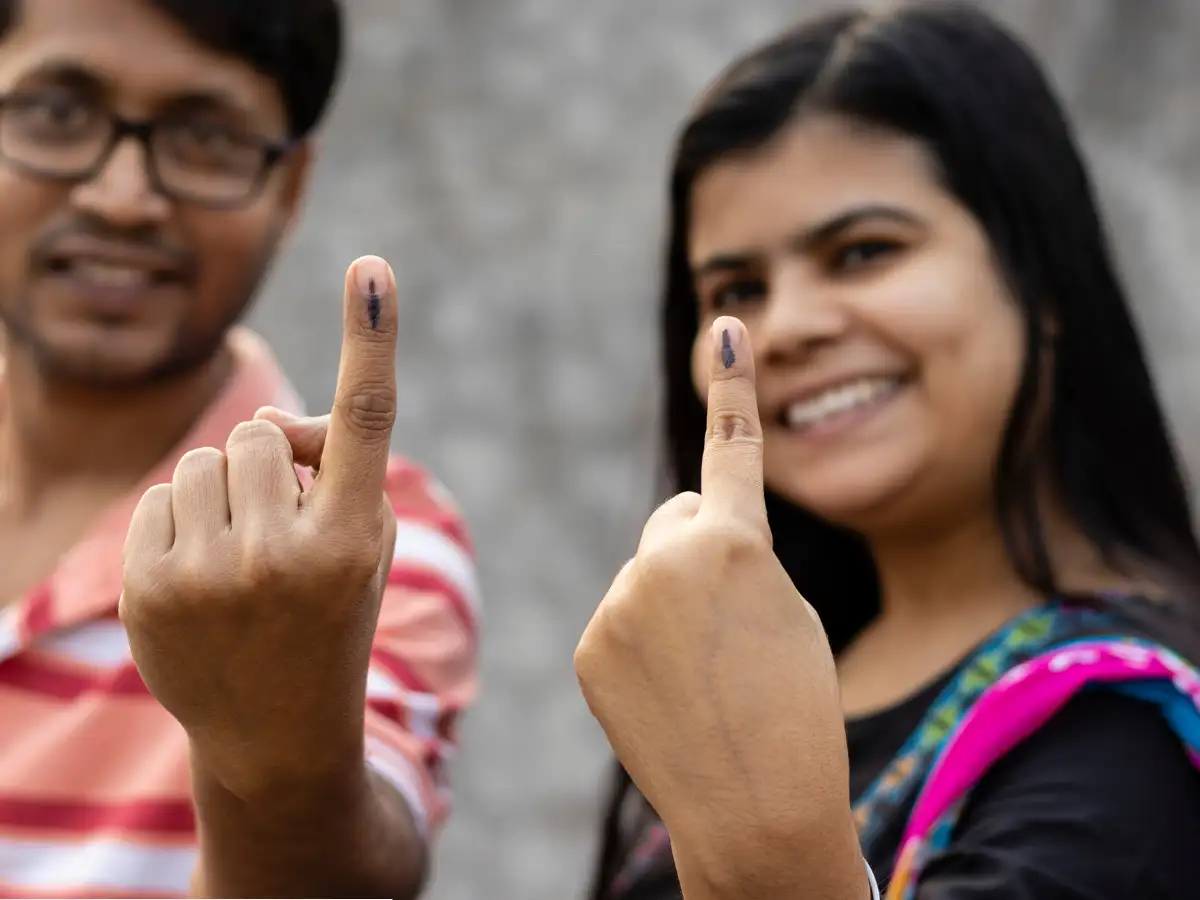
India's next general election could see an unprecedented youth influence, with Gen Z emerging as the largest voting bloc in several politically crucial states.
An analysis by the Times of India, based on United Nations World Population Prospects 2024, Government of India Census projections and research by the University of Southern California's Center for the Political Future, shows that if all eligible Gen Z citizens register to vote, they would account for 36.7% of Bihar's electorate and 33.9% each in Uttar Pradesh and Jharkhand. Together, these three states elect 134 Lok Sabha MPs, making them central to any national electoral strategy.

The analysis estimates that India has 391 million people aged 14-29, equivalent to 29.2% of the country's voting-age population. While Gen Z does not yet form a majority anywhere, the generation is becoming large enough to influence electoral outcomes, particularly in states with younger populations.
The Election Commission has increasingly focused on enrolling first-time voters through its Systematic Voters' Education and Electoral Participation (SVEEP) programme. With millions more Indians expected to turn 18 before the next Lok Sabha election, Gen Z's share of the electorate is set to expand further.
Where youth meets political power
The TOI analysis shows that the concentration of young voters is far from uniform across India.
Besides Bihar, Uttar Pradesh and Jharkhand, seven more states and regions have Gen Z accounting for at least 30% of the eligible electorate: Rajasthan (32.3%), Madhya Pradesh (31.4%), Jammu and Kashmir (31.2%), Chhattisgarh (30.7%), Assam (30.7%), the North-East excluding Assam (30.2%) and Uttarakhand (30.0%).
Together, these 10 states and regions send 234 MPs to the Lok Sabha—more than two-fifths of the House's 543 elected seats.
The concentration of younger voters also overlaps with India's electoral arithmetic. Uttar Pradesh sends 80 MPs to the Lok Sabha, Bihar 40 and Jharkhand 14, giving the three states a combined 134 seats. Together, they account for nearly one-fourth of the elected House, making them indispensable to any party hoping to form a majority government.
The numbers suggest political parties will increasingly need to appeal to first-time and young voters concentrated in the Hindi heartland and parts of eastern and northeastern India.
Two Indias, two demographic stories
The same analysis highlights a widening demographic divide between northern and southern India.
Kerala has the country's lowest share of Gen Z voters at 22.2%, followed by Tamil Nadu (22.6%), Andhra Pradesh (24.3%) and Himachal Pradesh (24.7%). Collectively, these four states account for only 88 Lok Sabha seats.
Meanwhile, nine states—including Maharashtra, West Bengal, Karnataka, Gujarat, Telangana, Odisha, Punjab, Delhi and Haryana—have Gen Z accounting for between 25% and 30% of eligible voters, representing another 212 Lok Sabha seats.
The divide reflects India's changing demographics. According to the Sample Registration System (SRS) Statistical Report and the National Family Health Survey (NFHS-5), several southern states reached replacement-level fertility years ago, resulting in slower population growth and older electorates. Fertility rates remain comparatively higher in states such as Bihar, Uttar Pradesh and Jharkhand, contributing to a larger pipeline of young and first-time voters.