Get all your news in one place.
100's of premium titles.
One app.
Start reading
Times Life
Times Life
Aishwarya Kapoor

India's Coastal Sea Snakes Are Highly Venomous, So Why Do They Almost Never Kill Anyone?

One of the Most Potent Venoms in the World, Living Just Offshore

The beaked sea snake, Enhydrina schistosa, is responsible for more sea snake bites on Indian fishermen than any other species, and its venom has a median lethal dose that rivals Russell's viper. The yellow-bellied sea snake, Hydrophis platurus, ranges across the entire Indian Ocean and into the waters off Lakshadweep and the Andaman Islands. These are not mildly venomous animals. Gram for gram, sea snake venom is among the most toxic of any snake on the planet, acting primarily as a myotoxin that breaks down muscle tissue rather than the haemotoxic or neurotoxic action people associate with land snakes. A paper published in Toxicon by David Warrell and colleagues documented that sea snake venom can cause rhabdomyolysis, the wholesale destruction of skeletal muscle, with renal failure following if treatment is delayed.

What makes this stranger is the geography. India has over 7,500 kilometres of coastline. The Gulf of Mannar, the Gulf of Kutch, the waters around the Andaman and Nicobar Islands, and the shallow estuaries of the Sundarbans are all active sea snake habitat. Tens of thousands of fishermen work these waters daily. The snakes are there. The venom is real. The deaths, statistically, are almost nowhere.

The Fang Problem

Sea snakes evolved from terrestrial elapids, the same family as cobras and kraits, but their fangs did not keep pace with their venom's potency. The fangs are short, fixed, and positioned at the front of the mouth, but the gape is narrow and the jaw musculature is adapted for gripping small, slippery fish, not for driving venom deep into mammalian tissue. Human skin, particularly on the palms and fingers where most accidental contact happens, is thick enough that a sea snake's fangs frequently cannot achieve meaningful penetration.

This is not a failure of intent. Sea snakes do not regard humans as prey or as a serious threat worth a defensive strike. When a fisherman's hand closes around one in a net haul, the snake's first response is to writhe free, not to bite. Bites that do occur are almost always what herpetologists call defensive bites under duress, and a high proportion of those are dry, delivering little or no venom. A study of sea snake bites in Sri Lanka and coastal India, reviewed in the journal Clinical Toxicology, found that envenomation occurred in fewer than half of confirmed bites, and severe envenomation in a fraction of those cases.

Who Actually Gets Bitten, and How

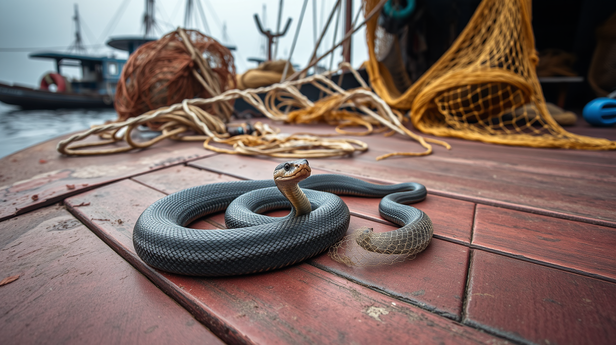
The bite profile in India is narrow. Fishermen working gill nets and trawl nets along the Gujarat coast, in Tamil Nadu's Palk Bay, and around the Andaman Islands account for the overwhelming majority of recorded bites. The mechanism is almost always the same: a snake entangled in a net is grabbed or stepped on during the sorting of the catch. Night fishing raises the risk because visibility is low and snakes are harder to spot among the catch.

Recreational swimmers are rarely bitten. Sea snakes encountered while diving or snorkelling in Indian waters, at sites like Netrani Island off Karnataka or the reefs around Havelock in the Andamans, will typically approach out of curiosity and retreat without aggression. Divers who have been followed by sea snakes for extended periods report no biting behaviour unless the animal was physically restrained. The marine environment itself is a factor: water disperses chemical threat signals differently than air, and a sea snake's sensory world is calibrated for fish, not for the large warm mammals that occasionally enter its habitat.

When Envenomation Does Happen

The cases where venom is delivered in meaningful quantity follow a predictable pattern. Fishermen who receive a confirmed bite and do not reach a hospital within four to six hours face the highest risk of myotoxic damage progressing to renal failure. The antivenom available in India, CSL's sea snake antivenom, imported and stocked at major coastal hospitals in Tamil Nadu, Kerala, and Andhra Pradesh, is effective against the most common Indian species when administered early. The problem is time and distance. A fisherman bitten twenty kilometres offshore in a small boat may not reach a facility with antivenom for hours.

Pain at the bite site is often minimal, which creates a dangerous delay. The systemic effects, muscle ache, dark urine from myoglobin in the kidneys, progressive weakness, can take two to four hours to appear. By the time a fisherman recognises he has been seriously envenomated, the window for easy intervention has narrowed. Awareness campaigns run by the Tamil Nadu Fisheries Department and organisations like the Coastal Safety Network have focused specifically on this gap: the absence of immediate pain does not mean the bite was dry.

The overall fatality rate from sea snake bites in India remains low partly because confirmed envenomation is genuinely uncommon, and partly because the fishing communities most at risk have developed practical knowledge over generations, they know to handle net catches carefully and to release a snake that is alive rather than attempt to kill it, which is when defensive bites most often occur.

Sign up to read this article
Read news from 100's of titles, curated specifically for you.
Already a member? Sign in here
Related Stories
Top stories on inkl right now
One subscription that gives you access to news from hundreds of sites
Already a member? Sign in here
Our Picks
Fourteen days free
Download the app
One app. One membership.
100+ trusted global sources.