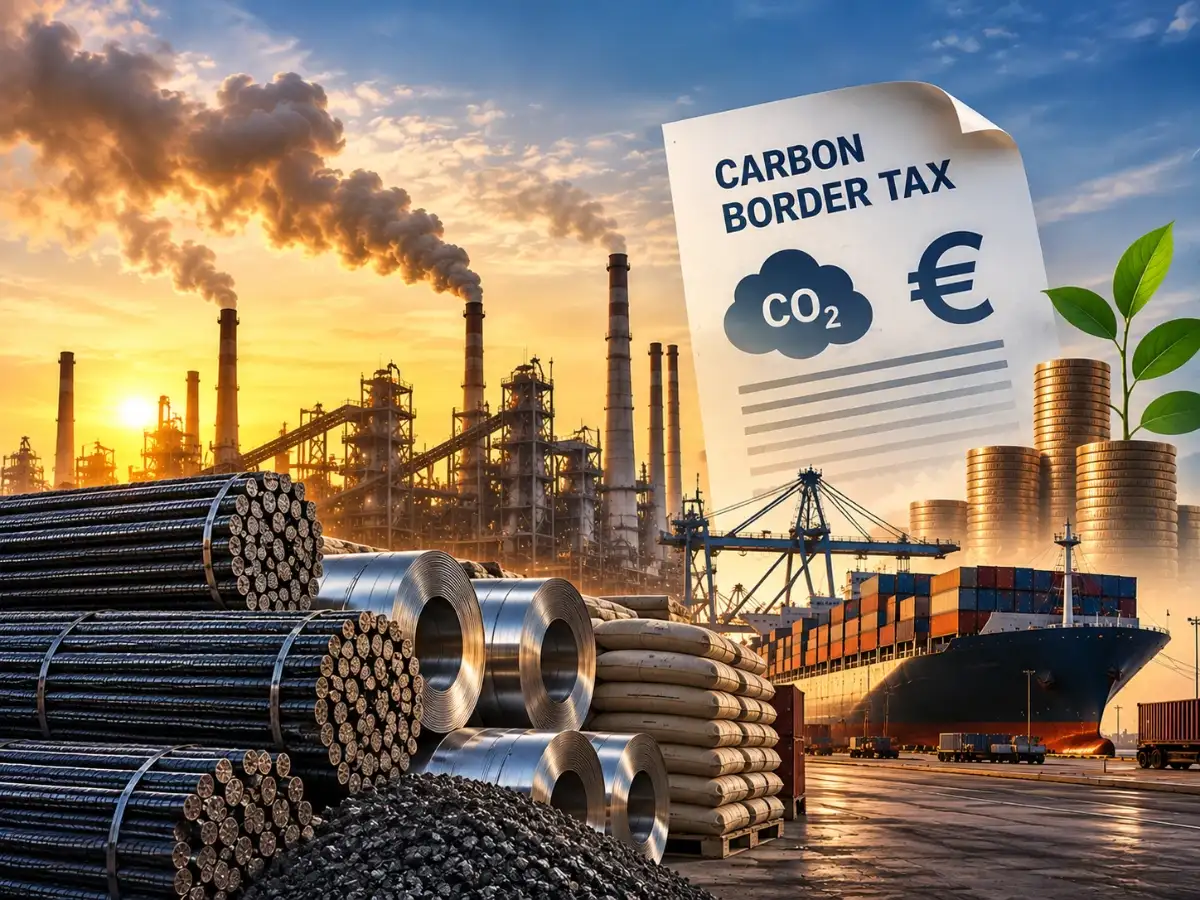
For Indian exporters, the price tag has a new line item: carbon. What once went up the smokestack could soon show up on the export bill, as carbon emissions increasingly become a cost of selling products overseas.
The European Union’s Carbon Border Adjustment Mechanism (CBAM) has entered its definitive phase in January 2026.

CBAM, essentially, puts a carbon cost on imports into the European Union. It requires EU importers to pay for emissions embedded in select carbon-intensive goods (based on carbon emissions during production) they import. The CBAM obligation is linked to the EU carbon price, while any carbon price already effectively paid on those emissions in the country of production can be deducted.
Also Read | On Edge: The Great Nicobar project faces a great engineering question
The EU importer pays the border carbon charge, but the economic burden can ultimately be passed back to the Indian exporter through lower margins, higher prices, or reduced competitiveness.
The United Kingdom is also preparing to introduce its own mechanism in January 2027.
For India, this policy creates a new trade calculation.
A factory may meet every conventional requirement for exporting a product, but its emissions could still determine how much more that product costs when it reaches a foreign market.
New Delhi is, therefore, trying a new route of its own: putting a price on emissions at home and building a domestic carbon market.
Also Read | Beating the Heat: India’s data centre dream and the 50°C reality in its path
The question is whether India can make carbon pricing work as an industrial policy—so that money associated with carbon emissions is invested in cleaner electricity, steel, technology and infrastructure inside the country instead of being collected at the borders of its trading partners.
The border tax mismatch
The stakes are high for India. Carbon-intensive industries such as steel, aluminium, cement and fertiliser are an important part of the country’s export economy. India’s merchandise exports touched $441.78 billion in FY26, with metals remaining a major export category.
The exposure to the EU’s CBAM, moreover, is concentrated heavily in metals.
The EU’s CBAM currently covers six sectors: iron and steel, aluminium, cement, fertilisers, electricity and hydrogen.
According to NITI Aayog’s Trade Watch Quarterly report released this month, annual metals exports stood at about $34.8 billion in 2025, with iron, steel and aluminium accounting for roughly 78% of that trade.
Steel, in particular, is seeing strong export growth. India exported 6.94 lakh tonnes of finished steel worth ₹5,541.2 crore in August 2026, up 31.3% in volume and 41.5% in value from August 2025. During April-August, finished-steel exports reached 29.86 lakh tonnes worth ₹23,646.6 crore, rising 34.1% in volume and 32% in value.
The challenge is compounded by the carbon intensity of India's metals production.
Indian metals have notably higher carbon intensity than the global average, mostly because primary steel production relies heavily on coal-based Blast Furnace–Basic Oxygen Furnace routes and coal-fired Direct Reduced Iron processes, rather than cleaner gas-based or Electric Arc Furnace routes, according to NITI Aayog’s Trade Watch Quarterly (April–June [Q1] FY27).
The scale of India's exposure to European markets adds another layer.
NITI Aayog estimates that the EU accounts for approximately 22% of India's combined steel and aluminium exports. In the iron and steel sector, India’s trade exposure to the EU stands at 39.3%, meaning nearly two-fifths of its steel exports are destined for the European market.
A June 2026 working paper by the Indian Council for Research on International Economic Relations (ICRIER), titled Carbon Border Adjustment Mechanism (CBAM): Impact on India’s Steel Exports to the EU and Carbon Tax Incidence , estimates that India’s steel exports to the EU could fall by 24% under the CBAM, based on simulations using the ICRIER Samriddhi Model, a GTAP-E-based general-equilibrium model.