
Get all your news in one place.
100's of premium titles.
One app.
Start reading
Times Life
Times Life
Aishwarya Kapoor

India Wildlife Safari Planning: What First-Timers Miss Before Booking a Tiger Reserve

The Permit System Will Confuse You the First Time

Every national park in India divides its core zone into numbered safari zones, and each zone has a fixed daily quota of jeeps. Ranthambore, for instance, has six zones in its core area. Zones 1, 2, and 3 sit closer to the lakes where tigers are frequently sighted. Zones 4, 5, and 6 are denser forest with fewer sightings but more leopard and sloth bear activity. The Forest Department releases permits through the government portal (forestdepartment.rajasthan.gov.in for Ranthambore; each state has its own), and peak-season slots, October through March, disappear within minutes of going live, often 90 to 120 days in advance.

The practical move: decide your dates at least three months out. Log in at midnight on the day permits open. Book a buffer safari, if you're going for three days, book four slots across multiple zones. One washed-out morning, one jeep breakdown, one no-show guide can cost you a full day.

For Corbett, the permit system splits further into Dhikala, Bijrani, Jhirna, and Durga Devi zones, each with its own booking window. Dhikala requires a minimum two-night stay inside the forest rest house and fills up faster than the others. If you're going to Corbett specifically for the Dhikala experience, treat that booking like a train reservation during Diwali week.

Choosing the Right Reserve Changes Everything

Most first-timers default to Ranthambore because it's the most photographed, or to Jim Corbett because it's the oldest. Both are excellent. Neither is automatically right for you.

Bandhavgarh in Madhya Pradesh has one of the highest tiger densities of any reserve in the country, which means sighting probability is strong even in the buffer zone. Kanha, also in Madhya Pradesh, offers a more open meadow terrain, better for photography, easier to spot the barasingha (the hard-ground swamp deer found almost nowhere else), and significantly less crowded than Ranthambore in season.

Kabini, on the Karnataka-Kerala border, operates differently. The Nagarhole Tiger Reserve around Kabini is famous for elephant herds and the annual gathering of wildlife at the reservoir edge during summer. The safari here uses both jeeps and coracle boats. It's a strong choice if you want variety in a single trip and don't want to spend your entire budget on flights to Rajasthan or Madhya Pradesh.

The question to ask yourself before booking: do you want maximum tiger probability, or do you want a full wildlife experience? These are different trips.

What to Know About Jeeps, Guides, and the Buffer Zone

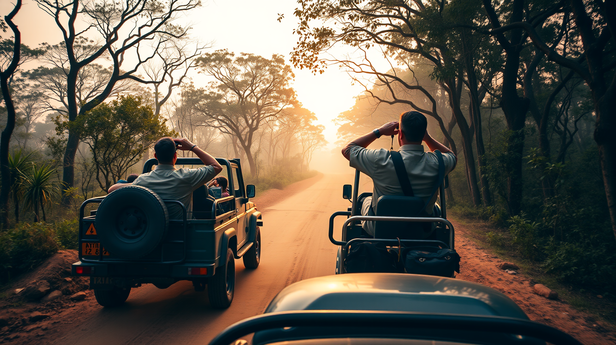
Every safari jeep carries a maximum of six tourists plus a driver and a naturalist guide. The guide is not optional, Forest Department rules require one. The quality of that guide determines more about your safari than the zone you're in.

A good naturalist reads pugmarks, listens for alarm calls from langurs and spotted deer, and positions the jeep before the animal appears in the open. A poor one drives to the last known GPS coordinate of a tiger sighting and waits. Book through a reputable lodge or a BNHS-affiliated operator rather than through a random aggregator. Ask specifically whether the naturalist is a certified wildlife guide or a driver doubling as one. These are different skill sets.

The buffer zone deserves more attention than it gets. Core zones are where the permit quotas apply. Buffer zones, the outer ring of the reserve, often allow more flexible entry, longer drives, and better birding. At Pench, the buffer zone runs along the Pench river and produces leopard sightings with some regularity. At Satpura, the buffer zone is where the walking safaris happen, the only tiger reserve in India that permits guided walks inside the forest.

Budget: What the Numbers Actually Look Like

A common mistake is calculating only the safari permit cost. The permit is the cheapest part.

Safari permit (government fee): Rs 1,500 to Rs 3,500 per person per safari, depending on the park and zone. Jeep hire (shared or private): Rs 2,500 to Rs 7,000 per safari. Naturalist fee: sometimes included, sometimes separate at Rs 500 to Rs 1,500. Accommodation near a good reserve, meaning within 10 minutes of the gate, ranges from Rs 4,000 per night at a decent mid-range property to Rs 25,000 and above at the luxury lodges that include safaris in their tariff.

The lodges that bundle safaris into their room rate are often better value than they look. They handle permit booking, provide trained naturalists, and their vehicles are maintained specifically for forest terrain. For a first trip, the time saved on logistics alone justifies the premium.

Budget realistically for two safaris per day, one at dawn, one at dusk. These are the two windows when animals are most active. A single mid-morning drive to save money on accommodation will almost certainly produce fewer sightings and a less satisfied traveller.

The Practical Details Nobody Mentions

Wear muted colours. Khaki, olive, grey, brown. Bright colours and white are discouraged at most reserves and actively prohibited at some. This applies to children too.

Carry a dust mask or a thin cotton scarf. Forest tracks are unpaved, and an open jeep at 40 kilometres per hour on a dry October morning generates significant dust. Eye drops help.

The best camera for a first safari is the one you already own. A phone with a good zoom mode will capture what a nervous first-timer needs, evidence that the tiger was real, that the elephant was three metres away, that the kingfisher was exactly that blue. Rent or borrow a long lens if you're serious about wildlife photography. Don't buy one for one trip.

Switch your phone to silent, not vibrate. A buzzing phone in a silent forest has ended more than a few sightings.

The thing that surprises most first-timers isn't the tiger. It's the alarm. When a spotted deer freezes and barks, when a langur drops from a tree and screams, the whole forest goes tense. The naturalist reads that alarm call and turns the jeep. You learn, over two or three safaris, that the forest is always talking, and that the tiger is usually already watching you before you see it.

Sign up to read this article
Read news from 100's of titles, curated specifically for you.
Already a member? Sign in here
Related Stories
Top stories on inkl right now
One subscription that gives you access to news from hundreds of sites
Already a member? Sign in here
Our Picks
Fourteen days free
Download the app
One app. One membership.
100+ trusted global sources.