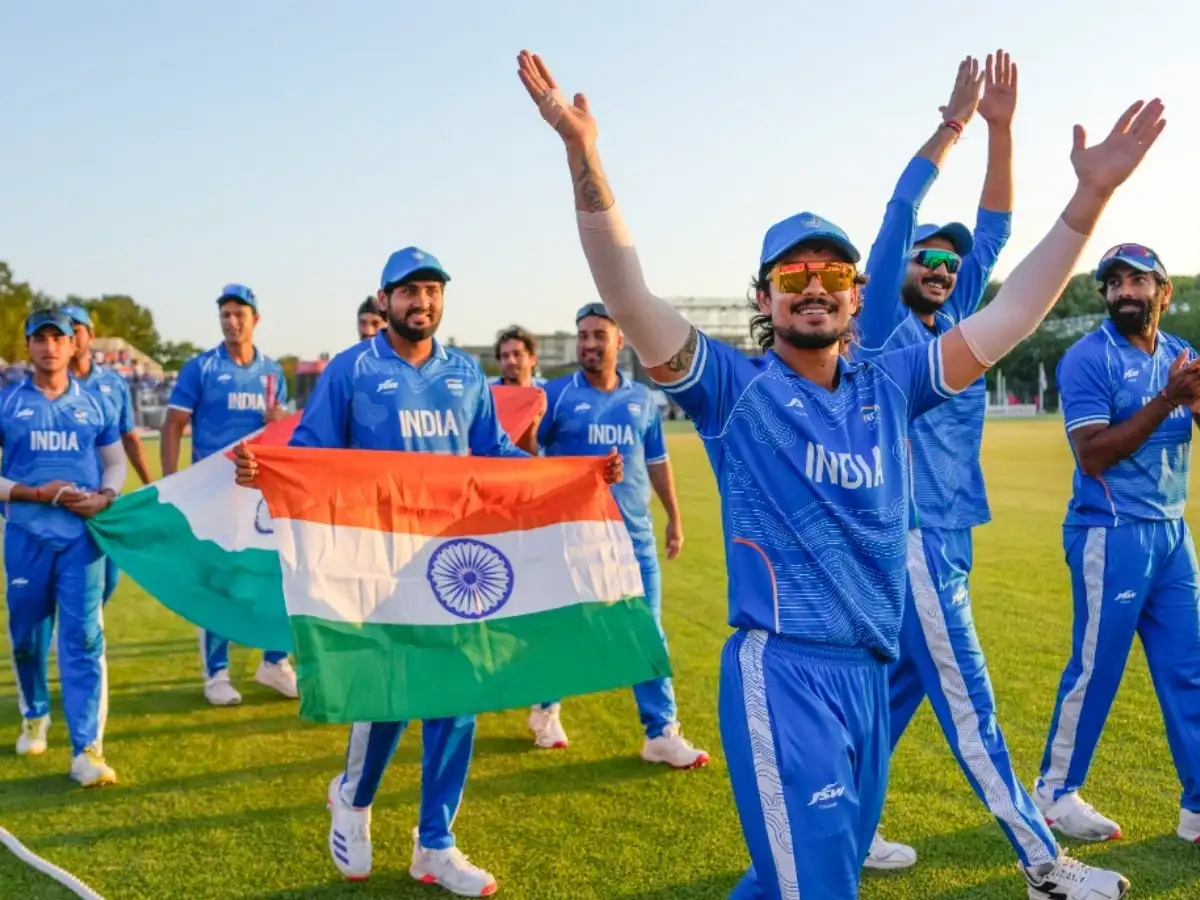
India-Pakistan clashes in men's cricket and hockey drew the biggest audiences in Asian Games history, the Olympic Council of Asia (OCA) said on Sunday, as it defended the Aichi-Nagoya edition despite criticism over accommodation, transport and logistics.
The OCA said the men's cricket final and hockey semifinal between the two neighbours were the most-watched matches in the history of the Asian Games.

Also Read: IND vs PAK Asian Games 2026: India defend Asiad cricket gold in thriller against Pakistan
India beat Pakistan 4-3 in the men's hockey semifinal at the Gifu Prefectural Green Stadium in Kakamigahara before going on to win the gold medal by defeating Malaysia in the final.
A day later, India beat Pakistan by 19 runs in the men's cricket final to successfully defend its Asian Games title.
"The broadcast had the biggest viewership ever for the Games. Thanks to two big matches: yesterday, the Pakistan-India cricket match was the most-viewed match, and the day before (on Thursday), the Pakistan-India hockey match was the most-viewed match ever in the Games' history," OCA Coordination Committee President Tayyab Ikram said at a press conference.
Ikram did not provide viewership figures or say which of the two matches attracted the larger audience.
He also highlighted what he described as the OCA's first safeguarding principle at an Asian Games.
"For the very first time, the OCA demonstrated a safeguarding principle in these Games. From all aspects it was a safe Games -- for athletes, for Asian federations and for the National Olympic Committees."
‘Mega multi-sport events always face some challenges’
The OCA's assessment came despite criticism of the Games' logistics.
The decision to scrap a traditional Athletes' Village as part of a cost-cutting exercise led to complaints over accommodation and transport. Around 17,000 athletes and officials were housed across hotels, temporary wooden containers and a cruise ship instead.
Ikram acknowledged that there had been complaints and operational challenges, but said such issues were inevitable at an event of this scale.
"We are also aware that there were some complaints, and there were certain issues which were highlighted. Of course there were some challenges, but the way we handled the challenges, should be more important to highlight.
"We tried to give our athletes the best conditions, logistics and communications. We have had many Games like Olympic Games, Asian Games, other continental Games and there are always some challenges in the operations."
Also Read: India did not get Asian Games gold ‘on a platter’, says Sanju Samson after Pakistan win
On the accommodation model, Ikram said the response from athletes had been positive while acknowledging that there were lessons for future editions.
"It was very well received by the athletes. It was a matter of adaptation. It was a different model to organise the Games without having white elephants -- bigger Villages which don't have a legacy. Yes, it is something to consider in the future.
"There are certain things we still need to improve, but it was one of the successful models."
212 Asian Games records broken
The OCA also pointed to the performances achieved by athletes in Aichi-Nagoya as evidence of the conditions provided to competitors.
OCA Director General Husain Al-Musallam said 54 world records, 11 junior world records, 89 Asian records and 212 Asian Games records were broken during the Games.
"This achievement does not come without the best environment the organising committee created for the athletes.
"The athletes cannot perform if they don't sleep well, don't eat well and don't have good transportation. We are happy to see that there is no big financial burden on the organising committee, and there is no white elephant left staying in Nagoya or anywhere."
Al-Musallam acknowledged the challenges faced by the organisers but said the OCA's role was to work with Japan to deliver the Games successfully.
"Yes, the organising committee had challenges. But our duty and responsibility as leaders was to work hard with the organising committee to help Japan demonstrate to the world that Japan can deliver, with all the challenges, the best Games: the best environment for the athletes, the best coordination, the best peaceful (event)."
OCA says sponsorship revenue rose 19%
The OCA also said its commercial performance had improved compared with the previous Asian Games in Hangzhou in 2023.
Al-Musallam said OCA marketing and sponsorship revenue was 19% higher than at the Hangzhou Games.
"In these Games, the OCA marketing and sponsorship did 19 per cent more than the last Asian Games in Hangzhou, China, in 2023. This is because the sponsors, the partners, the TV rights holders and all the different digital platforms trust in Asian Games. This is because the Asian people are united in sport."
The Aichi-Nagoya Games also used a geographically spread-out model, with venues located across different prefectures rather than being concentrated in a single hub.
Ikram said the approach could offer lessons for future multi-sport events, including the Brisbane 2032 Olympics.
"These Games were a different model, with the different characteristic that they were stretched across different prefectures. The Brisbane 2032 Olympic Games is also looking at a similar approach, stretching the Games into two or three main hubs, including the Gold Coast and others.
"So the model is already there, and people appreciate it. For our strategy in future, we would like to see more sustainable solutions, more economical solutions, not putting any extra burden on the host that is not required, but without compromising the athletes' conditions, the athletes' opportunity to compete and, most importantly, the athletes' Games experience."