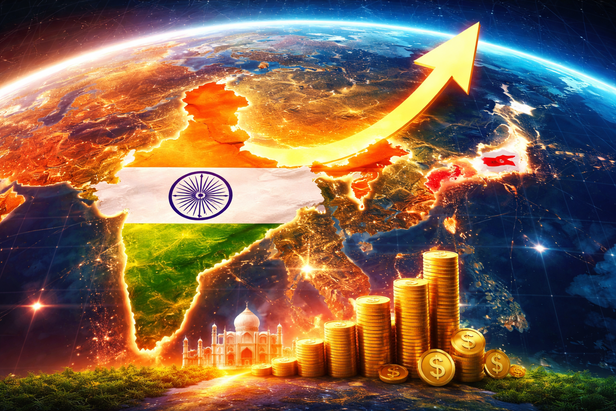
In a defining moment for India’s economic journey, the country has officially surpassed Japan to become the world’s fourth-largest economy, marking a major shift in the global financial order. This milestone is not just symbolic. It reflects years of steady growth, structural reforms, and rising global influence.
With a nominal GDP of around $4.18 trillion, India has moved ahead of Japan and now stands behind only the United States, China, and Germany.

The next goal is already clear: becoming the third-largest economy in the world.
A Historic Leap in Global Rankings
India’s rise from being the fifth-largest economy to fourth has happened faster than many expected. Just a few years ago, India overtook the United Kingdom to enter the top five. Now, it has crossed another major benchmark.
This transition reflects not just numerical growth, but a broader shift in global economic power. Countries that were once considered developing are now reshaping global rankings.
According to projections, India’s economy is expected to reach around $4.51 trillion, slightly ahead of Japan’s $4.46 trillion, further solidifying its position.
What Powered India’s Growth
India’s economic momentum has been driven by multiple factors working together:
1. Strong GDP Growth
India remains one of the fastest-growing major economies in the world. Consistent growth rates above 6 percent have helped expand the economy rapidly compared to slower-growing developed nations like Japan.
2. Domestic Consumption Engine
Unlike export-heavy economies, India benefits from a large and growing middle class. Rising consumption across sectors such as retail, technology, and services has created a strong internal demand cycle.
3. Digital and Infrastructure Push
Government initiatives focused on digital payments, startup ecosystems, and infrastructure development have increased efficiency and productivity across sectors.
4. Young Workforce Advantage
India’s demographic profile plays a key role. A large working-age population continues to fuel economic activity, innovation, and entrepreneurship.
5. Policy Reforms and Global Positioning
Economic reforms, improved ease of doing business, and increased foreign investment have strengthened India’s global economic standing.
A ‘Goldilocks’ Phase for the Economy
Experts describe India’s current economic phase as a “Goldilocks period”, where growth is strong while inflation remains relatively controlled.
This balance is crucial. It allows businesses to expand while keeping consumer spending stable, creating a favorable environment for long-term growth.
The Next Target: Germany
While overtaking Japan is a major achievement, India’s focus has already shifted to the next milestone: Germany.
Government estimates suggest that India could become the third-largest economy within the next 2.5 to 3 years, if current growth trends continue.
Projections indicate that India’s GDP could reach around $7.3 trillion by 2030, potentially pushing it ahead of Germany.
However, this will require sustained growth, stronger manufacturing output, and continued reforms.
Challenges That Still Remain
Despite the achievement, India’s economic journey is far from complete.
- Low per capita income compared to developed nations
- Income inequality and employment challenges
- Dependence on global trade conditions
- Need for stronger manufacturing base
These factors highlight that while the economy is growing in size, improving the quality of growth remains equally important.
What This Means for the World
India’s rise is not just a national milestone. It signals a larger transformation in the global economy.
- Emerging markets are gaining more influence
- Economic power is becoming more distributed
- Investment focus is shifting toward high-growth regions
India’s growth story is now being closely watched by global investors, policymakers, and businesses.