Get all your news in one place.
100's of premium titles.
One app.
Start reading
Newslaundry
Newslaundry
National
Abhishek Kumar

Independent journalists reporting on MP child deaths face surveillance, have Instagram accounts disabled

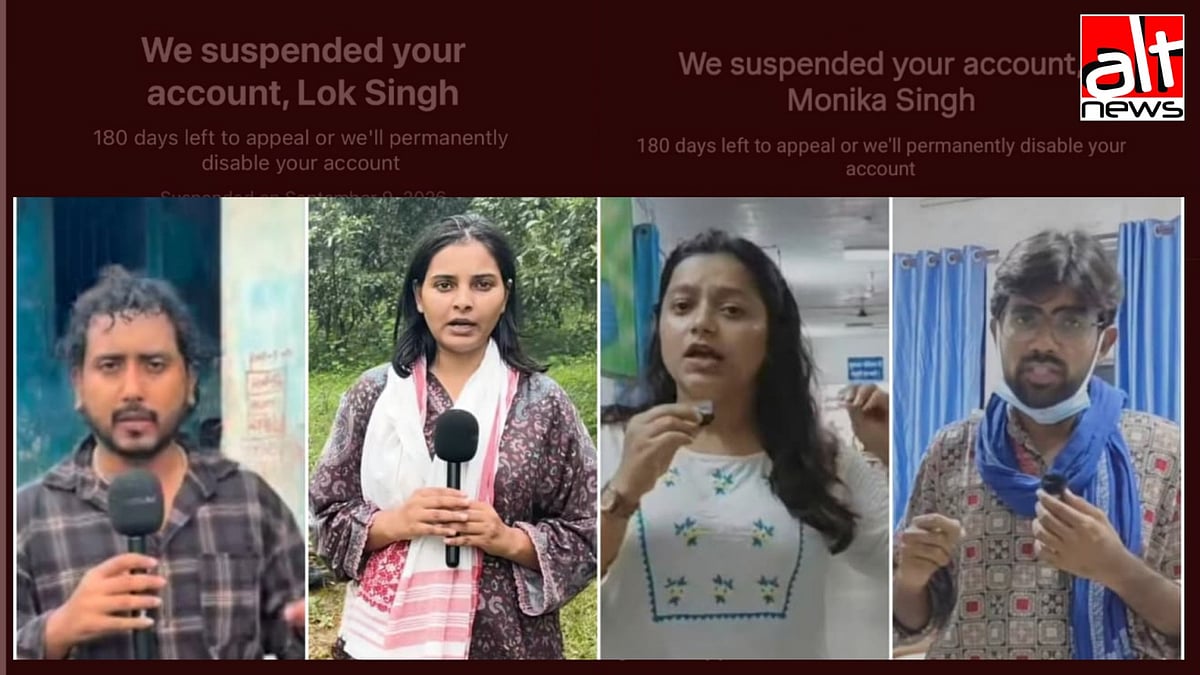
The Instagram accounts of three independent journalists — Bindu Gurjar, Lokbhadra Singh, and Monika Singh — were reportedly suspended earlier this month after they reported extensively on the deaths of tribal children in Madhya Pradesh’s Balaghat district, and raised questioned about the discrepancies in the government claims surrounding the death.

While Bindu and Monika’s accounts were initially restored after they appealed to Meta, last week, both the accounts were permanently disabled by Instagram. Lokbhadra’s account remained suspended throughout and he was compelled to open a backup account.

Another independent journalist, Saurabh Bhati, who runs a page on Instagram with Monika called The Unsalted, temporarily deactivated that page as well as his personal account as a precautionary measure, after observing the repeated suspensions faced by the other three journalists. The two accounts were later reactivated.

Speaking to Alt News, all three journalists narrated how they were subjected to surveillance, followed by plainclothes personnel, questioned about their movements and pressured through hotel authorities and local intermediaries, creating an intimidating environment that ultimately forced them to leave Balaghat.

Sudden suspension, eventual deletion

Narrating her ordeal, Bindu said that her account was the first to be targeted — on September 5, a copyright strike was issued against her ground report from the Balaghat district hospital, even though it was entirely her original reporting. The following day, on September 6, she received alerts on her phone indicating attempts to log into her account from three different locations. Her account was eventually suspended around 2:30 pm. She initially tried to verify her identity using her Aadhaar card to regain access to her account but was unsuccessful. On September 7, the option to use the PAN card became available, and using this she managed to restore her account around 10:00 am.

However, 11 days after she regained access, Bindu’s account was permanently disabled by Instagram on September 18. She received a notification that she no longer had access to her account, and all her information had been permanently deleted. “You cannot request another review of this decision,” it stated. The account did not follow community standards on account integrity, the notice said. She has now opened a backup account.

A few hours later on September 6, Monika’s account was also suspended twice, but on each occasion, it was restored following an appeal.

However, the account was also permanently disabled with a similar notice on September 20.

Lokbhadra’s account, which had the highest number of followers among the three, was suspended multiple times. Speaking to Alt News, he said the first suspension came at 5:47 pm on September 6. The handle was restored within 30 minutes after an appeal was filed at 10:30 pm. His account was suspended again on September 7 and 8, and for a fourth time around 11 pm on September 9. He said that he did not appeal anymore as cyber experts advised that this could be the work of hackers who might launch another attack immediately upon an appeal. His account remains suspended as of September 23.

The reasons cited by Meta for suspending these journalists’ accounts were identical. It was stated that the account or the activity associated with it did not follow the platform’s “Community Standards on account integrity”. This includes creating an account that impersonates another person, using another person’s photos to deceive others, or generating content that purports to speak on behalf of another individual.

In a statement released on September 8, the Press Club of India condemned the suspension of these journalists’ accounts, demanding an impartial investigation and describing the move as an attempt to intimidate or silence them.

What were these scribes reporting?

Reports of children dying from fever, rashes, or other symptoms began emerging from the tribal areas of Madhya Pradesh’s Balaghat district between June and July. Most of the deceased children belonged to the Baiga community, a Particularly Vulnerable Tribal Group (PVTG). Additionally, some children were from Gond families residing in villages nestled deep within dense forests, located nearly 150 kilometres away from the district headquarters.

The government initially reported an official death toll of only eight children. However, by August, locals, tribal organisations and the opposition began claiming the figure was much higher, ranging from 24 to 30 child deaths. Leader of Opposition in the Lok Sabha Rahul Gandhi raised the issue. Umang Singhar, the Leader of the Opposition in Madhya Pradesh, wrote to Prime Minister Narendra Modi citing 30 deaths and attributing them to a lack of water, nutrition, and timely medical treatment. The Madhya Pradesh high court sought a response of the state government to a public interest litigation that claimed that over 30 deaths had occurred and that approximately 400 children were admitted to a 50-bed hospital.

Towards the end of August, these four journalists arrived in Balaghat to report on the deaths of tribal children and uncover the reality. Visiting various villages and meeting affected families, they began investigating the death toll. Their reportage revealed discrepancies between the government’s figure and the rising numbers reported from various villages. The real figures, they reported, were much higher than eight.

Further, they highlighted the poor condition of the local hospital, where multiple children were being treated on a single bed. Subsequently, the reporters alleged that they were pressurised to meet officials and forced to leave their hotel — compelling them to leave Balaghat on the night of September 3.

The ground reality

Lokbhadra told Alt News that he arrived in Balaghat from Delhi on August 28. He mentioned that he had already learned through local and social media that while official figures cited only eight deaths, reports from the ground indicated 24 deaths. When he visited the district hospital the same day, the hospital staff informed him: “Over the past 12 days, more than 250 children exhibiting symptoms such as malaria or measles have been admitted.”

The next day, he reached the Bondari area of ​​Birsa block, located about 120 kilometres from Balaghat. This was the area where the highest number of children had been affected. He discovered that the death toll, initially reported as 24, had actually risen to 30. There was no official record of these additional deaths at the time. He gathered separate data on these six children and began publishing on-ground video reports by visiting their families. The video embedded below is from Lokbhadra Singh’s backup account.

View this post on Instagram

A post shared by Lok Singh (@lok_singh_backup)

On September 1, he learned that the district magistrate (DM) was scheduled to visit the district hospital that evening. Consequently, he arrived at the hospital before the visit to observe the conditions there. “When I had reported on the hospital previously, I found four children sharing almost every bed. Some of them were suffering from malaria, while others exhibited symptoms of measles. As soon as news of the DM’s impending visit spread, cleaning operations began, bedsheets were changed, and new beds were set up.”

View this post on Instagram

A post shared by Lok Singh (@lok_singh_backup)

Upon the DM’s arrival, Lokbhadra asked him about the death toll discrepancy, to which the DM did not provide a clear answer at first. He further questioned the DM on the hospital’s poor condition. Shifting the blame to the child’s background, the DM answered: “Children from tribal backgrounds often have as many as four siblings, and their parents are also present, which makes it appear crowded.”

Journalists countered by asking how children could be kept in the same bed if one was suffering from malaria and the other from measles. The DM failed to provide a satisfactory answer to this as well. However, in the course of the exchange, the DM admitted on camera, for the first time, to the figure of 24 child deaths. “When further questions were asked, the DM became irritated, swatted the camera away with his hand, and walked off,” Lokbhadra said.

Videos of the incident went viral on social media within hours, and reports began circulating that the Balaghat DM appeared to be dodging questions from the media. These videos, posted on Lokbhadra’s account and others’, are now unavailable as his account no longer accessible.

‘Forced to leave Balaghat’

“Around 2 am that same night, two individuals, one in police uniform and the other in plainclothes, arrived at my hotel room and asked the manager for documents verifying my identity, even though these had already been submitted at the time of check-in… I asked the manager if there was pressure from the police to keep me under surveillance, which the manager denied. However, when I stepped out of the hotel later that day, I spotted a vehicle bearing a police sticker and three or four plainclothes police personnel standing near the shops. As soon as I took out my camera, they were seen hiding behind posters,” Lokbhadra alleged.

“The same night after I questioned the DM, a local influencer visited my hotel, insisting that I meet the SP. I declined a private meeting at night and instead requested a formal press conference… The next day, while we were out reporting, another journalist staying at the same hotel informed us that some individuals had come to the hotel asking for our names and whereabouts,” he added.

A major district-wide shutdown protest was called by tribal organisations in Balaghat on September 3. On that very day, the hotel owner personally arrived and told the journalist that he had a family event, and the entire hotel needed to be evacuated to accommodate guests. No such information had been conveyed previously, Lokbhadra claimed.

After some discussion, it was decided that they would vacate their rooms in the evening after covering the protest. Throughout the demonstration, the same plainclothes individuals kept following them and recording videos, they alleged. He claimed that the journalists encountered the same police personnel all the way from their hotel during check out to the railway station as they were leaving Balaghat.

“Meanwhile, some local influencers from Balaghat started making videos against me, claiming that I lacked knowledge of media ethics and that my way of questioning the DM was inappropriate,” he alleged. He further claimed that he had received information from a local influencer that the SP had stated in a meeting that these four individuals from Delhi would be “taught a lesson”. Due to this “intimidating atmosphere”, they left Balaghat on the night of September 3rd.

‘Malnutrition, staff shortage and lack of medical facilities’

Monika and Saurabh arrived in Balaghat on August 31, before which the former had been tracking the story from Delhi. “Initially, information was available only on the pages of local influencers and city journalists, there were no official records. The official death toll stood at eight, but after speaking with protesters and the families involved, it emerged that their children’s names were missing from the lists. On ground, we discovered that the figure had risen from 24 to 30,” Monika told Alt News.

“The children are suffering from malnutrition, even if no one openly admits it, because acknowledging deaths due to starvation would be seen as a major failure on the part of the administration. Children in these hilly tribal areas have weak immunity, and malaria strikes every year but rarely makes headlines, and while symptoms of measles are clearly visible on their bodies, officials avoid explicitly naming measles and speak only of malaria,” Monika said, adding that the district hospital admitted that the children are malnourished and suffering from both measles and malaria.

Monika also visited the primary health centre (PHC) in Songuda village, which she claimed lacked the facilities to treat even a single patient. “Patients were put directly into an ambulance and sent to the district hospital, around 90 kilometres away. In the long journey, many children, who are already in critical condition, would die on the way,” she alleged. “In some cases, families did not even take the children to the hospital because there is a greater reliance on faith healing in that area. Some children died on the way to the hospital, since doctors did not record the cause of death, their names do not appear on any list. Others were referred from the district hospital to a hospital in Gondia, Maharashtra. The change of state meant these children were excluded from the Madhya Pradesh list.”

She echoed Lokbhadra’s observations for the district hospital, where she claimed there was a severe shortage of beds, and three or four children suffering from conditions ranging from measles, malaria, and malnutrition to ordinary fever, would share a single bed. She visited the hospital both at daytime and at night, and highlighted the severe staff shortage. MP police personnel were performing nursing duties, such as administering medication, while actual nurses were few and far between, and doctors were largely absent, often taking considerable time to arrive when summoned for emergencies, she observed. “Children traveling nearly 100 kilometres for treatment often set out in the evening and did not reach the hospital until 2 or 3 am, leaving no one available at that hour to treat them,” she said.

Monika reiterated Lokbhadra’s claim that the district hospital was given a complete makeover before the DM’s visit on September 1. In the same ward where she had previously reported four children sharing a single bed, the DM found only one child per bed, and the entire area had been cleaned up, she said.

Monika also recounted the same situation faced by Lokbhadra — the constant police surveillance and pressure tactics which ultimately forced the independent journalists out of Balaghat. On September 2, she received a message from another journalist stating that some people had come to the hotel asking about her. On her way back on a bike, she noticed people in plainclothes tailing her almost everywhere.

Bindu Gurjar arrived in Balaghat on August 28. A protest was underway on the main road about a kilometer from the district hospital. Speaking to people there, she came to know that the government was acknowledging only eight deaths.

While preparing her report, she learned that the Baiga community was classified as a Particularly Vulnerable Tribal Group (PVTG), and under various government schemes, Baiga mothers received Rs 1,500 monthly to purchase nutritious food for their children. Yet the situation on the ground was dire, Bindu observed while reporting from the Balaghat district hospital.

She learned that separate wards had been designated for patients from tribal communities. Across those wards, there were over 100 patients, and almost every single bed was occupied by over two patients along with their entire families, she said, adding that the hospital lacked basic amenities such as sanitisers and masks.

‘Last rites done before parents arrived’

A family at the hospital told Bindu that the parents of a child named Lavkush who had recently died did not live in Balaghat. They had gone to Bengaluru for work.

“By the time they were informed of the child’s illness, they were already on the way back. However, the child passed before they could arrive. In accordance with the traditions of the tribal belt, the last rites involved burying the child. This process was carried out without the parents’ consent. By the time the parents reached, the last rites had already been performed, sparking a dispute,” she told Alt News.

Bindu met Lavkush’s parents at the same hospital where their three other children were admitted and kept on the same bed. They were suffering from fever, symptoms resembling measles, and swollen eyes.

Lavkush’s family with their three sick children on the same bed

After speaking with the hospital staff, Bindu further learned that just one or two nurses were attending to over a hundred patients, and more than 250 patients had been admitted in the past 15 days. To address this shortage, personnel from the police lines were assisting at the hospital, an observation made by Monika earlier. The police, she said, worked four shifts per day, with ten people per shift helping to move patients around and support the staff.

In the course of her investigation, she also tracked the case of a girl named Kajal, who had died on August 29. Kajal had been referred to Gondia, where she passed away. Bindu’s team visited her village, Kisangarh, and witnessed her burial. Subsequently, Bindu and Lokbhadra launched an independent survey the same day. They recorded details, such as names, fathers’ names, village, the onset and nature of the illness, and prior medical consultations on printed forms.

On August 29, Madhya Pradesh chief minister Mohan Yadav visited Kisangarh village, where, according to Bindu, over eight children had died. He announced compensation of Rs 2 lakh for the families of the deceased children. However, it turned out that none of the eight children from that village, whose deaths had been reported, were on his list. As Yadav left without addressing the issue of accountability, Bindu said that locals there began raising slogans.

Bindu mentioned that she came under state surveillance after posting regular reports on the matter online. She recounted that on September 2, Dr. Nilay Jain, a surgeon at the hospital, had allegedly remarked, “Some people from Jamia Muslim University have arrived. I have spoken to the SP, and we will have to decide whether or not to allow them entry into the hospital.”

Meanwhile, a video had gone viral of Lokbhadra interviewing the sister of a deceased child, Rooplal, where she claimed that CM Yadav had dismissed her when she tried to talk to him about her brother’s death.

View this post on Instagram

A post shared by All India Adivasi Congress (@incadivasi)

“When I went to speak to the CM, he told me stop talking. He said, ‘don’t say anything right now, you talk too much’, so I came back without saying anything. My brother was the first to lose his life…but his name has not appeared on any list, and no compensation has been given to us so far,” she told Lokbhadra.

This story was originally published by Alt News and has been republished with permission.

Newslaundry is a reader-supported, ad-free, independent news outlet based out of New Delhi. Support their journalism, here.

Sign up to read this article
Read news from 100's of titles, curated specifically for you.
Already a member? Sign in here
Related Stories
Top stories on inkl right now
One subscription that gives you access to news from hundreds of sites
Already a member? Sign in here
Our Picks
Fourteen days free
Download the app
One app. One membership.
100+ trusted global sources.