
Get all your news in one place.
100’s of premium titles.
One app.
Start reading
LiveScience
LiveScience
Sascha Pare

Incredible, first-of-their-kind images show an orca being born in Norway — and the rest of its pod forming a protective circle

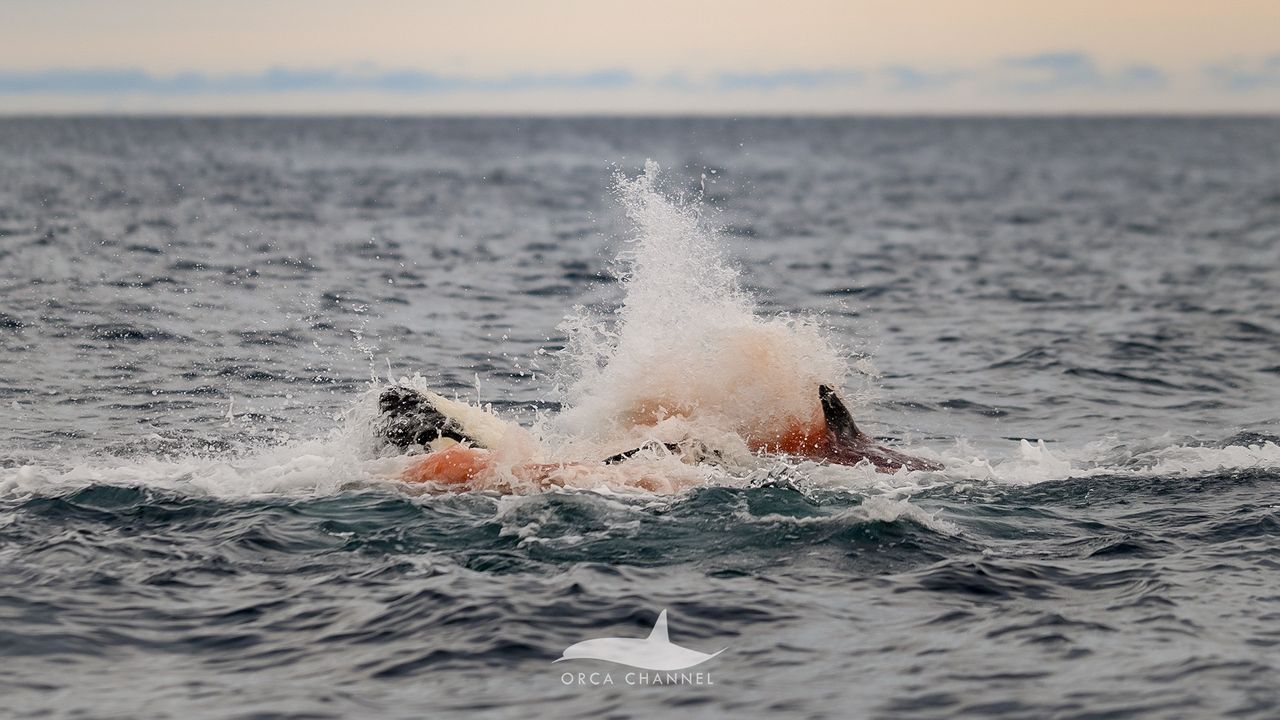
An orca giving birth in the wild. We see blood in the water and the orcas are splashing around.

Scientists in Norway have witnessed the birth of a baby orca in the wild, first-of-their-kind pictures show.

The researchers were observing a group of orcas (Orcinus orca) during a whale-watching trip off the coast of Skjervøy in the Arctic Circle when the water around the animals suddenly turned crimson with blood, they said.

"We were floating calmly and watching the feeding, when all of a sudden, close to the boat, there was blood spilling and splashing everywhere," Krisztina Balotay, a photographer and videographer at Orca Channel, a boat tour company that also gathers marine mammal data in Norwegian waters, wrote in a Facebook post on Nov. 2.

"At first, I had no idea what was going on," Balotay wrote in the post. "A moment later, I saw a little head pop above water. As it turned out, a female gave birth right next to us."

Moments after the calf was born, the rest of the group formed a protective circle around it. The orcas, mostly females and juveniles, were unusually energetic and seemed to be forcefully pushing the newborn toward the surface, which worried the team on the boat at first.

"We observed them carrying the calf on their back and holding it above water for air," Balotay wrote. "I was not sure if it was alive."

Scientists with the Norwegian Orca Survey, a research and conservation organization, flew a drone above the orcas to take a closer look. They also asked five other whale-watching boats that were on the scene to clear the area so the animals could calm down, representatives of the survey wrote in a Facebook post on Nov. 3.

Immediately after the birth, the orcas formed a protective circle around the calf. (Image credit: Krisztina Balotay)
The orcas forcefully pushed the calf to the surface so it could breathe. (Image credit: Krisztina Balotay)
The newborn orca's coloration is slightly more orange than that of adults. (Image credit: Krisztina Balotay)
After 15 minutes of struggle, the orca calf was able to swim on its own. (Image credit: Krisztina Balotay)
Eventually, the orca group could swim off. The calf was alive and well. (Image credit: Krisztina Balotay)

Footage from the drone showed that the calf had struggled to stay afloat for the first 15 minutes after birth, but that it was alive and well after that.

"The mother was identified as NKW-591, a known female first identified in 2013," the representatives wrote. "She has had multiple offspring and is therefore an experienced mother."

The calf's dorsal fin was bent, but this is to be expected in the hours after a newborn emerges from the womb, Balotay noted in Orca Channel's post. "It was so amazing to watch something like this in the wild," she added.

This is the first documented case of an orca being born in the wild and of its first hour alive, Norwegian Orca Survey representatives wrote on Facebook. The team followed the orcas until darkness fell, maintaining a distance of more than 1,000 feet (300 meters) so as not to disturb the animals. "We also ensured the whales' space was protected by stopping additional boats from approaching," they said.

The Norwegian Orca Survey hope they will encounter this orca group and the calf again in the coming weeks. In the meantime, researchers will collate the data they collected during and after the birth for a study.

"Documenting calf survival remains one of the core objectives of our long-term research," they said.

Sign up to read this article
Read news from 100’s of titles, curated specifically for you.
Already a member? Sign in here
Related Stories
Top stories on inkl right now
One subscription that gives you access to news from hundreds of sites
Already a member? Sign in here
Our Picks
Fourteen days free
Download the app
One app. One membership.
100+ trusted global sources.