
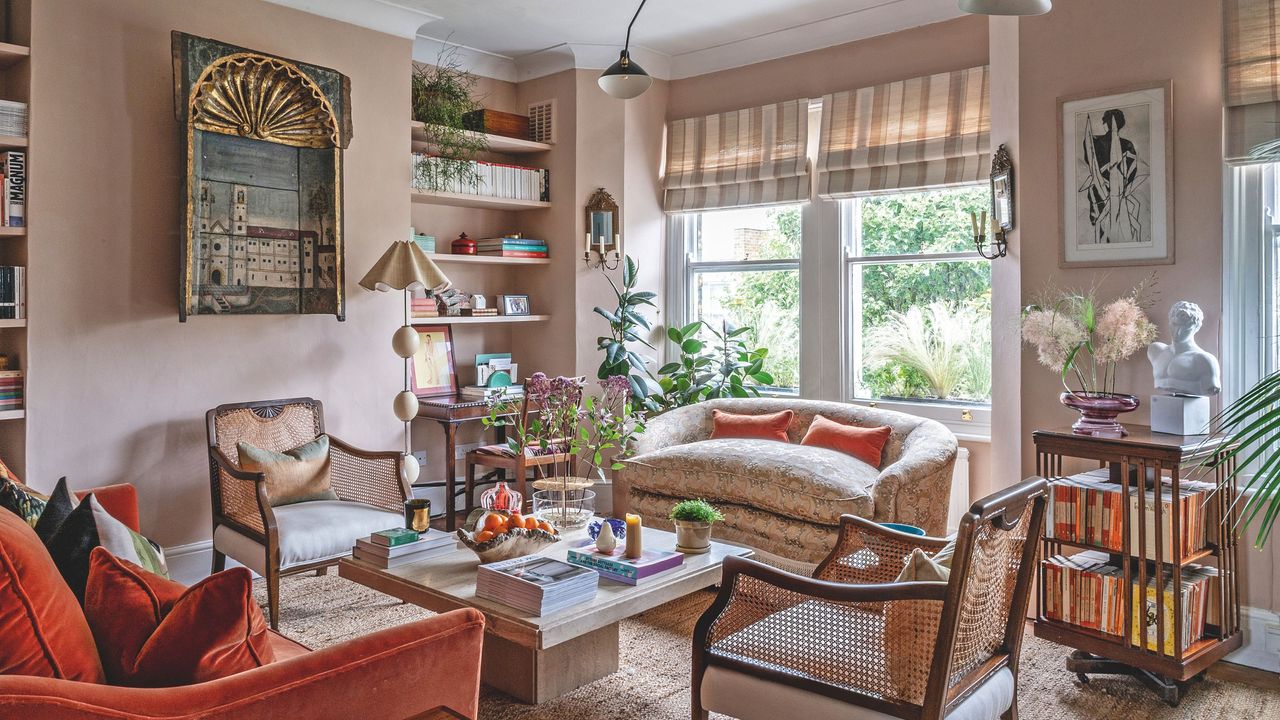
The eclectic style of interior designer Ananth Ramaswamy’s home, shared with his barrister husband Alexander Drapkin, took shape as their relationship was taking off.
The couple embraced the transformation of an apartment in south London into their inviting one-bed home with the same gusto as their budding relationship. Meeting a new partner includes discovering an interior design style that aligns with or differs from the other person’s. Ananth points out that they fell into the former camp.

‘My aesthetic is more modern than Alex’s. I like 1970s and 1980s design and contemporary lighting, while he loves Georgian furniture for its simplicity and honesty.’ Not that their divergent tastes proved irreconcilable, evidenced by the way they’ve fused Alexander’s more traditional taste with Ananth’s pluralist eye.

‘Alex bought the flat in 2018,’ says Ananth, who was born in Bangalore and in 2008 moved to London to study at the Architectural Association. ‘I moved in with Alex in 2020.’ The flat, formerly student accommodation, needed a lot of work.
‘What’s lovely about it is that it spans two houses and is very wide,’ says Ananth. ‘Alex had a brainwave – to swap a large bedroom for a smaller room as we spend the least amount of time in it. We converted the former to a dining room as we love entertaining.’

The house is part of a terrace tucked away from nearby Elephant & Castle. Ananth wanted to work with the house’s architecture, which helped dovetail the pair’s contrasting tastes. ‘We worked with the Victorian bones,’ says Ananth. ‘For the dining room, I chose a Cole & Son chinoiserie wallpaper with pagoda and weeping willow motifs.’ The neighborhood’s feeling of relative calm deepens as you enter this cocooning home.

The couple did the work in a methodical way. ‘Alex first decided to sand the timber floorboards, which had a nasty dark stain. This revealed beautiful old pine floorboards which we loved. We took a phased approach as we didn’t have the budget to tackle everything at the same time. Early on, we upgraded the electrics and had joinery made to add storage space.’
Flexible lighting was a core consideration. ‘My clients are in hospitality, so for me good lighting is crucial,’ says Ananth. His ingenuity with lighting is evident throughout the flat.

In the living room, a black articulated pendant light casts light over different areas of the space, while mirror-backed sconces support candles that animate it with their flickering flames. ‘The second phase was redoing the kitchen and bathroom. We wanted a very practical kitchen.’
This now has ultra-minimal IKEA kitchen cabinets, although a Carrara marble work surface adds a ritzy feel. ‘We had a bath installed in the bathroom. I prefer a shower but Alex loves a bath. That was non-negotiable.’

Soon after, raw-silk window treatments made in Bangalore were installed. When furniture-hunting, the couple scoured auction houses. In the living room, their finds include Danish mid-century nesting tables and lamps incorporating ostrich eggs, redolent of 1970s designs by David Hicks and Neil Zarach. Alex already owned antiques, including a revolving Victorian bookcase that contains Penguin paperbacks, whose orange spines tone with a sofa in velvet from Rubelli.
‘The last, most important layer for me is art,’ continues Ananth. In the dining room hangs a stylized portrait of a woman, reminiscent of Modigliani’s paintings, by Russian-born artist Jacob Kramer. In the living room is a framed embroidered textile that Ananth’s father brought back from Uzbekistan as a gift. ‘My father, who’s passed away, was very cultured,’ he says. ‘My sensibilities come from him and my mother, who loves fashion, travel, and food.’

Ananth has introduced Indian artifacts, such as a pair of heads made using a woodworking craft called kinnal, a gift from a friend. And he’s acquired Italian glassware by Salviati and cushions covered in colorful handwoven textiles by Turkish company Kutnia.
Did Alexander defer to Ananth when it came to decorating decisions, given his design expertise? ‘I’d say we struck a balance.’ The end result, he says, was ‘definitely collaborative’. And with the potential to add more art and artifacts, this project is ever-evolving.