
Get all your news in one place.
100’s of premium titles.
One app.
Start reading
Radio France Internationale
National
Sarah Elzas

In the supermarket age, outdoor markets remain at the heart of French life

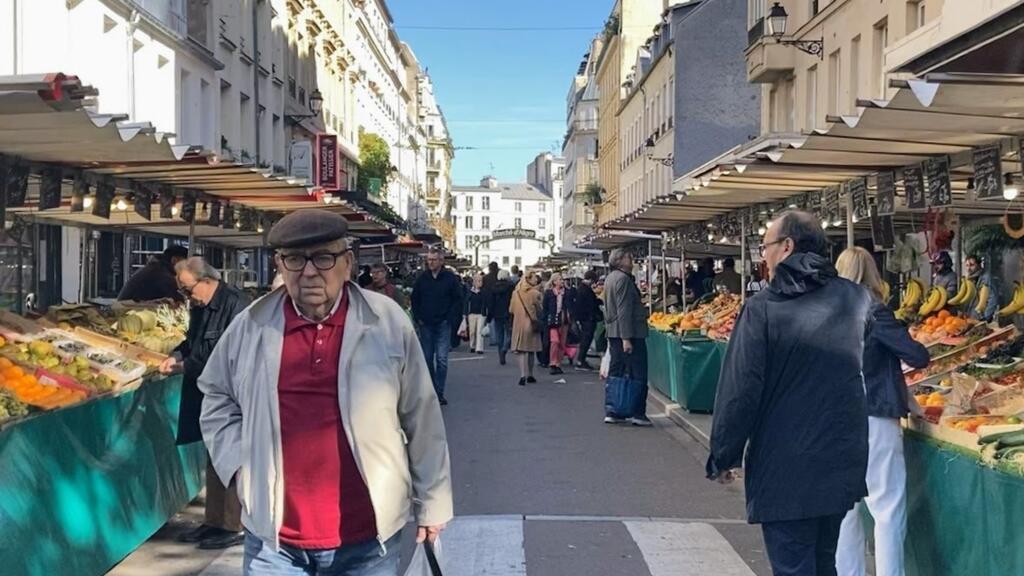
The Marché d'Aligre in Paris, pictured on 7 October, 2025. © Sarah Elzas/RFI

France’s weekly markets are more than just places to buy food, they are social hubs that define cities, argues journalist Olivier Razemon. He calls them 'an ingredient for a happy society' and believes that in an age of supermarkets and online shopping, policy makers and city planners should not overlook the contribution made by markets to French life.

Unlike most outdoor markets in France, which are held once or twice a week, the Marché d’Aligre in the west of Paris takes place every day.

Inside the central market hall – one of 15 in the city – and in the streets surrounding it, shoppers can stock up on fruits and vegetables as well as meat, fish, flowers and clothing.

“The quality varies. This seller here is making noise to attract clients,” says Olivier Razemon, passing a stall where a man shouts out: “Three mangoes for a euro!"

“His main argument is price. Others do not shout as much, because their main argument is not the price but the quality of their products. Some clients come for local food, others come for the deals.”

Take a visit to the Marché d’Aligre with Olivier Razemon in the Spotlight on France podcast:

Spotlight on France, episode 134 © RFI

There is something for everyone at the French capital's 200 weekly markets – and the almost 8,000 across the country, one for every town of 1,000 inhabitants or more.

“In every big village, in every mid-sized city, there is a market and people gather there. It really defines the city, because people come together and talk and things happen,” says Razemon, who recently published a book extolling these virtues.

French farmers contend with drop in demand for organic food

Big supermarkets

In his research, he found that France has the largest number – and the largest – markets in Europe, which he attributes in part to the country's love for gastronomy.

“People do like good food, and they spend more time at the table than their neighbours,” he said.

But he found another, less romantic reason for the ubiquity of outdoor markets: the rise of big supermarkets on the outskirts of towns.

Some of the first large-scale supermarkets were French, with chains including Leclerc and Carrefour appearing in the 1960s, drawing people away from local businesses in town centres such as fishmongers and butchers.

“In many small cities, local shops disappeared,” Razemon says. “The only place you can find fresh food now is the market.”

Nine in 10 French supermarkets still selling alcohol to underage customers

Journalist Olivier Razemon at the Aligre market. © Sarah Elzas/RFI

The national imagination

The percentage of food purchases in France made at outdoor markets is low, yet they have an outsized place in the national imagination.

For Razemon they are a symbol of conviviality and part of the French psyche, and yet he says they are largely overlooked by policy makers and city planners trying to revitalise downtowns.

One problem for city planners is that markets are ephemeral; they are set up once or twice a week on a city square or a few sidewalks, and then they disappear.

Some cities are looking to phase out their outdoor markets and instead put in place more permanent food courts or food halls, which would be open every day.

While this could be seen as a more efficient use of public space, Razemon warns it would be loss for French life.

“Markets answer a lot of [the concerns that preoccupy us] today,” he says. “They offer food direct from producers. You can get recipes from the merchants, people talk to each other.”

Charity warns one in three French people struggle to afford three meals a day

At the Marché d'Aligre, Razemon passes a stand selling pierogies, Polish dumplings.

“You talk with people in line and ask what things are, and they explain that these are pierogi, Polish raviolis. They give you recipes, and the sellers who are listening give you some extra. It happens every time,” he says.

He also believes the very fact that markets are only held once or twice a week is part of their charm, and their power.

“The probability of meeting someone at the market is very high because it is only once a week,” he explains. “If something is open every day, the probability – it is just mathematics – is quite low to run into someone.”

“Markets remind us that we need human interaction,” concludes Razemon. "We need more humanity."


Listen to more from Olivier Razemon and the Marché d’Aligre in the Spotlight on France podcast, episode 134.

Sign up to read this article
Read news from 100’s of titles, curated specifically for you.
Already a member? Sign in here
Related Stories
Top stories on inkl right now
Our Picks
Fourteen days free
Download the app
One app. One membership.
100+ trusted global sources.