Get all your news in one place.
100's of premium titles.
One app.
Start reading
The Economic Times
The Economic Times
Shreya Biswas

In the late 1990s, Arkansas agencies urged landowners to use BMPs to keep cattle from streams. Today, 2 agencies and local owners protect these sensitive waters together

Water quality concerns in Fulton County, Arkansas, prompted the Arkansas Department of Agriculture and the Fulton County Conservation District to focus on protecting local tributaries and streams in the late 1990s.

Many of these waterways were designated as Extraordinary Resource Waters or Ecologically Sensitive Waterbodies. The Fulton County Conservation District focused on best management practices designed to prevent livestock from accessing waterways and reduce nonpoint source pollution.

Over the years, the district worked with landowners to implement conservation practices aimed at protecting riparian corridors, perennial streams and watersheds.

Water quality concerns in Fulton County

The Strawberry River was added to the Clean Water Act Section 303(d) list of impaired waters in 1998 because of excessive turbidity. In 2006, it was also listed for Escherichia coli, with livestock agriculture identified as the primary cause.

Other impaired waters in the county included a segment of the Southfork Spring River, Gut Creek, English Creek and another segment of the Spring River. The Southfork Spring River was listed for dissolved oxygen in 2020, although that impairment was removed in 2022.

Livestock agriculture is the primary land use in Fulton County and was identified as contributing to nonpoint source pollution affecting the Little Strawberry and Strawberry River headwaters.

The county's watersheds are located in the Ozark Highlands ecoregion and include three Extraordinary Resource Waters: the Spring River and all its tributaries, the South Fork Spring River and the Strawberry River.

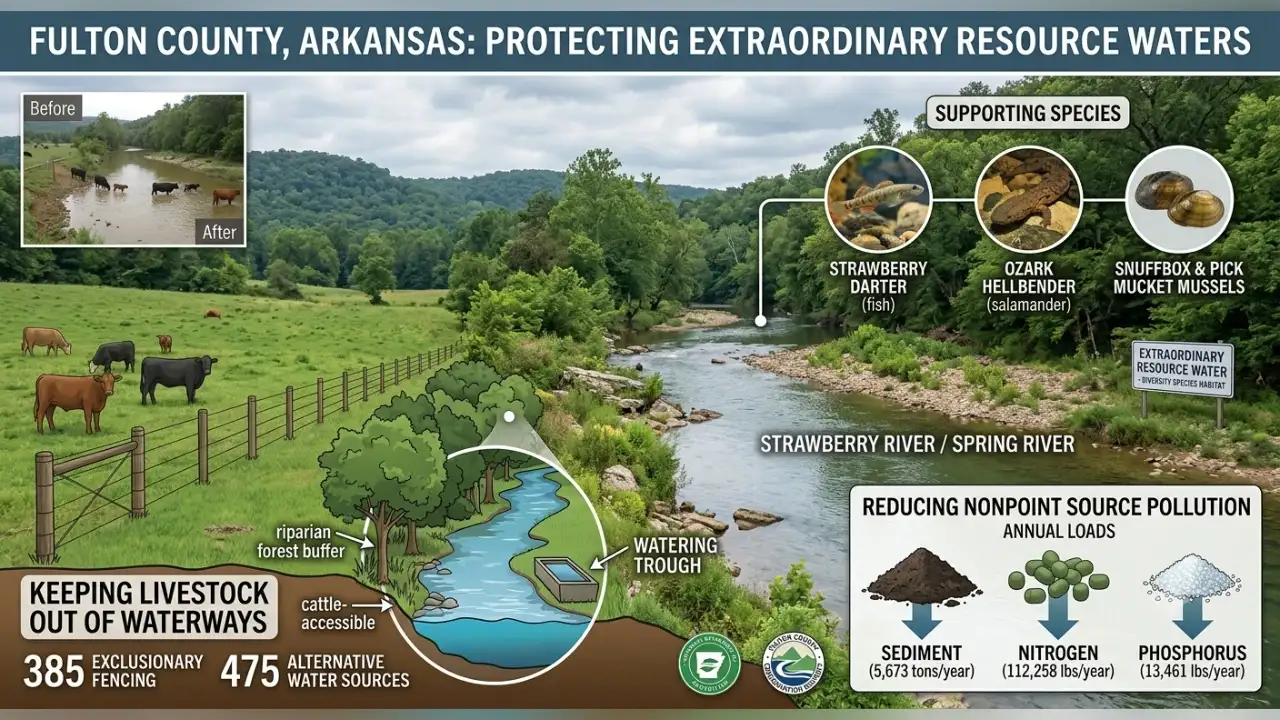
Two watersheds are also designated as Ecologically Sensitive Waterbodies. The Strawberry River supports the strawberry darter, while the Spring River supports the snuffbox and pick mucket mussels and the Ozark hellbender.

READ ALSO: In 2016, the Living Bog Project began restoring 750 hectares of Ireland’s raised bogs. 10 years later, over 6,300 peat dams have helped bring pioneer bog vegetation back

Keeping livestock out of waterways

The Fulton County Conservation District prioritised protecting water quality through the protection of riparian corridors and perennial streams.

Before cost-share programs were implemented in the area, a study examined whether cattle exclusion could reduce nutrient and sediment runoff in a stream beside a large cattle farm.

Water quality was tested upstream and downstream of the cattle operation before and after exclusionary fencing was installed. After the fencing was put in place, the downstream site showed similar conditions to the upstream testing site.

In 2001, cost-share programs began in Fulton County. The Fulton County Conservation District has provided 10 cost-share projects in its subwatersheds, with one ongoing in the Myatt Creek subwatershed of the Spring River.

Landowners gradually embraced the practices

Livestock exclusion from waterways was initially a major concern among landowners participating in nonpoint source pollution and water quality management cost-share programs.

The Fulton County Conservation District used education, demonstrations and outreach to show how these practices could benefit landowners, livestock and watershed health.

Over time, reluctance gave way to excitement, with full participation from landowners associated with the projects.

The district has also placed greater emphasis on landowners who directly affect creeks and rivers in funded watersheds, particularly those located within one-quarter mile of tributaries.

READ ALSO: In 2006, Arkansas DEQ listed Clear Creek for E. coli. 12 years later, the creek attained the recreation standard in 2018, restoring contact recreation after BMP projects

Conservation practices helped reduce pollution

The combined efforts of the Fulton County Conservation District, landowners, the Arkansas Department of Agriculture's Natural Resources Division and the Environmental Protection Agency resulted in 3.49 miles of exclusionary cattle fencing along the Southfork Spring River and a total of 385 miles throughout the district.

The projects also provided 475 alternative watering sources for cattle.

Other best management practices included pasture and hayland planting, riparian forest buffers, prescribed grazing, nutrient management, pipelines and stream channel restoration.

The conservation efforts were estimated to reduce annual loads of nitrogen by 112,258 pounds, phosphorus by 13,461 pounds and sediment by 5,673 tons.

Sign up to read this article
Read news from 100's of titles, curated specifically for you.
Already a member? Sign in here
Related Stories
Top stories on inkl right now
One subscription that gives you access to news from hundreds of sites
Already a member? Sign in here
Our Picks
Fourteen days free
Download the app
One app. One membership.
100+ trusted global sources.