
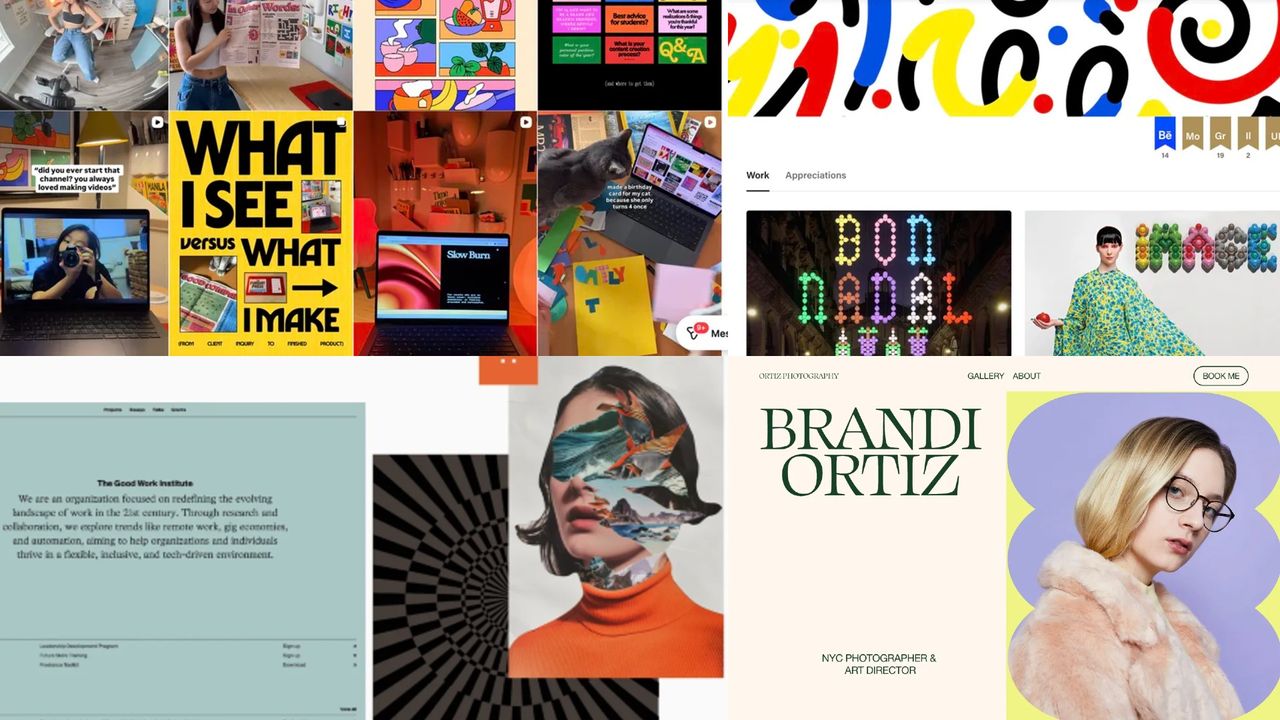
It's a question more and more of us are asking ourselves. At a time when the best social platforms offer instant reach, built-in audiences and zero set-up costs, what's the point of having a 'proper' portfolio website?
The more you look into it, though, the more complicated the answer gets. Social media does offer things a website can't, but it also comes with serious drawbacks that many designers underestimate. Throw in, you know, the most competitive job market in recent memory and the picture starts to get even more confusing.

For this article, I chatted to some industry experts to weigh up both sides of the argument, explains why making the right choice is so important, and give some practical advice on making both your socials and your website work for you.
What social platforms can offer
Let's be fair to the social platforms first. In 2026, Instagram, Behance, Dribbble and LinkedIn are powerful tools for a working designer. They offer discoverability, momentum and community in ways that a standalone website simply can't match.
A post that goes viral can reach thousands of potential clients overnight. A well-maintained Behance profile might surface in recruiters' searches for years to come. And none of this will cost you a penny.
As Robert Froedge, executive creative director at Lewis Communications, puts it: "In 2026, designers have more ways than ever to share their work, and all of them play a valuable role. They're great for visibility, discovery and momentum."
When you're at the start of your career, social platforms make it easy to get your work online without the hassle of building a website. They're also where industry conversation happens, where trends pop up and where collaborators find each other. So there's a lot of potential there to help your career.
For most recruiters, though, the problem isn't with using social platforms; it's with relying on them exclusively. And the disadvantages of that stack up quickly.
Why not having a website can cost you
The most fundamental issue is that fact that you don't own any of the content you post: the platforms do. Every follower, every post, every scrap of reach you've built on a social platform belongs, ultimately, to a billion dollar corporation. And that's not just a theoretical problem.
In practice, countless creatives who've put time and energy into building a following have seen algorithms shift, formats change and their accounts restricted or suspended without warning. "Social platforms are rented space," says Robert. "Your website is owned space. For me, the difference is control: control of narrative, of presentation, of how and when the work is experienced."
Here's another thing. Compared to having your own website, you have much less control over how you tell your story on social media. A social grid compresses your work into a format designed for scrolling, not exploration.
Elliott Scott, creative director at Applied Design, puts it bluntly: "I think of social media as casual and temporary, sort of a 'Hey, check this out' versus 'This is my body of work'." A website, by contrast, lets you set the pace, lead with your thinking and show the depth behind your work.
And then there's the all-important question of trust. As Simon Manchipp, founding partner at SomeOne, says: "High-ticket clients view a custom domain as a trust mark; it proves you own your space and aren't subject to the whims of an algorithm." His warning is worth taking seriously: "You might not win work by having a website, but you can lose it by not having one."
Why this matters more than ever
All of this would have been worth weighing up at any time in the last couple of decades. But right now, the balance is tipping sharply towards having a website, because the design job market is under such intense pressure.
Tom Alexander, digital design director at Conran Design Group, highlights it from a hiring manager's perspective. "The job market right now is so competitive," he says. "In a world where recruiters are receiving hundreds of applications for a single role, sometimes upwards of 400, not having a website might be enough to have your application dismissed before they've even read your cover letter."
An oversupply of designers, driven partly by the growth of design education and partly by economic uncertainty pushing more freelancers into the market, means that the threshold for being taken seriously has risen. Elliott is candid about his own views. "A portfolio website is where I put the projects I'm most proud of: the career highlights," he explains. "It’s the same ritual as your parents putting your best work up on the fridge. During the interviewing and screening process, if someone only sends me a social media link, I will judge them. What, you don’t think your work is fridge-worthy?"
In a crowded field, a website isn't just a nice-to-have; it's a signal of professional seriousness. Clients and hiring managers use it to filter, quickly and often ruthlessly. In that light, can you afford not to have one?
How to make your website count
Accepting that you need a website is the easy part. Making it effective is what really counts. The good news is that the bar isn't as high as you might think.
Simon is reassuring on this point. "A website in 2026 doesn't need to be a complex technical marvel," he says. "A clean, single-page site with fast load times and high-quality imagery is often more effective than a bloated, over-engineered portfolio. It just needs to be a stable, professional home for your best work." Speed and clarity matter more than visual spectacle.
What you put on the site matters just as much as how it looks. Jessica Walsh, founder of &Walsh and Type of Feeling, makes it clear that the best portfolio websites require editorial discipline.
"Show your strongest pieces, show any personal projects or experiments, not everything you've ever made," she urges. "Quality over quantity." A website that demonstrate you've made those decisions is, in itself, a demonstration of your design judgment. As Jessica puts it: "A well-built portfolio forces you to make editorial decisions about your work that social media doesn't."
She adds that a portfolio website should do more than display finished work. "When someone's serious about hiring you, they want to understand how you think," she stresses. That might mean, for example, case studies with context, process shots where they add value, and writing that explains the brief, the problem and the solution.
The bottom line
So what's my conclusion? I reckons it's something like this. Think of social media as the window display and your website as the studio inside. One draws people in; the other is where the real conversation happens.
Use the social platforms, build your following and stay visible. But give people somewhere to land when they're serious, somewhere you own, somewhere that shows not just what you make but how you think.
In 2026's hiring market, that distinction could make all the difference.







