In the 1980s, a University of Aberdeen clean-out led to an unthinkable disposal. Rare seashells collected during Captain James Cook's Pacific voyages were tossed straight into a campus dumpster. A student named Keith Burnley noticed the discarded treasures and rescued them. He recognized their historical weight and kept them safe for decades.
Now, forty years later, those forgotten specimens have finally returned to England. They arrived at the Whitby Museum in North Yorkshire where historical maritime archives thrive. Experts confirmed the shells are authentic relics from Cook's eighteenth-century expeditions. The collection bridges a painful gap in maritime history and national heritage. Burnley's quick thinking saved irreplaceable scientific artifacts from permanent destruction. Today, visitors can view these historic shells where they truly belong.

Captain Cook’s Lost Shells Were Nearly Thrown Away in the 1980s—40 Years Later, the Forgotten Collection Has Returned to England’s Heritage Archives
Captain James Cook had already become one of Britain’s best-known explorers by the time he set out on his third major voyage in 1776. His earlier expeditions had taken him to places including New Zealand and the Antarctic region, while also producing extensive records of unfamiliar landscapes, peoples, plants and animals.
The third voyage had a different objective. Cook was searching for the Northwest Passage, the long-sought sea route believed to connect the Pacific and Atlantic oceans through the Arctic. The expedition reached the Pacific and included visits to the Hawaiian Islands, but the journey ended tragically in 1779 when Cook was killed in Hawaii after tensions between his crew and local Hawaiians escalated.
One member of that expedition was George Dixon, who served as Cook’s armorer. Dixon had another interest while travelling with the expedition: collecting natural specimens for Bridget Atkinson, a collector in England. Among the objects he sent home were seashells gathered during the voyage.
Those shells were part of a wider culture of collecting that had become increasingly important in 18th-century Britain. Natural specimens arriving from distant parts of the world allowed collectors to study species they could never have encountered at home. They also became physical evidence of expanding European exploration, trade networks and imperial connections.
The shells nearly disappeared in a university dumpster
At some point after entering Britain, the collection became associated with Newcastle University. By the 1980s, its historical importance was apparently no longer obvious to those clearing an office, and the shells were placed in a dumpster during the cleanout.
That could have ended their story. Instead, a lecturer at the university rescued the collection before it was taken away for disposal. The decision was seemingly simple at the time, but it meant that specimens connected to an 18th-century expedition survived long enough to be properly identified and preserved.
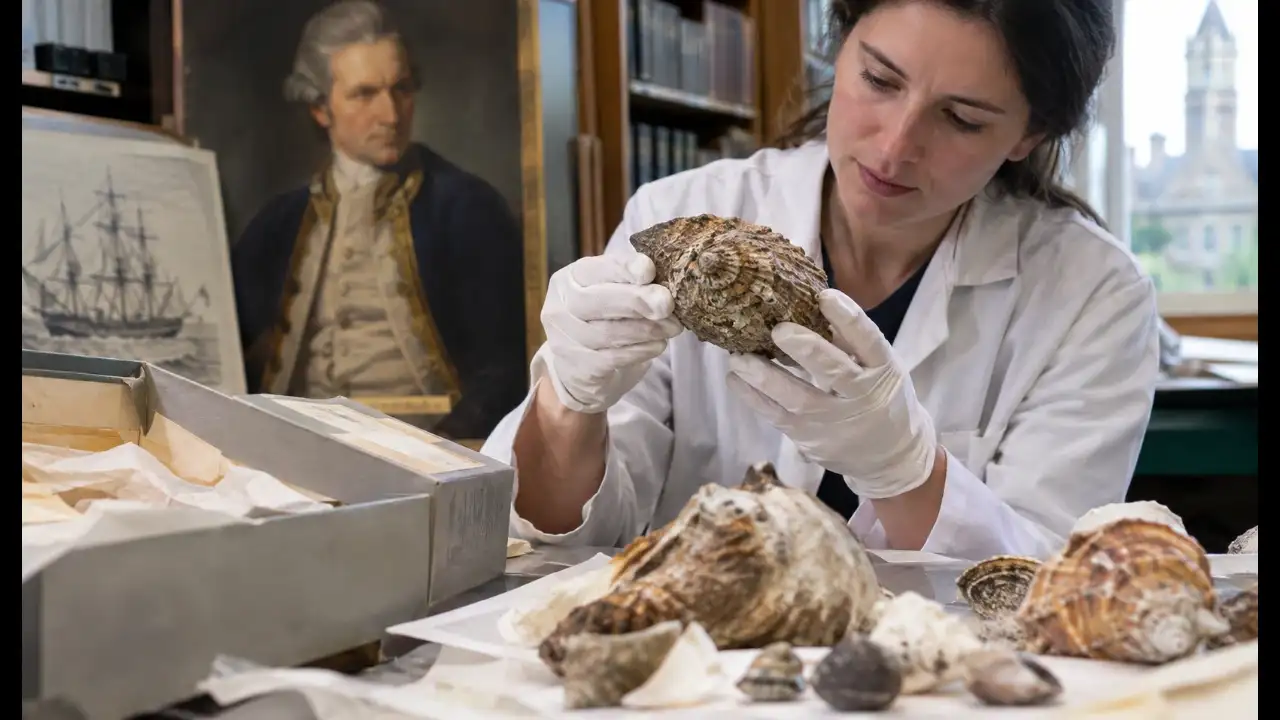
The lecturer kept the shells for decades. After his death, his descendants ultimately decided to donate them to English Heritage, allowing specialists and the public to gain access to a collection that had spent years largely outside the spotlight.
The group contains more than 200 specimens. English Heritage says it includes an extinct species, while several specimens are believed to have been sent back from Cook’s third voyage. The wording matters because not every shell can necessarily be traced with complete certainty to that expedition.
Why the collection matters beyond the shells
The importance of the collection lies partly in what the specimens reveal about how natural history, exploration and empire were connected. Shells were not simply souvenirs for collectors. They were objects through which people in Britain could study distant ecosystems and expand their knowledge of the natural world.
English Heritage describes the collection as a record of Britain’s role in global trade and its colonial reach during the late 18th century. That broader context is essential because Cook’s voyages were scientific and exploratory enterprises, but they also took place during a period of expanding European imperial influence.
Bridget Atkinson herself is an important part of that story. She was a collector who helped preserve natural specimens arriving from overseas, creating links between people travelling across the world and those studying natural history in Britain. Dixon’s decision to collect and send shells home shows how exploration could extend far beyond maps and navigation.
The collection also demonstrates how easily historical objects can disappear when their significance is forgotten. A specimen that looks ordinary to an untrained eye may carry information about a particular voyage, species or period of history. In this case, a routine office clearance nearly erased that evidence altogether.
From forgotten specimens to preserved history
The shells' survival depended on an unlikely chain of events. They first had to make their way from an 18th-century expedition to Britain, remain together through changing collections and institutions, survive a university office cleanout, and then be recognized as worth saving from a dumpster.
Now, their destination is very different. English Heritage can preserve, study and interpret the collection as part of a wider historical record. The shells offer researchers an opportunity to examine specimens linked to an important period in natural history while also considering the people, journeys and colonial networks that brought them to Britain.
Their journey is striking precisely because the objects themselves are so modest. They are small natural specimens, but their history connects an 18th-century voyage, a collector in England, a university lecturer in the 20th century and a modern heritage organization.
For Cook, the third voyage became his final expedition. For the shells collected along the way, the voyage continued in a far less predictable form. Nearly two centuries after Cook's death, they were close to being discarded before one person's decision to look twice gave them another chance to be remembered.