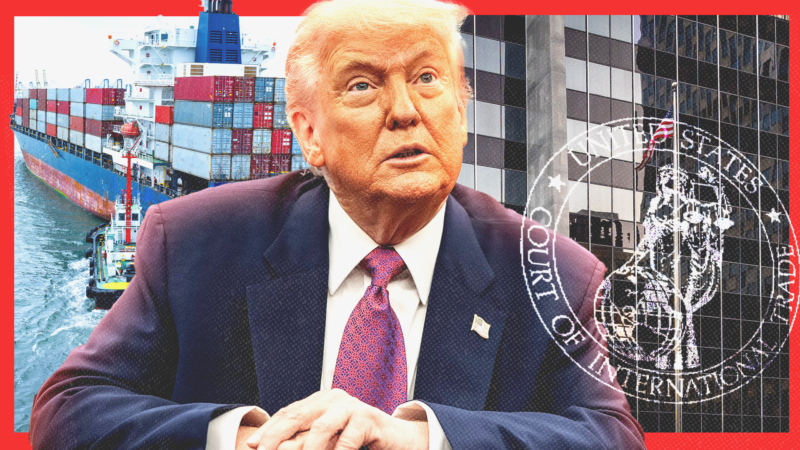
Hours after the Supreme Court rejected President Donald Trump's "emergency" tariffs on February 20, he revealed a backup plan. Instead of relying on the International Emergency Economic Powers Act (IEEPA), which the justices held does not authorize import taxes at all, Trump invoked Section 122 of the Trade Act of 1974, which allows tariffs in response to "fundamental international payments problems" caused by "serious United States balance-of-payments deficits." The main issue raised by that new legal rationale is whether Trump is right in asserting that the United States faces such a situation.
On Friday, the U.S. Court of International Trade (CIT) considered that question during oral argument in two cases challenging Trump's Section 122 tariffs, which he initially set at 10 percent before saying they would be raised to 15 percent—the maximum rate allowed by the statute. One lawsuit was filed on March 5 by the governors and attorneys general of 24 states, while the other was filed on March 9 by the Liberty Justice Center (LJC) on behalf of two small U.S. businesses. Both sets of plaintiffs argue that the circumstances described by Section 122 not only do not exist but cannot exist under the current monetary system.