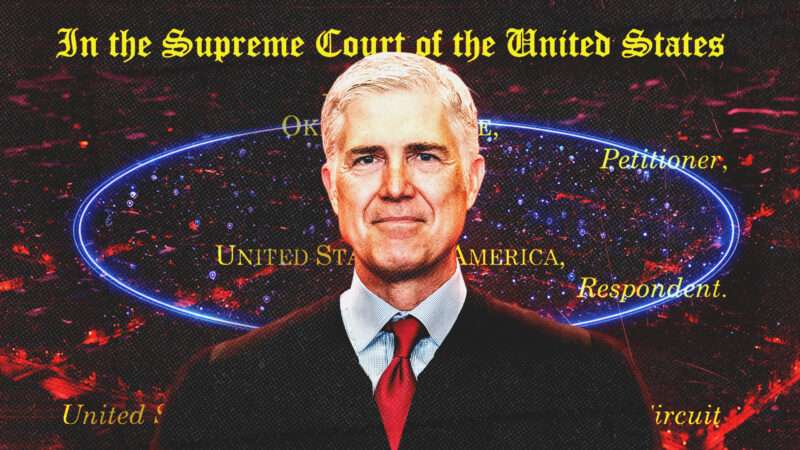
On Monday in Chatrie v. United States, the Supreme Court held that government-ordered analysis of data collected via Google's Location History feature, which tracks the whereabouts of cellphone users, qualifies as a "search" within the meaning of the Fourth Amendment. Justice Neil Gorsuch concurred in that judgment, but he wrote separately to reiterate his longstanding critique of two dubious concepts that have figured prominently in the Court's Fourth Amendment reasoning for half a century: the "reasonable expectation of privacy" test and the third-party doctrine.
In the 1967 case Katz v. United States, the Supreme Court held that electronic surveillance of telephone conversations requires a search warrant. By attaching a monitoring device to a telephone booth used by a suspected bookie, the majority said, the FBI had "violated the privacy upon which [the target] justifiably relied while using the telephone booth." The surveillance "thus constituted a 'search and seizure' within the meaning of the Fourth Amendment." In other words, Justice John Marshall Harlan II said in a concurring opinion, the Fourth Amendment applies when someone has an "expectation of privacy" that "society is prepared to recognize as 'reasonable.'"