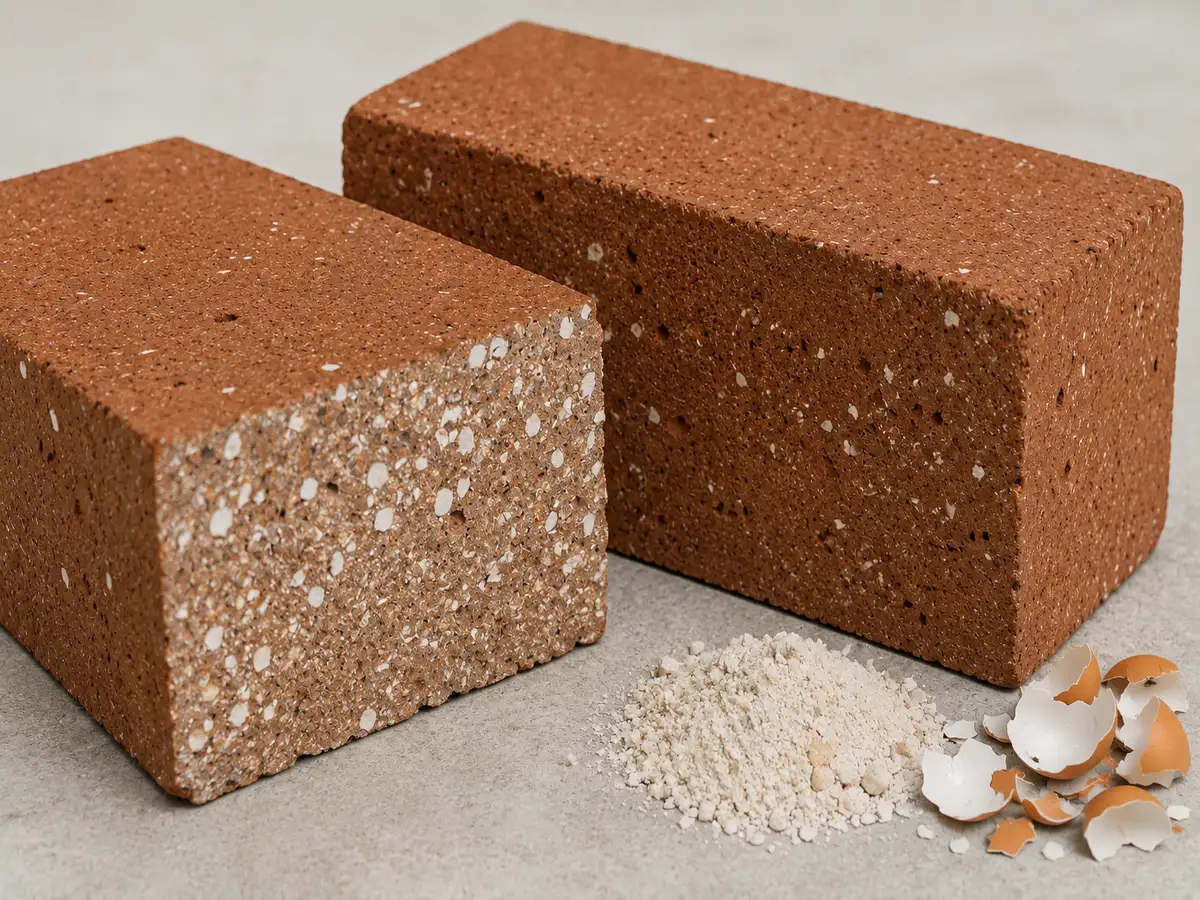
Fired clay bricks have changed little over the centuries, but researchers are finding new ways to improve the clay mix. Researchers experimenting with kitchen and poultry waste have found that a small dose of crushed eggshell, dropped directly into the clay before firing, can cut how much heat a brick lets through by half. The finding turns a food byproduct that usually ends up in landfill into a useful insulating additive.
A 10% eggshell mix cut heat conductivity by half
Fired clay brick development with eggshell waste incorporation , reported in Scientific Reports (vol. 15, article 3367, published 27 January 2025), has involved a systematic study of fired clay bricks incorporated with 1-10 wt% of eggshell powder, with a firing temperature of 1,100°C for 4 h. The most notable improvements in insulation properties were observed for the 10 wt% eggshell brick, where thermal conductivity decreased by 50%, while thermal diffusivity and effusivity decreased by 30% in comparison to the reference sample without any doping. The 7% eggshell formulation (CEs7%) showed, compared with the reference brick: a 38.7% decrease in dry shrinkage, a 78.8% increasein average pore size, an apparent porosity of 52.7% (up from the reference sample), an 8.3% decrease in bulk density (to 1.66 g/cm³), and a 57.5% decrease in compressive strength (to 0.5 MPa).
Conducted by an Egyptian research team, the study highlights a common problem in hot climates: poorly insulated walls let houses absorb excess heat, forcing occupants to rely on air conditioners. Bricks that inhibit heat transfer could help reduce this burden.
Porosity and strength shifted alongside the insulation gains
The same research evaluated the brick's physical properties at different eggshell contents. It compared the brick with 10% eggshell content and another sample containing 7% eggshell (labeled as CEs7% in the study). In comparison with the control brick, dry shrinkage decreased by 38.7%, average pore diameter increased by 78.8%, and apparent porosity reached 52.7%. The bulk density was equal to 1.66 g/cm³ and compressive strength was 0.5 MPa for this composition. The XRD analysis in the study suggested that higher sintering temperatures produce a siliceous melt in the brick, increasing pore formation and improving insulation. Larger pores capture more air and air is an inefficient heat conductor, thus improving the insulating qualities of the brick.
Earlier work had already flagged eggshell's potential
The 2025 experiment is informed by findings from research conducted years back. A 2019 study, Enhancing physical-thermal-mechanical properties of fired clay bricks by eggshell as a bio‑filler and flux , published in Science of Sintering, prepared fired clay bio‑bricks by incorporating eggshell powder into earthenware clay via an extrusion process rather than conventional molding. It reported that eggshell powder, which is predominantly calcium carbonate, reacts with the silica and alumina in earthenware clay during firing to form calcium aluminosilicate phases that modify the bricks' physical, thermal, and mechanical properties.