Get all your news in one place.
100's of premium titles.
One app.
Start reading
The Economic Times
The Economic Times
Shreya Biswas

In 2025, scientists recorded a giant iceberg threatening an Antarctic penguin colony. Later it produced a heartbreaking environmental outcome

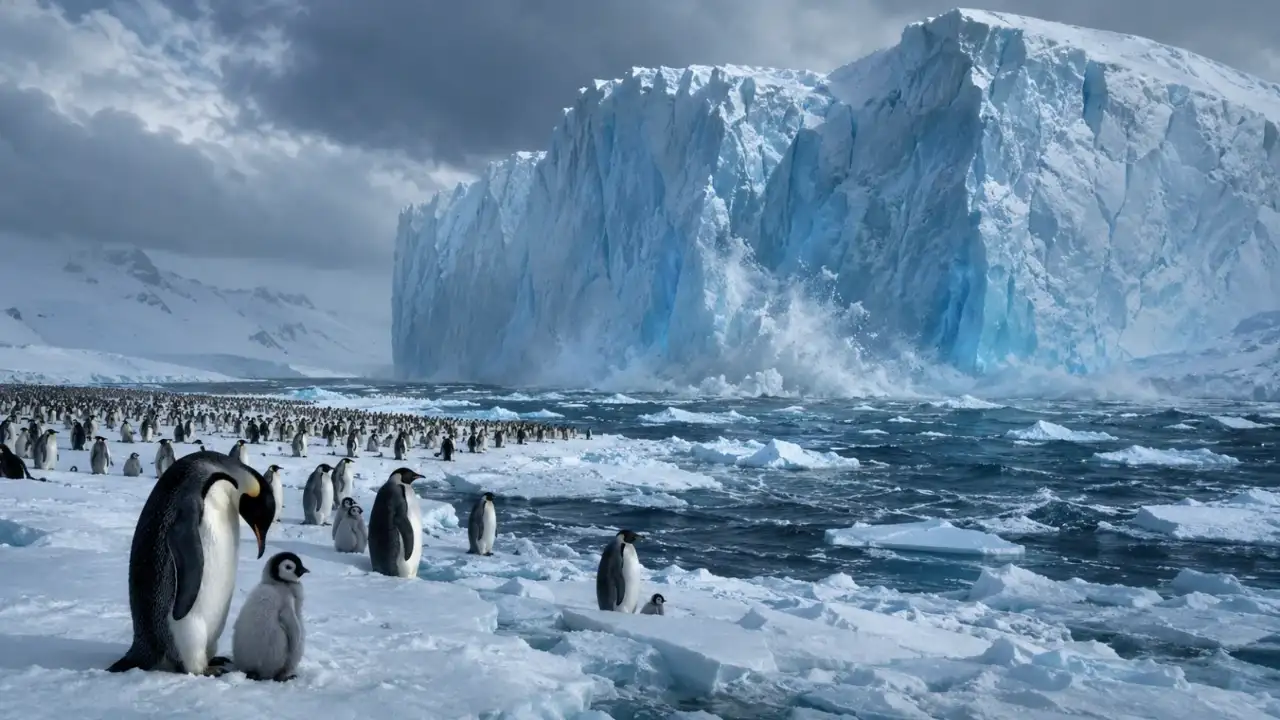
Giant iceberg threatens penguins : A grounded iceberg near one of Antarctica's largest emperor penguin colonies was later linked to a devastating breeding season for the birds.

Researchers found that the number of surviving emperor penguin chicks on Coulman Island dropped by 69% in 2025 compared with the previous year. Their study, published in 'Communications Earth & Environment', suggests the grounded iceberg disrupted the adults' journey back from the sea, delaying food deliveries to their chicks.

A grounded iceberg changed the penguins' route

Coulman Island is home to one of the world's largest emperor penguin colonies. During the breeding season, emperor penguin parents take turns crossing sea ice to reach the ocean, where they forage before returning to feed their chicks.

According to the researchers, the iceberg became grounded just north of Coulman Island in July 2025 after breaking away from a larger ice shelf farther south. It remained there until early January 2026, blocking the penguins' usual route for much of the breeding season.

The shortest distance between the colony and open water increased from about 9.3 kilometers in 2024 to 14.9 kilometers in 2025, according to lead researcher Jeong-Hoon Kim of the Korea Polar Research Institute, as reported by Science News.

READ ALSO: Psychology researchers reveal how gaslighting rewires a person's sense of reality over time

The iceberg became an unexpected obstacle

Aerial photographs taken in 2025 counted 6,658 surviving chicks, compared with 21,242 in 2024.

The same images also showed large numbers of adult penguins gathered on and along the grounded iceberg.

Researchers found that the iceberg's gentle slope may have encouraged penguins to climb onto it after returning from the sea. They then reached a steep, roughly 20-meter cliff that they could not pass, forcing them to turn back and walk around the iceberg before continuing to the colony, as per the report.

Marine biologist Michael Polito of the University of California, Santa Cruz, who was not involved in the study, said, “The shape of the iceberg itself trapped adult penguins as they were returning to the colony from the sea,” as quoted by Science News. By the time they made the longer journey back, many chicks may have starved.

READ ALSO: Quote of the day by Franz Kafka: 'Anyone who keeps the ability to see beauty never...' - motivational quote by Metamorphosis and Trial author teaches life lessons on aging, growing old, living a meaningful life and why finding joy at every age keeps you young at heart

Researchers warn similar events could become more common

Using aerial photographs and satellite imagery, the research team reconstructed the iceberg's movement and three-dimensional shape to understand how it affected the colony.

Both Kim and Polito noted that the iceberg has now passed by, meaning future breeding seasons could return to normal.

However, they said climate change could weaken Antarctic ice shelves, increasing the likelihood that large icebergs break away, drift away and affect emperor penguin colonies.

Kim said, “It was certainly a sobering experience,” adding, “I had always hoped we would never see something like this at one of the colonies we monitor. It is something I will not easily forget,” as quoted by Science News.

READ ALSO: Researchers develop chewing gum that targets HPV and microbes linked to head and neck cancer

Sign up to read this article
Read news from 100's of titles, curated specifically for you.
Already a member? Sign in here
Related Stories
Top stories on inkl right now
One subscription that gives you access to news from hundreds of sites
Already a member? Sign in here
Our Picks
Fourteen days free
Download the app
One app. One membership.
100+ trusted global sources.