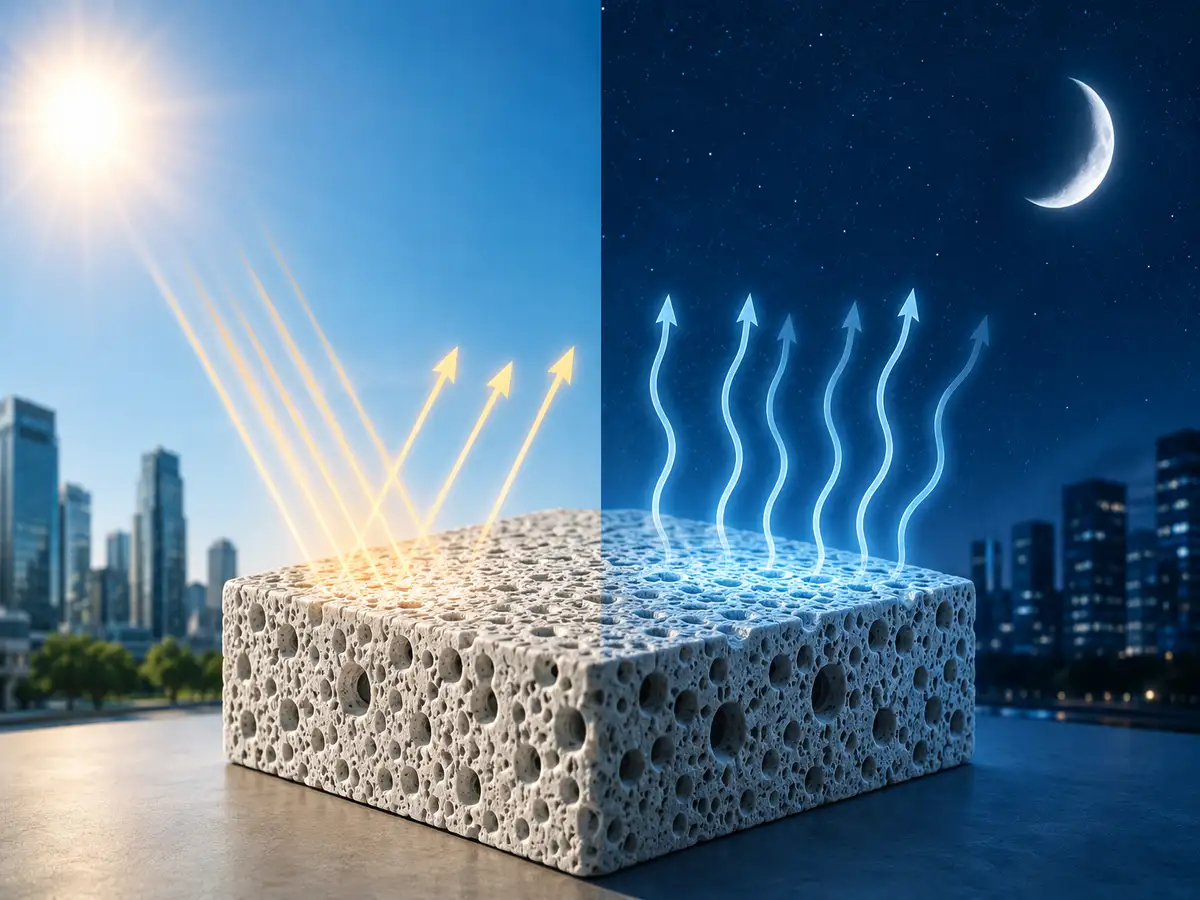
For the past decade, passive daytime radiative cooling research has focused on how much a surface temperature can be lowered below ambient air through sunlight reflection and heat radiation into space. This unrelenting obsession has yielded not only impressive advances but also an unintended side effect: coatings designed to radiate as much heat as possible during the day keep doing so at night, causing buildings covered with these materials to become cooler than necessary and sometimes requiring additional heating to compensate.
In 2025, researchers at Monash University’s Department of Civil Engineering developed a ceramic that addresses both daytime cooling and nighttime overcooling. The material reduces surface temperatures by approximately 19.5 °C during the day while limiting nighttime overcooling to about 3.3 °C, performance the authors describe as ‘self‑adaptive’ rather than merely high‑performing.

Why radiative cooling materials can overcool at night
The principle behind passive cooling is quite simple. High solar reflectivity prevents the absorption of sunlight, while high emissivity in the mid-infrared range lets a material emit its own heat directly through the atmosphere into outer space. When we try to maximize those two properties, we can obtain an amazing cooling surface for daytime conditions. But the problem here is that the property of mid-infrared radiation does not turn off at nighttime.
The ceramic Monash engineered to solve both problems
The study, 'Self-adaptive broadband microporous ceramic for passive radiative cooling in buildings' in Chemical Engineering Journal, 2025, took an alternative route from other spectrally selective cooling technologies. Instead of designing the ceramic as a selective emitter, the Monash team built a broadband-emitting ceramic with high solar reflectivity (0.98) and wide-ranging mid-infrared emissivity (0.94).
The ceramic is made of SiO₂ hollow spheres and Al₂O₃ nanoparticles: the hollow spheres create the regular micropore network and solid-state diffusion between the two materials during sintering locks the structure in place. This microporous structure gives the ceramic its high solar reflectivity (0.98) and broadband mid-infrared emissivity (0.94). Rather than radiating heat to the sky alone, the broadband design also exchanges heat with the surrounding air and building surfaces; this added non-radiative heat exchange offsets some of the continuous radiative loss at night, which is what limits nighttime overcooling instead of the ceramic somehow "switching off" its emission.
What the numbers actually showed
In field conditions under intense midday sunlight, the ceramic had its maximal daytime temperature decrease to 19.5 degrees Celsius below the ambient air temperature. At night, when most radiative coolers continue radiating and therefore have their temperature well below the ambient temperature, the ceramic has its temperature decrease limited to only 3.3 degrees Celsius. This difference between these two values is the whole point: the smaller the temperature difference between the daytime and nighttime cooling, the lower the chances for the structure to require supplementary heating due to an excessively cooled surface.
The ceramic also demonstrated its self-adaptive nature under cloudy and smoggy weather, when the performance of radiative coolers is generally impaired due to closure of the atmospheric window. In addition, the ceramic is said to be light, waterproof, mechanically strong and colored; all these qualities are intended to make it suitable for use as a construction material.
How this fits alongside Monash's cement-based cooling work
This is just one of the many discoveries that this group has made. Researchers from Monash University, working alongside other researchers including Wenhui Duan and Kwesi Sagoe-Crentsil, came up with the idea of creating a radiative cooling cement composite known as 'Multiscale architecturing of high-performance passive daytime radiative cooling cementitious composite,' as presented in Cement and Concrete Composites. According to Huang et al.’s 2026 study, 'Multiscale Architecturing of High-Performance Passive Daytime Radiative Cooling Cementitious Composite,” published in Cement and Concrete Composites, the composite combines a honeycomb cement structure with a nano-engineered porous polymer, achieving a solar reflectance of 94.9% and a longwave infrared emission of 97.0%.