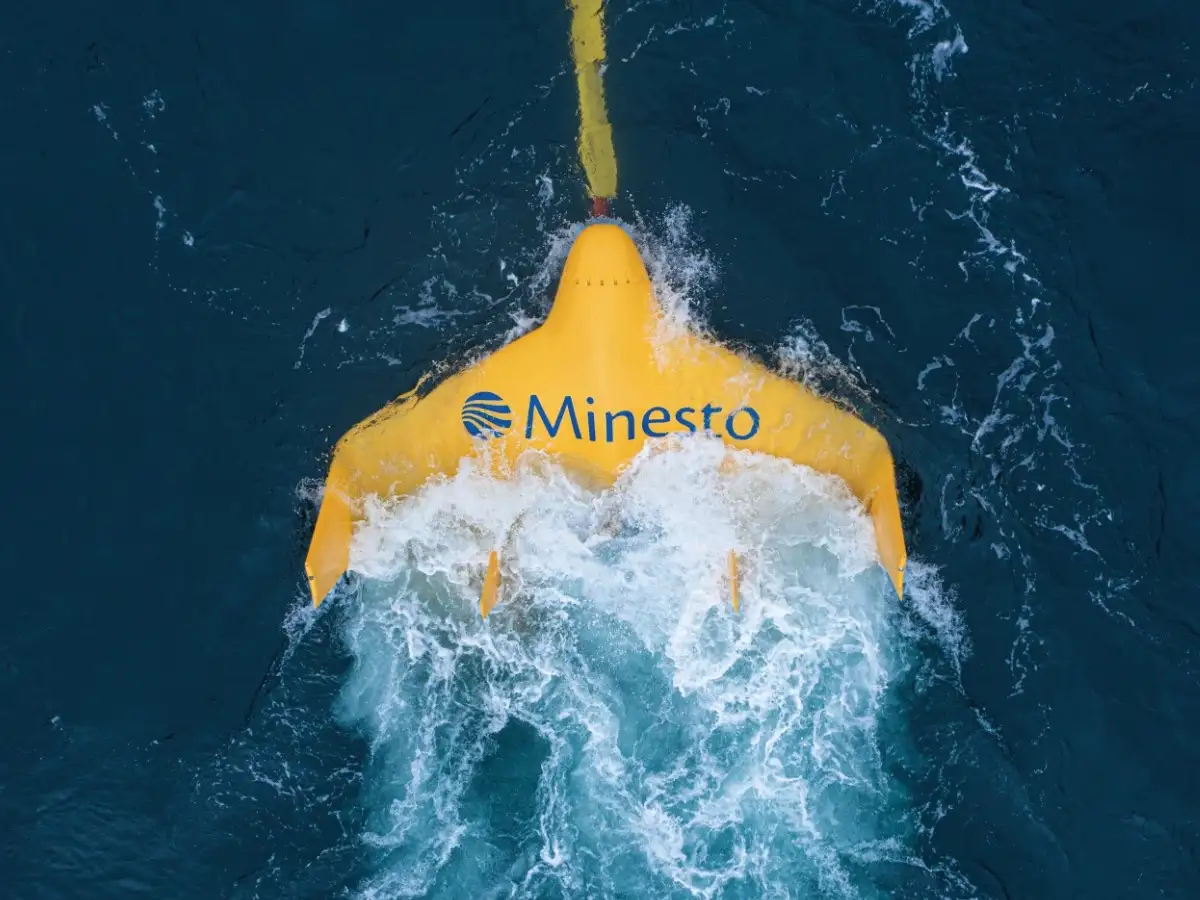
In 2024, engineers lowered a 28-ton underwater kite off the Faroe Islands, and it began generating up to 1.2 megawatts of electricity by flying figure-eight loops through the tide at speeds faster than the tide itself. The machine is named Dragon 12 and made by the Swedish company Minesto. On February 9, 2024, it generated its first electricity for the Faroese national grid. According to Minesto, the kite is 12 meters wide, weighs 28 tons, and flies a figure-eight path while tethered to the seabed and steered by the tidal current passing under it. It uses no fuel, and no fixed turbine on the seabed waits for the tide to pass to turn it. If thinking about tidal power usually means a big stationary turbine stuck on the seabed, this one doesn't work like that, and it's worth knowing why.
The trick that lets a machine outrun the water pushing it

The system works on a different principle than a conventional turbine. Dragon 12 does not wait in the tidal flow, letting the current twist it like a propeller. It flies across the flow in a repeating figure-eight, like a stunt kite in a steady wind. This sideways, looping motion allows the wing to slice through the water much faster than the current that drives it. Research funded by the Department of Energy and carried out with North Carolina State University explains the same process: flying across the flow, not directly into it, allows the kite to build speed that the current alone could not provide. The turbine's power output increases considerably because power rises dramatically with speed; even a small increase in relative speed creates a large increase in the electricity produced. This is the process that caused Dragon 12 to jump from Minesto's previous 100-kilowatt prototype to a full 1.2 megawatts, a twelvefold increase which it documented directly on its own site.