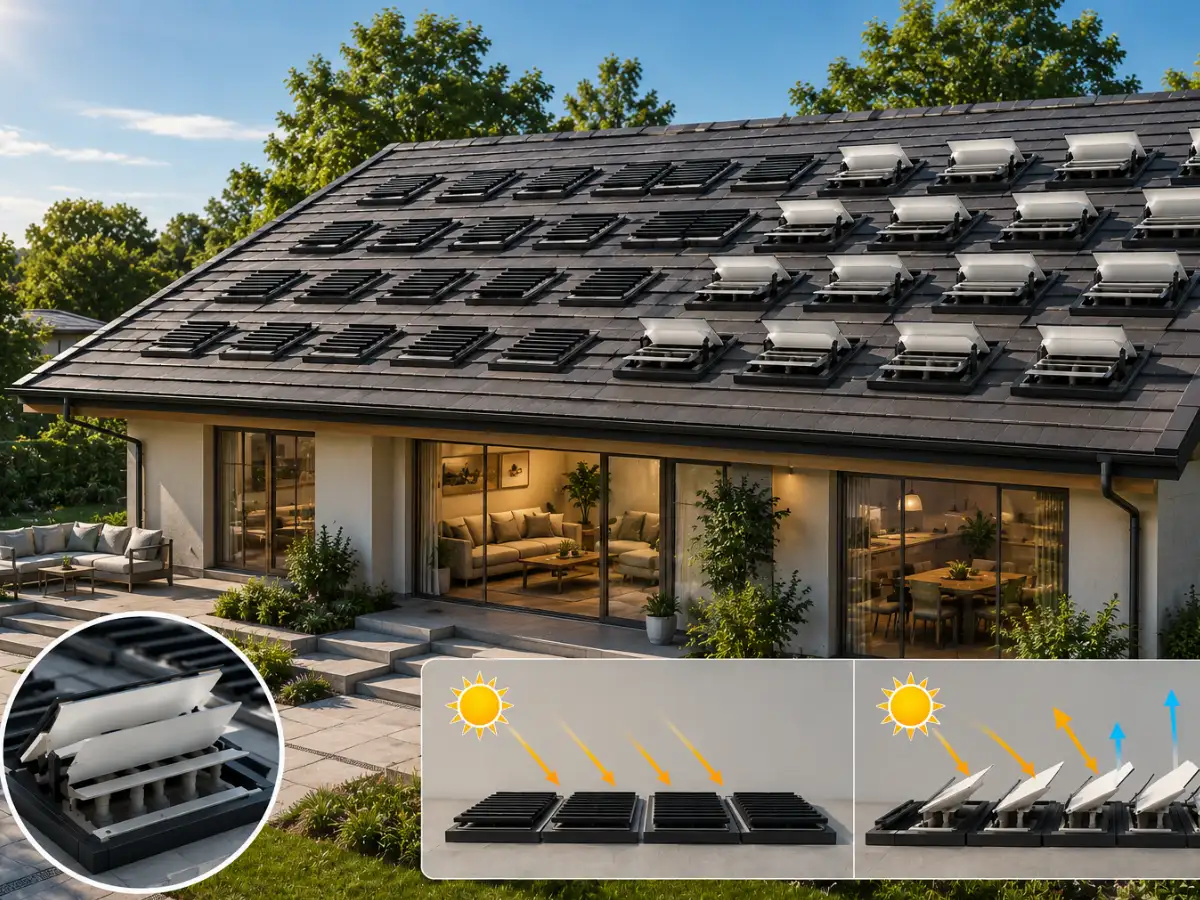
Air-conditioning bills often rise in summer. One reason is that buildings absorb heat during the day and then need energy to remove it. Buildings are not very good at regulating when to keep heat in and when to let it out. Roofs are exposed to sunlight throughout the day. They absorb this heat whether we want them to or not. Then the cooling system has to correct the problem after it happens. A team of engineers wanted to fix this problem at the beginning. They wanted to make the building’s surface responsive so it could switch on and off on its own. According to a study, "Passively adaptive radiative switch for thermoregulation in buildings" published in the Cell Press journal Device, engineers at the University of California, Santa Barbara built exactly that. They made a tile with tiny fin-like parts that open when the surface gets hot and close when it cools. The tile does not need any electronic sensors, batteries, or external wiring to work.
A tile is doing a thermostat's job without a single wire
The tiles are compact enough to arrange in rows across a rooftop. Each tile has a row of slats on top. The slats are black on the side that faces out and white on the underside. When the slats are closed, the black surface gets sunlight and heat. This is useful in the morning. The tiles warm up quickly when it's cold outside. When the slats open, they show the underside. This white surface reflects sunlight. It sends heat back out to the sky. This can help a building stay cooler on a hot afternoon.
Wax powers the switch, not wiring
The louvers move because of a wax-based actuator within each tile, a passive component sometimes called a wax motor, which runs without electricity or electronic controls. Wax is a phase-change material because it expands when it melts and shrinks when it solidifies. When the tile temperature rises to about 65°F, the wax melts, expands, and pushes a piston to open the louvers. When the temperature decreases, the wax shrinks, closing the louvers automatically without any external energy source. Because the switch responds to the tile's own surface temperature rather than the surrounding air, a sunny but cold morning could, in principle, still trigger the slats to open early. The researchers note this is one of the behaviors future testing will need to characterize across different climates and seasons.