Get all your news in one place.
100's of premium titles.
One app.
Start reading
The Economic Times
The Economic Times
Shreya Biswas and ET Science Desk

In 2023, researchers tested a Vancouver rain garden against a tire-derived toxin; it kept more than 90% from passing through into drainage

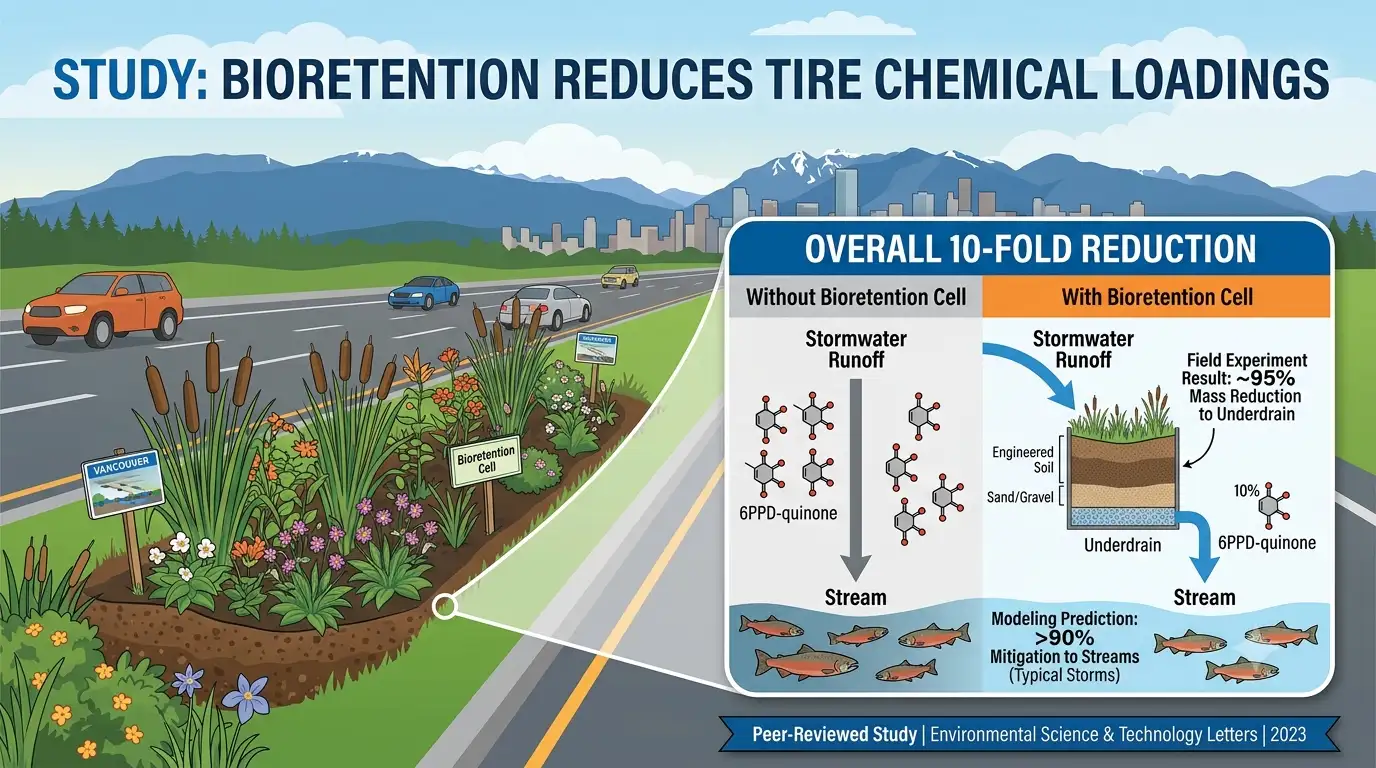
A full-scale bioretention cell in Vancouver reduced 6PPD-quinone mass loadings by about 10-fold, according to a peer-reviewed study published in 2023.

Researchers investigated whether bioretention could reduce 6PPD-quinone, a transformation product of 6PPD, an additive used in vehicle tires. The study combined a field experiment with modelling to examine how the stormwater system affected the chemical's movement through the system.

Vancouver Bioretention Cell Tested for Tire-Derived Chemical

The researchers studied a full-scale, mature bioretention cell in Vancouver.

Bioretention cells are stormwater-management systems designed to collect and treat runoff. The Vancouver system was tested to determine how effectively it could reduce 6PPD-quinone mass loadings.

The researchers conducted a field experiment in which they introduced 6PPD-quinone along with tracer compounds into the system and measured the resulting concentrations and mass reaching the underdrain.

The study was published in Environmental Science & Technology Letters in 2023.

READ ALSO: Meet Yan Hongsen, the 11-year-old Chinese boy who wrote 600 lines of code, built a rocket and became known as “Rocket Boy”

Field Experiment Showed About 95% Reduction to the Underdrain

The field experiment showed an approximately 95% reduction in 6PPD-quinone mass reaching the underdrain.

This figure applies specifically to the field experiment. It should not be interpreted as a universal claim that the bioretention cell removes 95% of the chemical from every storm or every type of stormwater system.

The researchers then used the field data to model how the bioretention system could perform under different storm conditions.

Study Reported an Approximately 10-Fold Reduction

The researchers reported an approximately 10-fold reduction in 6PPD-quinone mass loadings to receiving waters.

That finding is reflected in the title of the study: “Bioretention Cells Provide a 10-Fold Reduction in 6PPD-Quinone Mass Loadings to Receiving Waters: Evidence from a Field Experiment and Modeling.”

The 10-fold reduction is the study's central overall finding, based on evidence from the field experiment and modelling.

READ ALSO: In 2006, Nicole Kidman became a UN goodwill ambassador; she later donated $500,000 to efforts fighting violence against women

Modeling Predicted More Than 90% Reduction Under Typical Storm Conditions

The researchers also modelled the performance of the bioretention system under different storm events.

The modelling indicated that stormwater bioretention systems could mitigate more than approximately 90% of 6PPD-quinone loadings to streams under most typical storm conditions.

The paper describes these typical conditions in terms of storms with a return period of less than two years.

This modeled result is separate from the approximately 95% reduction observed in the field experiment. The 95% figure concerns mass reaching the tested system's underdrain, while the >90% figure describes modeled mitigation of loadings to streams under the specified storm conditions.

What Is 6PPD-Quinone

6PPD-quinone is a transformation product of 6PPD, an additive used in vehicle tires.

6PPD can react with ozone to form 6PPD-quinone. The compound can be transported in stormwater runoff and has been identified as highly toxic to some fish species.

READ ALSO: In 1982, Paul Newman started selling salad dressing; more than four decades later, the brand had given over $600 million of its profits to charity

Why the Vancouver Study Matters

The 2023 research provided field and modelling evidence that bioretention can substantially reduce 6PPD-quinone mass loadings associated with stormwater.

The field experiment found an approximately 95% reduction in the chemical's mass reaching the underdrain, while the study's modelling indicated that more than approximately 90% of 6PPD-quinone loadings to streams could be mitigated under most typical storm conditions.

The findings should not be treated as a universal removal rate for every rain garden, bioretention cell or rainfall event. They describe the results of the Vancouver field experiment and the conditions examined through the study's modelling.

Sign up to read this article
Read news from 100's of titles, curated specifically for you.
Already a member? Sign in here
Related Stories
Top stories on inkl right now
One subscription that gives you access to news from hundreds of sites
Already a member? Sign in here
Our Picks
Fourteen days free
Download the app
One app. One membership.
100+ trusted global sources.