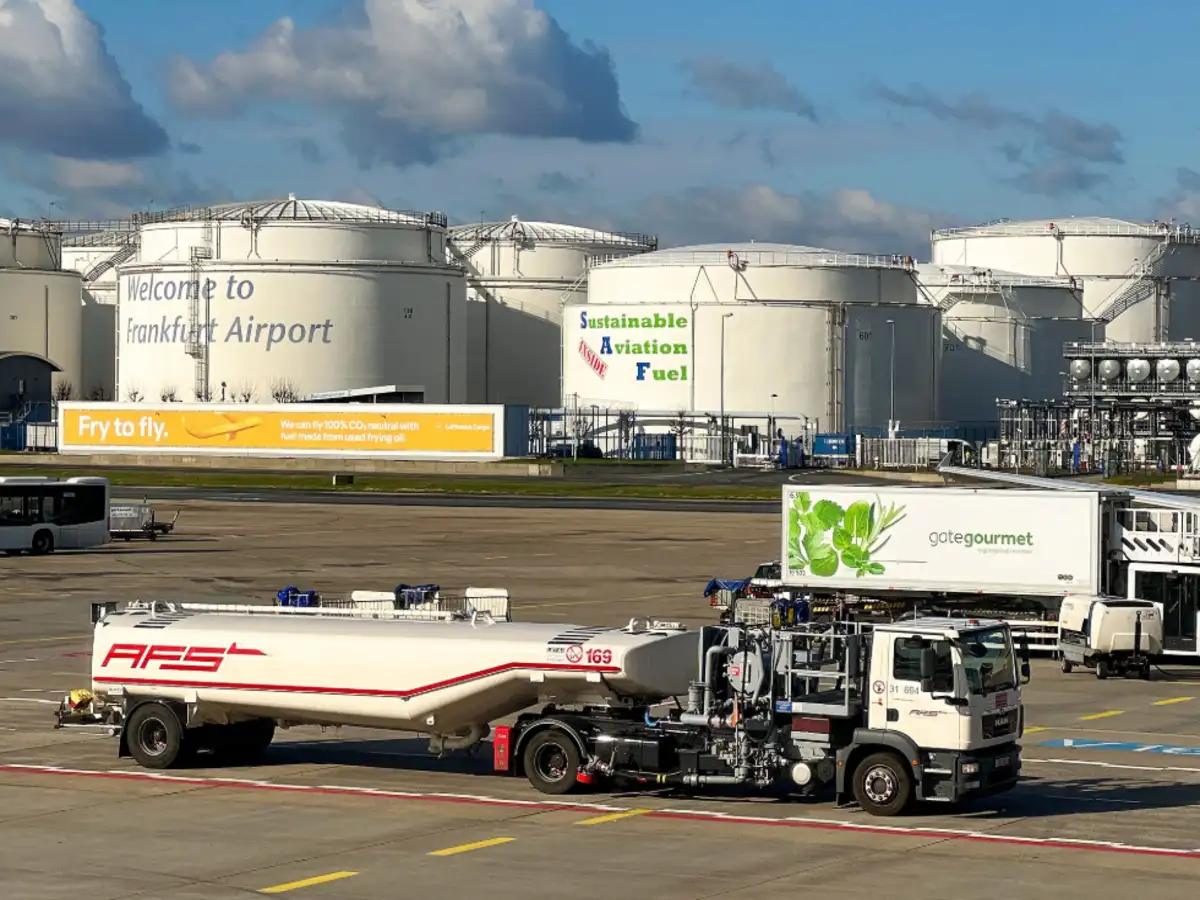
For years, airlines have been looking for an alternative fuel that could replace kerosene without requiring airports to overhaul their infrastructure. In a 2022 study titled 'Toward Net-Zero Sustainable Aviation Fuel with Wet Waste-Derived Volatile Fatty Acids,' published in the journal Proceedings of the National Academy of Sciences (PNAS), a group of scientists led by the National Renewable Energy Laboratory (NREL) gave an unexpected answer: garbage. By fermenting food waste and then converting the resulting molecules into jet fuel through catalysis, the researchers produced a fuel that, under certain assumptions, was estimated to cut life-cycle carbon emissions by as much as 165% compared with conventional jet fuel.
Why wet waste is hard to turn into fuel

Decarbonization is particularly difficult for aviation, as long-haul aircraft would require a high-energy-density fuel that is liquid in nature, making battery-powered propulsion impractical for the majority of the routes. In addition, the industry uses enormous volumes of fuel: U.S.- based airlines alone consumed about 18.3 billion gallons of jet fuel in 2019, according to Department of Energy analyses, and the U.S. Energy Information Administration projects that global commercial jet fuel demand will more than double by 2050 under baseline scenarios.
Food waste has long been an underused feedstock. It is inexpensive and ubiquitous, and even accounting only for its energy content, it could theoretically displace more than 20% of the jet fuel consumed by U.S. based airlines. The challenge is that wet, mixed organic waste is difficult to process efficiently; most of it is simply landfilled rather than converted into methane at all, let alone into fuel.
Interrupting fermentation before it reaches methane
The paper details how the fermentation step was deliberately halted partway through, arresting microbial methane formation before it could run to completion. Researchers managed to get the intermediate products in the form of volatile fatty acids (VFAs), which consisted of hydrocarbons with chain lengths of two to eight carbons.
Zirconia-based catalysts have demonstrated stable performance over about 100 hours in fuel-reforming tests, according to a 2023 study in ' Catalysts' on doped ceria–zirconia reforming catalysts. The reaction produced two types of products: straight-chain (normal) paraffins, which qualify under ASTM International's 'Fast Track' pathway for jet fuel blends of up to 10%, and branched isoparaffins, which could raise the renewable blend limit even further. Together, the two products help address blend-limiting properties such as flash point and viscosity; the normal paraffins support near-term certification at the 10% blend level, while the isoparaffins are aimed at eventually supporting a much higher blend limit, up to 70%, pending further certification. In one study, a 70% blend of wet waste-derived volatile fatty acid SAF showed 34% lower sooting than fossil jet fuel, as reported in a 2022 paper in Proceedings of the National Academy of Sciences (PNAS).
Why the 165% figure depends on where the waste would have gone
The number is not inherent to the chemical composition of the fuel itself. A peer‑reviewed life‑cycle assessment in 'Environmental Science & Technology' used a conventional jet fuel reference of 88.9 g CO₂‑eq/MJ and reported SAF pathways in the low‑double‑digit g CO₂‑eq/MJ range. It is the difference that leads to 165%, but this is true only if the food waste used for the fermentation would otherwise be disposed of by means of a landfill.