Get all your news in one place.
100's of premium titles.
One app.
Start reading
The Economic Times
The Economic Times

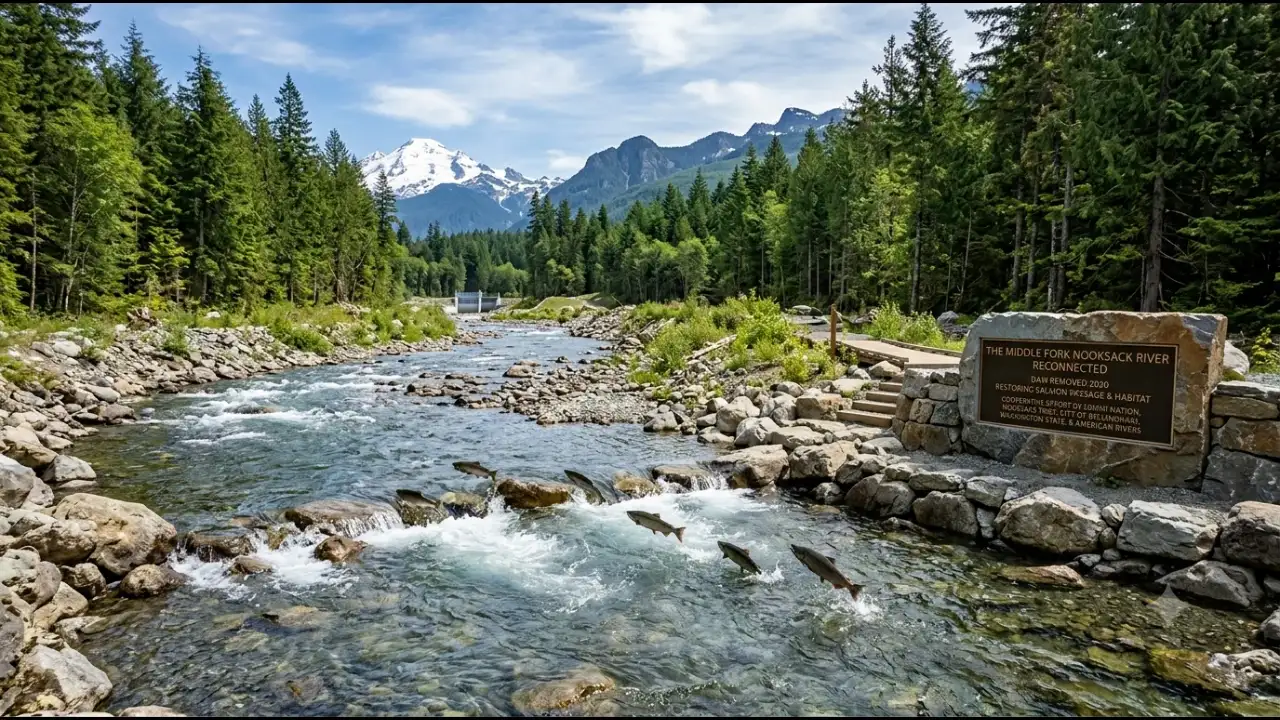
In 2020, American Rivers removed the Middle Fork Nooksack dam after 50 years of blocking fish in Washington. 2 years later, the river reopened 16 miles of habitat for Chinook salmon and trout

Middle Fork Nooksack salmon habitat : For more than five decades, fish could not reach important habitat in Washington’s Middle Fork Nooksack River because of a dam built to divert water for Bellingham.

That changed in 2020, when crews demolished the Middle Fork Nooksack Dam and completed work to reconnect the river.

The dam was built to supply Bellingham with water

The City of Bellingham built the dam in 1961 to divert water for the community. State law at the time required fish passage, but the dam was permitted without it.

The structure blocked access to upstream habitat for three ESA-listed Puget Sound species: Chinook salmon, steelhead and bull trout.

The Nooksack Tribe and Lummi Nation advocated for fish passage for years. In 2002, the two tribes, Washington Department of Fish and Wildlife, City of Bellingham and other fishery co-managers signed a memorandum of understanding to work together on a solution, as per American Rivers report.

Several designs and feasibility studies followed, but none produced an approved option.

READ ALSO: In 2004, Illinois began Cedar Lake restoration with 3 projects to curb erosion. 18 years later, Cedar Creek was delisted for 3 impairments after sediment and TSS improved

American Rivers joined the effort in 2017

American Rivers formally became a project partner in 2017.

The Paul G. Allen Family Foundation provided funding for project management, coordination, design, construction and planning. The support also helped the partners leverage public funding.

The eventual solution involved moving Bellingham’s water diversion point upstream, just above the existing dam, allowing the city to maintain its water supply without the structure.

The project restored the river channel

After the diversion was moved, crews restored the river channel and installed fully compliant fish screens to protect fish and prevent them from being drawn into the water system.

Construction crews prepared the site in 2020. The dam was demolished in July, river-channel restoration took place in August and in-water work was completed in September.

The river then flowed freely for the first time in more than 50 years.

READ ALSO: A decade ago, Maryland Agriculture restored 2 farms to improve Little Antietam Creek habitat. Today, 10 years of monitoring show mayflies, caddisflies and trout thriving

The reopened habitat could support salmon recovery

The project restored access to roughly 16 miles of cold, pristine river and tributary habitat for spring Chinook salmon, steelhead and bull trout, including spawning and rearing areas.

It was identified as a top-priority action for increasing spring Chinook in the WRIA 1 Salmon Recovery Plan.

Restoring Chinook habitat can also help support recovery efforts for endangered southern resident killer whales, which rely on Chinook salmon as an important part of their diet.

The river has deep cultural significance

The Middle Fork Nooksack is important to the Nooksack Indian Tribe and Lummi Nation.

Before non-native settlers arrived, the Nooksack Tribe used the area for hunting, gathering, solitude and spiritual practices. The river is a Traditional Cultural Property and has been nominated by the tribe as a Place of Significance.

The Lummi Nation’s Usual and Accustomed area under the 1855 Point Elliot Treaty includes the Nooksack watershed. Early Chinook salmon are also an important part of the community’s heritage and culture.

READ ALSO: In 2004, Illinois began Cedar Lake restoration with 3 projects to curb erosion. 18 years later, Cedar Creek was delisted for 3 impairments after sediment and TSS improved

Recovery will take time

The restoration is part of a much longer recovery effort.

The Nooksack basin has multiple factors affecting the recovery of early Chinook, and habitat improvements may take decades to show their full effects.

Hatchery programs provide adult salmon spawners to help seed the newly accessible habitat. Partners also plan to monitor the effects of the project and track how fish respond to the restored river.

The project brought together the City of Bellingham, Nooksack Indian Tribe, Lummi Nation, American Rivers, Washington Department of Fish and Wildlife and numerous state and federal partners.

Sign up to read this article
Read news from 100's of titles, curated specifically for you.
Already a member? Sign in here
Related Stories
Top stories on inkl right now
One subscription that gives you access to news from hundreds of sites
Already a member? Sign in here
Our Picks
Fourteen days free
Download the app
One app. One membership.
100+ trusted global sources.