Get all your news in one place.
100's of premium titles.
One app.
Start reading
The Economic Times
The Economic Times

In 2019, Ontario's Trent University created green parking from 35,640 pounds of recycled plastic. 7 years later, the system can hold 64,627 gallons of stormwater on campus

In 2019, Trent University in Ontario announced plans for a different approach to parking at its Symons Campus: permeable grid paving.

Made from 100% recycled plastic, the system was designed as an alternative to asphalt while helping the university address growing parking needs. The approach had become popular in Europe and was also being used around the world in agriculture, parks and industrial spaces.

How permeable grid paving works

The paving consists of interlocking grids installed over land and filled with grass or gravel.

The design provides better drainage and can reduce flood risk by increasing stormwater management capacity. The grids are also weather-resistant and can be plowed.

The system also requires far less road salt during winter, which can lessen its impact on nearby animal habitats.

Kent Stringham, vice-president of Finance and Administration at Trent, said the project would help the university balance campus growth with its environmental commitment. Stringham said, “This innovative and environmental solution to meeting campus demands boasts a number of ecological benefits including the ability to plant grass within the grid, better drainage, and less required road salt in the winter. It’s a win-win for Trent and for our environment,” as quoted by Trent University.

READ ALSO: In 2021, Australia's RMIT helped Coles put 900,000 pieces of soft plastic into concrete. 1 year later, another Coles development was set to reuse 6.5 million pieces through Polyrok

The project's environmental impact

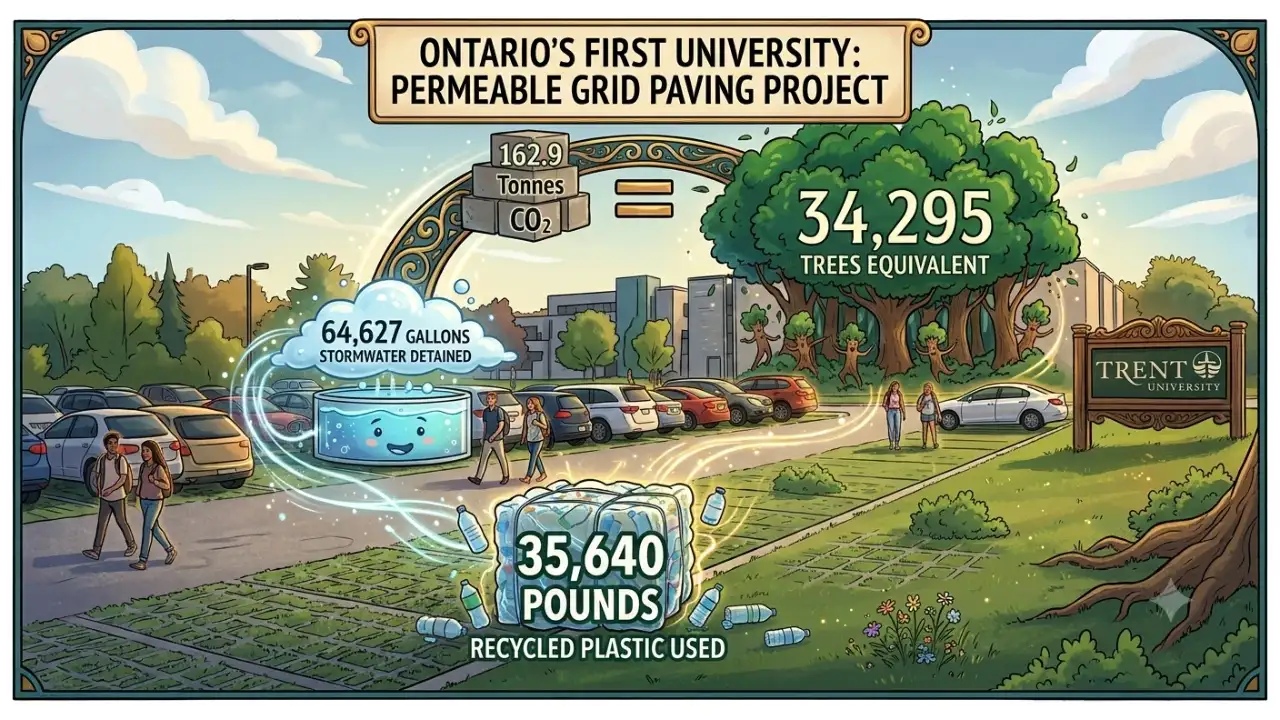
The project was designed to utilize 35,640 pounds of recycled plastic.

It was also designed to detain 64,627 gallons of stormwater and save 162.9 tonnes of CO2, equivalent to planting 34,295 trees.

More parking for a growing campus

The project was expected to add approximately 100 parking spaces at Symons Campus to address increased demand as the campus grew.

Trent was slated to become the first university in Ontario to install permeable grid paving, adding the project to its long-standing commitment to environmental sustainability.

READ ALSO: In 1972, FHWA used 5 inches of scrubber waste in a parking-area base at Washington's Dulles Airport. 2 years later, wet weather caused the experimental base to soften and be replaced

FAQs

1. What is Trent University's green parking system?

It is a permeable grid paving system designed as an alternative to conventional asphalt parking.

2. What is the parking system made from?

The paving system is made from 100% recycled plastic.

3. Where was Trent's green parking installed?

The project was installed at Trent University's Symons Campus in Ontario.

4. How does permeable grid paving work?

Interlocking grids are placed over the land and filled with grass or gravel, allowing water to drain through the surface.

READ ALSO: In 1977, Pennsylvania tested an 800-foot road base made with power-plant scrubber sludge; its strength rose from 720 to 1,014 PSI over seven years

Sign up to read this article
Read news from 100's of titles, curated specifically for you.
Already a member? Sign in here
Related Stories
Top stories on inkl right now
One subscription that gives you access to news from hundreds of sites
Already a member? Sign in here
Our Picks
Fourteen days free
Download the app
One app. One membership.
100+ trusted global sources.