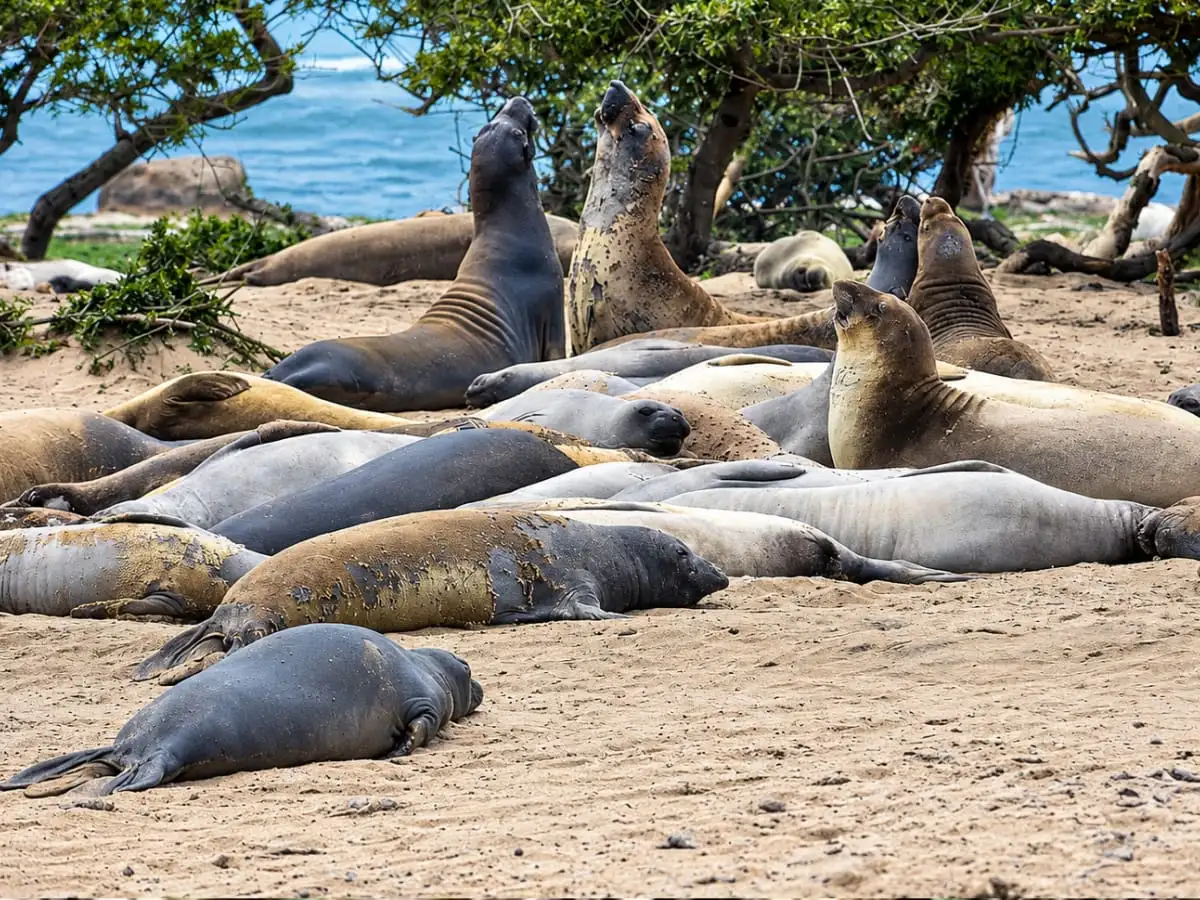
Each year, thousands of elephant seals come ashore on a rugged island off the coast of Santa Cruz to give birth, but for decades no realistic method could count the entire population in one effort. Then some scientists realized the internet might do the job. Beginning in August 2019, over 1,500 volunteers spent 212 days poring over images from drones of Año Nuevo Island, an endeavor that continued into 2020 and in the process tested something that scientists truly did not have the answer to: Could amateurs, from their living rooms, count wild animals as accurately as trained scientists? According to a study, “Accuracy and precision of citizen scientist animal counts from drone imagery,” published by PLOS ONE, those volunteers sorted through more than 90,000 images from drone flights over the island. The outcome of that effort was mixed.
A small island that needed thousands of extra eyes

Año Nuevo Island is difficult to access. It's located near the coast; researchers can visit only a few times a year, and it regularly hosts a gathering of northern elephant seals, harbor seals, California sea lions, and Steller sea lions, sometimes including one or more species at the same time. Ground surveys can disrupt the animals and miss those hidden in crevices. Manned aircraft can help, but they are expensive to use regularly. The UC Santa Cruz team had already been flying consumer drones over the area every two weeks or so as part of an ongoing monitoring program, building full maps of the island from the imagery well before the 212-day volunteer counting campaign began, and researchers eventually faced a separate issue: nobody on the research team had the time to count every single creature in every one of the photographs. According to UCSC, the idea was to conduct the first-ever truly comprehensive count of Año Nuevo Island's wildlife, which had previously been impossible because of limited access.
The accuracy numbers, and what they actually mean
This is where the headline figure needs qualification. According to the study, citizen scientists were within 5% of expert counts for seals during the winter breeding season, when elephant seals monopolize the beaches and are not easily confused with sea lions. For sea lions, the proportional error was closer to 9%. Once summer arrived and sea lions crowded the same beaches as seals, volunteers had a harder time telling the two species apart, and the accuracy of seal counts declined as a result. So while the 5% and 9% figures are accurate, they describe performance during the breeding seasons specifically rather than the project as a whole, and readers should treat them as best-case results rather than a fixed error rate that applies year-round.