Get all your news in one place.
100's of premium titles.
One app.
Start reading
The Economic Times
The Economic Times
Shreya Biswas

In 2018, Deloitte redesigned London's New Street Square with around 6,300 plants and 600 sit-stand desks. 8 years later, 365 bike spaces and a 1,100m² gym have reshaped office life

Deloitte New Street Square sustainable office : When Deloitte set out to create its “campus of the future” at 1 New Street Square in London, its leadership understood the business benefits of occupying a healthy, efficient and sustainable workplace.

The project achieved WELL Building Standard certification, with verification in 2018. Deloitte combined environmental design with a wellbeing agenda that focused on areas including air quality, mindfulness, physical activity, nutrition and hydration.

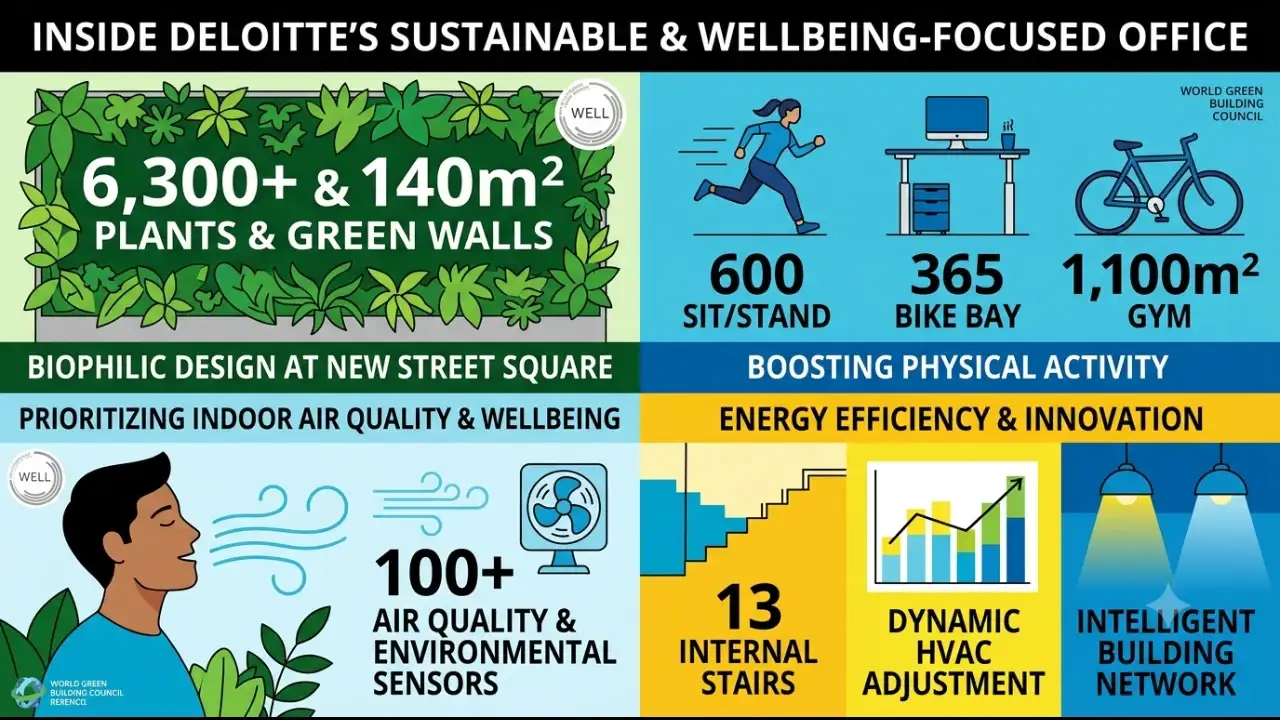
As part of the biophilic design, Deloitte installed 6,300 plants across 700 displays, along with 140m² of green walls. The project also made significant use of timber and stone and provided access to nature through a terrace on the 12th floor, as per a World Green Building Council report.

The project included 600 sit/stand desks, 13 internal accommodation stairways, a 365-bay cycle facility and a 1,100m² gym on campus. These measures were included to promote physical activity.

READ ALSO: In 2024, Botswana used Slaty Egret surveys to track ecosystem damage at Okavango Delta. 2 years later, researchers found 3 eggs, offering fresh hope for the Delta after a very long search

6,300 plants and 700 displays supported biophilic design

Deloitte's wellbeing plans also focused on indoor air quality.

The company asked more than 200 material, furniture and cleaning suppliers to assess their products against stringent air-quality and environmental criteria before they would be considered. It also worked with its Facilities provider to ensure cleaning and maintenance regimes used low-toxicity products.

The project used performance-based design to prioritise energy efficiency and comfort. Deloitte developed an operational energy model and used thermal, acoustic, daylight and circadian lighting models to help optimise the working environment, as per a BRE Group report.

The company also installed 620 sensors to monitor environmental conditions, including air quality and temperature. These were connected to its Intelligent Building network, allowing HVAC settings to be dynamically adjusted to maintain a balance between energy efficiency and comfort performance.

Sign up to read this article
Read news from 100's of titles, curated specifically for you.
Already a member? Sign in here
Related Stories
Top stories on inkl right now
One subscription that gives you access to news from hundreds of sites
Already a member? Sign in here
Our Picks
Fourteen days free
Download the app
One app. One membership.
100+ trusted global sources.