Get all your news in one place.
100's of premium titles.
One app.
Start reading
The Economic Times
The Economic Times

In 2009, scientists began with a 3.8% perovskite solar cell. 17 years later, LONGi's silicon-perovskite tandem set a 35.5% world record

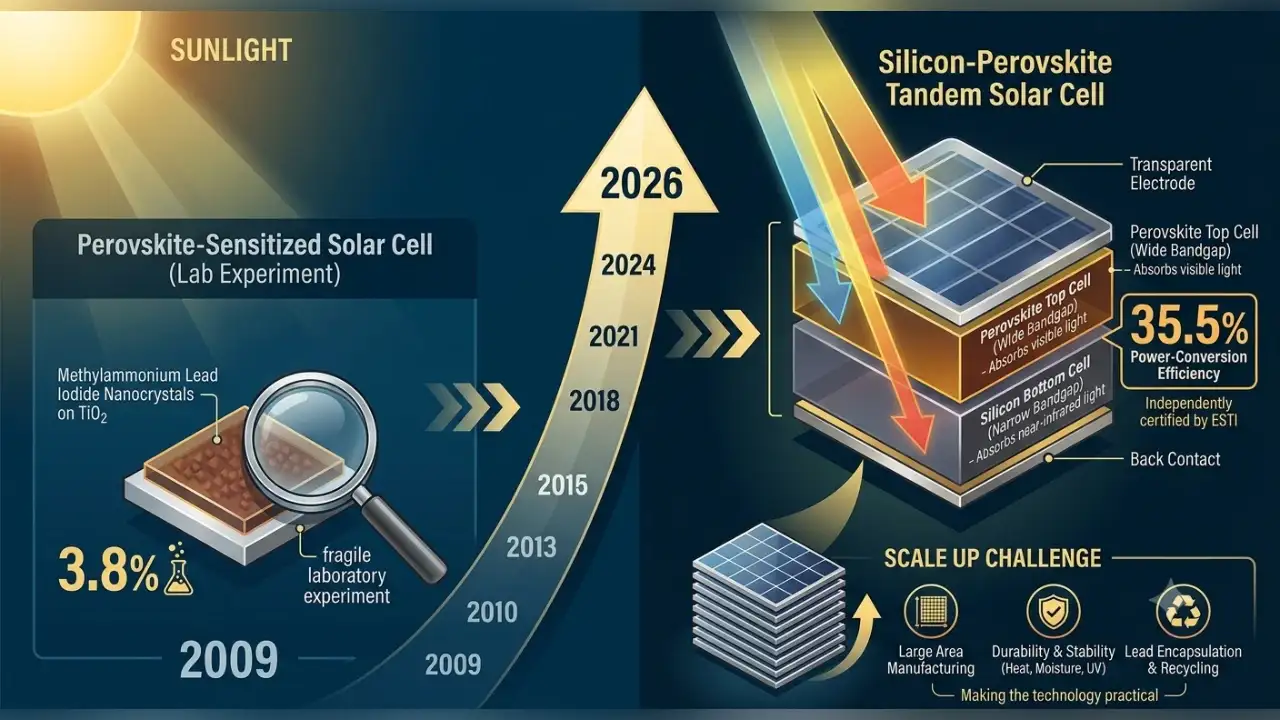
In 2009, a new type of solar cell could convert just 3.8% of incoming sunlight into electricity. At the time, perovskite solar technology was still a fragile laboratory experiment.

Seventeen years later, LONGi says its research team has reached 35.5% power-conversion efficiency with a crystalline silicon-perovskite tandem solar cell, as per a report. The result was independently certified by the European Solar Test Installation, or ESTI.

The 35.5% figure applies to a research cell rather than a commercial solar panel. LONGi's announcement does not specify the area of the latest cell or provide an accompanying peer-reviewed paper, so some technical details are not yet available.

How perovskite solar cells evolved

The original 2009 device used methylammonium lead iodide nanocrystals to sensitize a porous titanium-dioxide electrode, as per a ScienceBlog report. It converted 3.8% of incoming solar energy, but it relied on a liquid electrolyte that dissolved the perovskite. Its performance could decline within minutes.

Researchers later moved toward solid transport layers, improved crystal growth, reduced defects, and developed ways to protect the thin interfaces between materials.

Perovskite refers to a crystal structure rather than one fixed substance. Its composition can be adjusted to change its bandgap, allowing researchers to tune how it absorbs sunlight. That flexibility became particularly useful when perovskite was combined with silicon.

READ ALSO: In 1978, Turkey Point workers found 1 crocodile nest when Florida had fewer than 300 left. 48 years later, about 400 live in its canals, turning a nuclear plant into an unlikely crocodile habitat

Why silicon and perovskite work together

A conventional silicon solar cell uses a single light-absorbing junction, which limits how effectively it can use the full solar spectrum. A tandem cell divides the job between two absorbers.

The perovskite top cell absorbs higher-energy visible light, while lower-energy red and near-infrared light passes through to the silicon bottom cell. The two materials can therefore handle different parts of the spectrum.

This allows a tandem device to exceed the efficiency limits of a single-junction silicon cell. Detailed calculations put the practical theoretical ceiling for a single-junction crystalline silicon cell at roughly 29%, as per the ScienceBlog report.

Why 35.5% research efficiency is different from panel efficiency

LONGi's 35.5% result applies to a research cell. A commercial module combines many cells across a much larger area, adding inactive borders, interconnections and other optical and electrical losses.

LONGi says its larger tandem cells have reached 34.3% over 261 square centimeters and 32.2% over 274 square centimeters, as per the ScienceBlog report. Its tandem modules have reached 31.4% and 29.4%.

The figures show why laboratory cell efficiency and commercial module performance should not be treated as interchangeable.

READ ALSO: In 2009, German startup SkyWind first showed its rooftop micro turbine design. 17 years later, the machine has secured certification, with Utah testing verifying roughly 615 kWh of electricity per year

The latest result follows LONGi's 34.58% result

LONGi had previously reported a tandem efficiency of 34.58%. In a 2025 Nature paper, researchers described an asymmetric self-assembled molecule used as a hole-selective layer. The treatment improved coverage over textured silicon and helped align energy levels at the buried interface.

The approach helped useful charge leave the perovskite while reducing opportunities for electrons and holes to recombine.

ESTI certified that earlier device at 34.58%. LONGi has not yet provided equivalent device-level details for the new 35.5% result, so it is not clear exactly what produced the additional 0.92 percentage points.

The next challenge is making the technology practical

Higher efficiency is only one part of developing a usable solar technology.

Perovskite tandems need to operate reliably over large areas and withstand heat, moisture and ultraviolet exposure over long periods. Manufacturing also needs to remain consistent.

Many leading perovskite compositions contain lead, making robust encapsulation, leakage testing and responsible end-of-life handling important.

A 2025 Nature Photonics review identified efficiency, long-term stability and scalability as connected challenges for the technology. Progress in one area does not automatically solve the others.

READ ALSO: Free-range vs. farm-raised chicken: Why one has firmer meat and stronger flavor while the other is cheaper and more tender

Sign up to read this article
Read news from 100's of titles, curated specifically for you.
Already a member? Sign in here
Related Stories
Top stories on inkl right now
One subscription that gives you access to news from hundreds of sites
Already a member? Sign in here
Our Picks
Fourteen days free
Download the app
One app. One membership.
100+ trusted global sources.