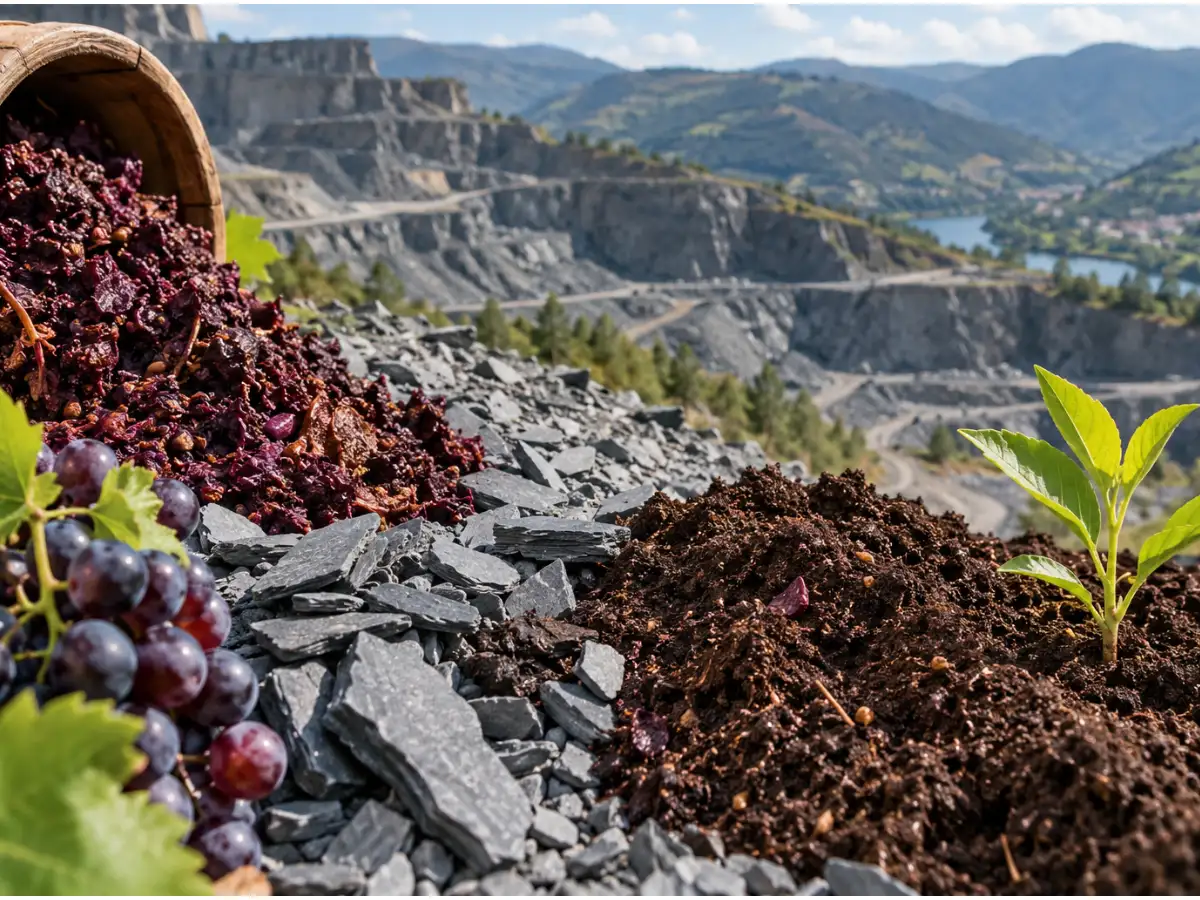
In north-west Spain, researchers have been exploring an unusual way to give barren mining waste a second life: mixing it with the leftovers from wine production. In the slate-producing region of Valdeorras in Galicia, scientists tested whether grape marc — the skins, seeds and pulp left behind after grapes are processed — could be turned into an organic amendment for fine slate waste. The idea was not simply to dispose of one waste stream with another, but to transform the mineral residue into something closer to a functioning soil, with better water retention, nutrient availability and biological activity.
The problem begins with what slate extraction and processing leaves behind. Large quantities of fine slate particles are generated during production, and this material contains very little organic matter. Its physical structure can also make plant establishment difficult. Fine particles can become compacted, restricting the movement of water and air through the material while making it harder for roots to penetrate. On a conventional landscape, soil provides a combination of minerals, organic matter, microorganisms, water and pore spaces that plants depend on. A slate-waste dump is missing much of that foundation, meaning that simply scattering seeds over it may do little to establish lasting vegetation.