Get all your news in one place.
100's of premium titles.
One app.
Start reading
The Economic Times
The Economic Times
Shreya Biswas and ET Science Desk

In 2009, Granville Ecopark began its planning process for food-waste anaerobic digestion; it now has capacity to export 4.8 MWe of renewable electricity to Northern Ireland’s grid

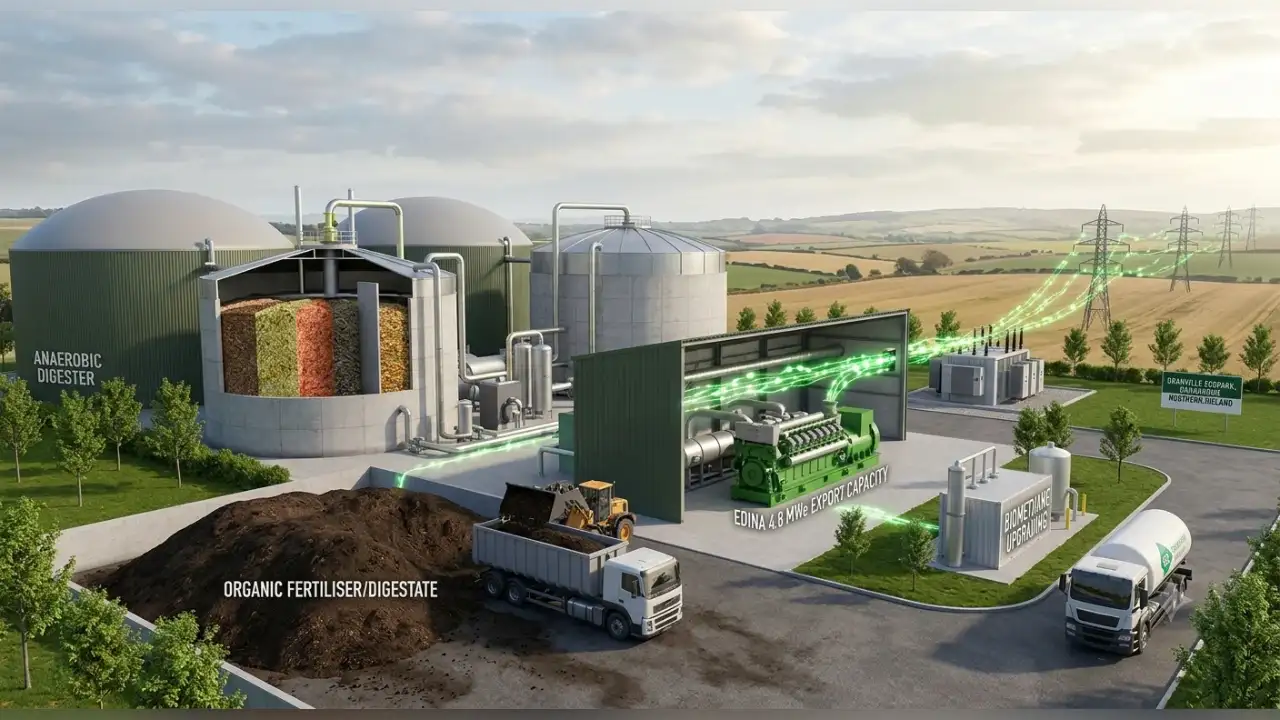
Food waste is being used as a resource at Granville Ecopark in Dungannon, Northern Ireland, where an enhanced anaerobic digestion facility uses food waste to produce biogas for electricity generation.

Edina says Granville Ecopark has the capacity to export 4.8 MWe of renewable electricity onto Northern Ireland’s local grid.

How Granville Ecopark uses food waste

Granville Ecopark operates an anaerobic digestion facility at Granville Industrial Estate in Dungannon.

The Northern Ireland Department of Agriculture, Environment and Rural Affairs (DAERA) says the facility uses both packaged and unpackaged food waste from local businesses and domestic customers to produce electricity from high-quality biogas.

Through anaerobic digestion, the food waste is broken down to generate gas and an organic by-product known as digestate. DAERA says the gas is burned in an engine to produce electricity, while digestate can be used as fertiliser and soil conditioner.

Edina describes Granville Ecopark as the largest Enhanced Anaerobic Digestion facility in Ireland taking only food waste as a resource.

READ ALSO: In 2000, artist Kimberly Wurster restored 1 Montana mining property for wildlife and trout. 20 years later, it supported elk breeding grounds and trout spawning habitat

The planning application dates back to 2009

The year 2009 refers to Granville Ecopark’s planning application, not the start of electricity generation.

The UK government’s Renewable Energy Planning Database records March 25, 2009 as the planning application date and September 1, 2013 as the construction date.

EnergyMap records June 10, 2014 as the project’s generator-live date.

4.8 MWe refers to export capacity

The 4.8 MWe figure refers specifically to Granville Ecopark’s capacity to export renewable electricity onto Northern Ireland’s local grid.

Edina separately lists a CHP capacity of 5.78 MWe for the project. Therefore, the 4.8 MWe figure should not be described as the facility’s total CHP capacity.

It also should not be interpreted as evidence that exactly 4.8 MW was continuously generated or exported. Edina describes 4.8 MWe as the facility’s capacity to export electricity.

READ ALSO: A painting bought for £2,090 at auction looked ordinary. Experts later identified it as a lost Helen McNicoll masterpiece valued at £300,000

Excess biogas can be converted into biomethane

Granville Ecopark’s excess biogas can also be used for further energy applications.

Edina says the facility’s expansion allows excess biogas to be cleaned into biomethane, which is transported across Northern Ireland to power combined heat and power engines and create renewable heat and electricity for customers.

The Northern Ireland government’s Prosperity Agreement also describes excess biogas being converted into biomethane and transported across Northern Ireland for use in CHP engines producing renewable heat and power.

DAERA says gas produced through anaerobic digestion can be burned in an engine to produce electricity or transported off-site to fuel engines at other locations.

Food waste becomes a source of renewable energy

Granville Ecopark connects food-waste treatment with energy generation. Food waste is processed through anaerobic digestion to produce biogas, while digestate is produced as a by-product that can be used as fertiliser and soil conditioner.

The facility has a stated capacity to export 4.8 MWe of renewable electricity onto Northern Ireland’s local grid. Its excess biogas can also be cleaned into biomethane and transported across Northern Ireland for use in combined heat and power engines at other locations.

READ ALSO: The View co-host Joy Behar listed her Hamptons home for $10.95 million in 2024; after multiple price cuts, the 1903 house finally sold for $5.65 million

Sign up to read this article
Read news from 100's of titles, curated specifically for you.
Already a member? Sign in here
Related Stories
Top stories on inkl right now
One subscription that gives you access to news from hundreds of sites
Already a member? Sign in here
Our Picks
Fourteen days free
Download the app
One app. One membership.
100+ trusted global sources.