Get all your news in one place.
100's of premium titles.
One app.
Start reading
The Economic Times
The Economic Times

In 2006, scientists discovered giant Antarctic lakes 4 kilometres below surface that never froze despite brutal cold and could harbor ancient life

Giant Antarctic lakes discovered : In 2006, scientists reported the discovery of two giant lakes buried more than 4 kilometres beneath Antarctica's ice sheet, revealing vast bodies of liquid water that remained unfrozen beneath one of the coldest environments on Earth, as per a report.

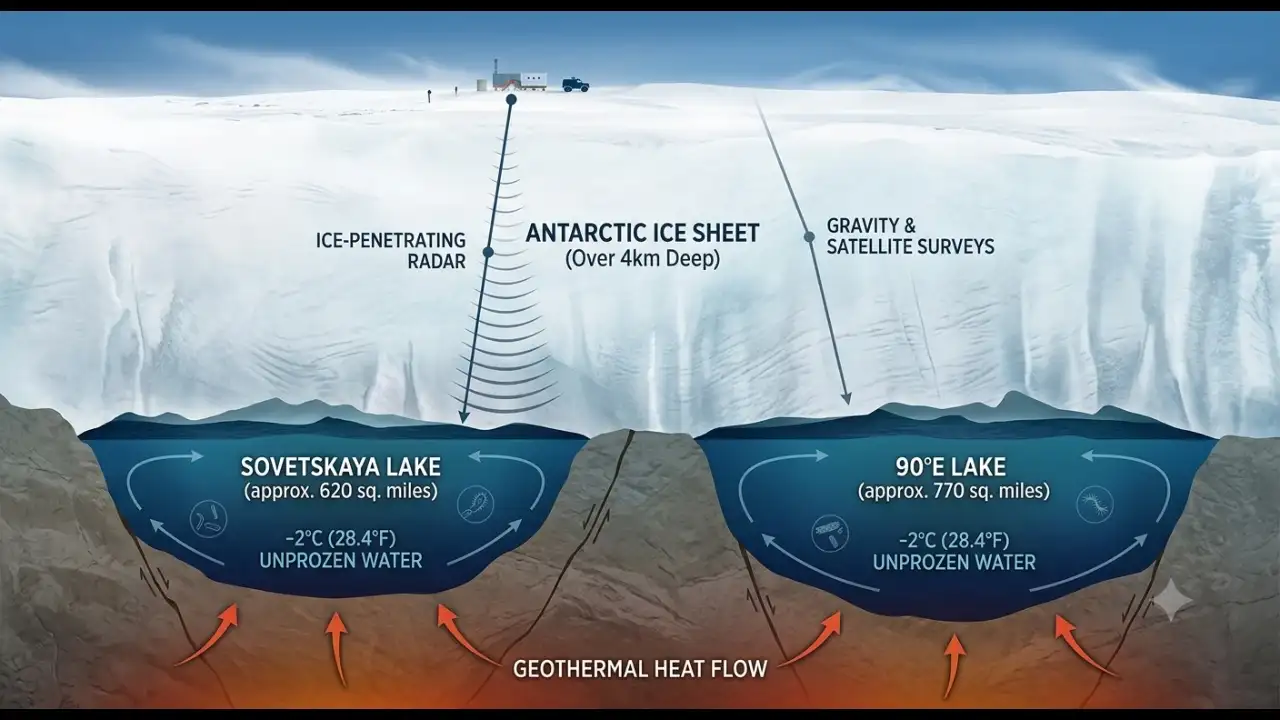
The findings identified the second- and third-largest known subglacial lakes in Antarctica after Lake Vostok. Researchers said the lakes may harbor unique ecosystems that have remained untouched for about 35 million years, as per a Livescience report.

Hidden lakes beneath Antarctica's ice

Before the discovery, scientists knew of at least 145 smaller lakes beneath Antarctica's ice, along with the massive Lake Vostok.

The newly identified lakes, named 90°E Lake and Sovetskaya Lake, were found beneath more than 2 miles (about 4 kilometres) of ice. Researchers estimated that both lakes are about half a mile deep.

The larger of the two covers about 770 square miles, roughly the size of Rhode Island, while the other spans about 620 square miles.

READ ALSO: In 1940s, a blind automotive engineer created the car feature, cruise control that changed highway driving forever

Scientists combined multiple technologies to find them

Robin Bell of the Lamont-Doherty Earth Observatory and Michael Studinger made the discovery by combining data from ice-penetrating radar, gravity surveys, satellite imagery, laser altimetry and records from a Soviet Antarctic Expedition that unknowingly crossed the lakes in 1958 and 1959, according to the Livescience report.

According to Bell, the pull of gravity above the lakes was noticeably weaker because of the large cavities filled with water beneath the ice.

The lakes' shorelines also appeared as subtle surface disturbances in satellite images, while radar data showed slight depressions where the ice floated above the water.

Why the lakes never froze

Despite air temperatures that can fall to minus 112 degrees Fahrenheit during the Antarctic winter, the water at the top of both lakes remains at about 28.4 degrees Fahrenheit.

Researchers said heat rising from below the Earth's surface, combined with the thick layer of insulating ice above the lakes, prevents the water from freezing, as per Livescience report.

READ ALSO: In 2009, a Navy veteran's low-cost invention helped thousands get glasses in places without eye doctors

Ancient ecosystems may exist below the ice

Researchers said the lakes are bounded by faults, and evidence suggests water circulates within them while receiving nutrient flows.

These conditions could support unique ecosystems that have remained untouched for about 35 million years beneath Antarctica's ice.

The discovery was detailed in the February issue of Geophysical Research Letters.

Sign up to read this article
Read news from 100's of titles, curated specifically for you.
Already a member? Sign in here
Related Stories
Top stories on inkl right now
One subscription that gives you access to news from hundreds of sites
Already a member? Sign in here
Our Picks
Fourteen days free
Download the app
One app. One membership.
100+ trusted global sources.