Get all your news in one place.
100's of premium titles.
One app.
Start reading
The Economic Times
The Economic Times
Shreya Biswas

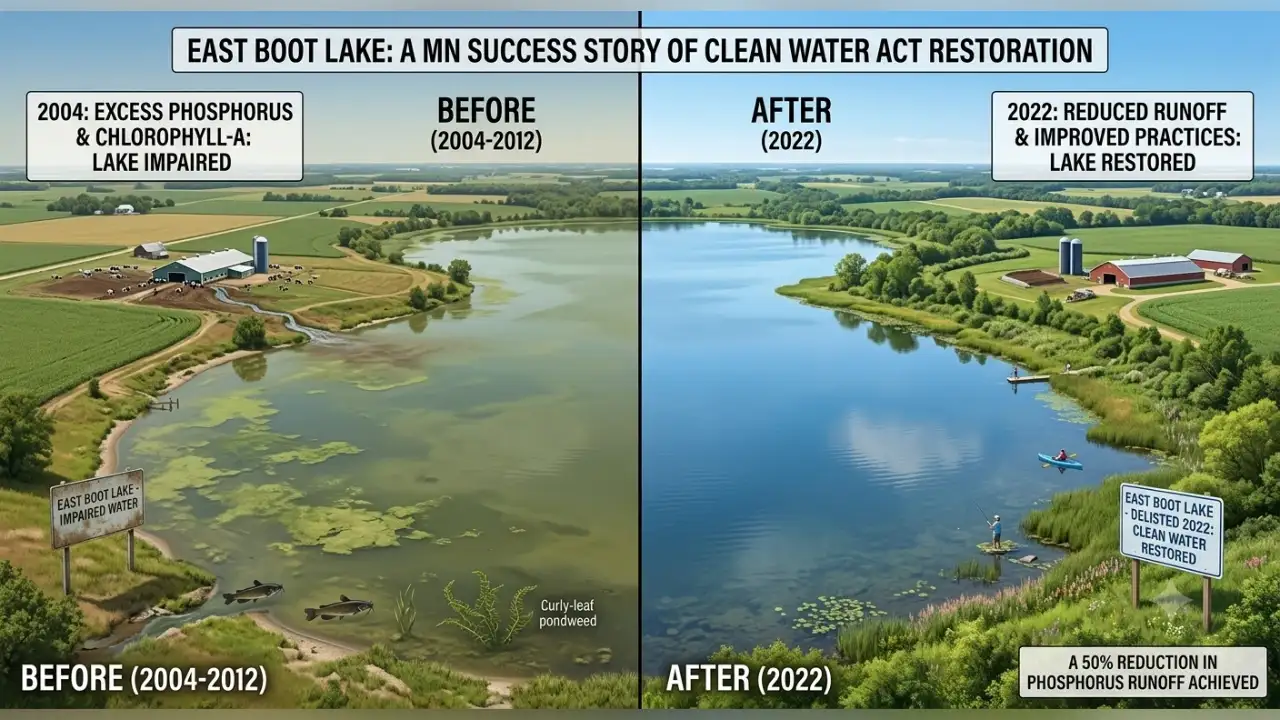
In 2004, Minnesota's East Boot Lake was listed for nutrients with a 27-pound phosphorus target. 18 years later, targeted projects improved water quality and led to delisting in 2022

In 2004, East Boot Lake in Minnesota was added to the Clean Water Act Section 303(d) list of impaired waters because of excess phosphorus and chlorophyll-a concentrations.

Eighteen years later, targeted watershed and in-lake management strategies had improved water quality conditions, leading to the lake's removal from the state's impaired waters list.

A multi-lake Total Maximum Daily Load plan completed in 2012 called for reducing East Boot Lake's total phosphorus loading by 27 pounds per year, equivalent to a 14% reduction from existing conditions.

A lake affected by excess nutrients

East Boot Lake is a 47-acre lake in May Township in Washington County that drains an undeveloped 232-acre agricultural watershed.

Before management strategies were implemented, the lake exceeded state standards for total phosphorus and chlorophyll-a, although it met Secchi transparency standards.

The main phosphorus sources were watershed runoff, feedlots and internal loading. Around half of the lake is less than 15 feet deep, making it susceptible to internal phosphorus cycling and shallow-lake dynamics.

Agricultural fields and feedlots contributed runoff, while black bullhead populations and the seasonal die-back of curly-leaf pondweed exacerbated internal loading. During late summer, phosphorus and chlorophyll-a concentrations increased as grazing pressure from large zooplankton declined, reinforcing eutrophic conditions.

READ ALSO: In 2023, Arizona State University began planning a 1-2-acre pollinator garden by Phoenix’s Salt River. Today, the project aims to restore habitat and support pollinators

Projects focused on reducing runoff

The 2012 multi-lake TMDL guided efforts to reduce phosphorus entering East Boot Lake.

Priority actions included improving manure and feedlot management and restoring upland and shoreline areas contributing runoff.

In 2011, a nearby dairy farm worked with the Natural Resources Conservation Service to install a waste management system that prevents manure from running off into the lake.

Other practices included conservation cover and tillage, nutrient management, runoff management systems, fencing, pipelines and streambank and shoreline protection.

Watershed and lake management produced results

The Carnelian-Marine-St. Croix Watershed District and its partners used watershed practices as the primary approach for reducing phosphorus inputs while also implementing in-lake strategies to address biological contributors to internal loading.

Ongoing monitoring and adaptive management tracked changes over time, while the Met Council's Community-Assisted Monitoring Program provided volunteer monitoring data for East Boot Lake.

The work resulted in a measurable decline in total phosphorus loading, meeting the TMDL reduction target. Phosphorus contributions from watershed sources were reduced by nearly 50%.

Monitoring also showed improvements in chlorophyll-a concentrations and overall lake conditions compared with pre-implementation conditions.

The improvements restored East Boot Lake's aquatic recreational use.

Erik Anderson, a Senior Water Resource Specialist at the Washington Conservation District, described the change as one of the most dramatic improvement stories in Washington County.

Anderson said, “When I first started this job in the early 2000s, the lake would turn pea green with algae every summer. Now the water is clear, and it was taken off the state’s impaired water’s list,” as quoted by the EPA.

READ ALSO: In 2025, Hampton, New Hampshire, completed a $4.3 million drainage project using a repurposed pump station. 1 year later, residents estimated flooding had fallen 75%, transforming a flood-prone neighborhood

Sign up to read this article
Read news from 100's of titles, curated specifically for you.
Already a member? Sign in here
Related Stories
Top stories on inkl right now
Our Picks
Fourteen days free
Download the app
One app. One membership.
100+ trusted global sources.