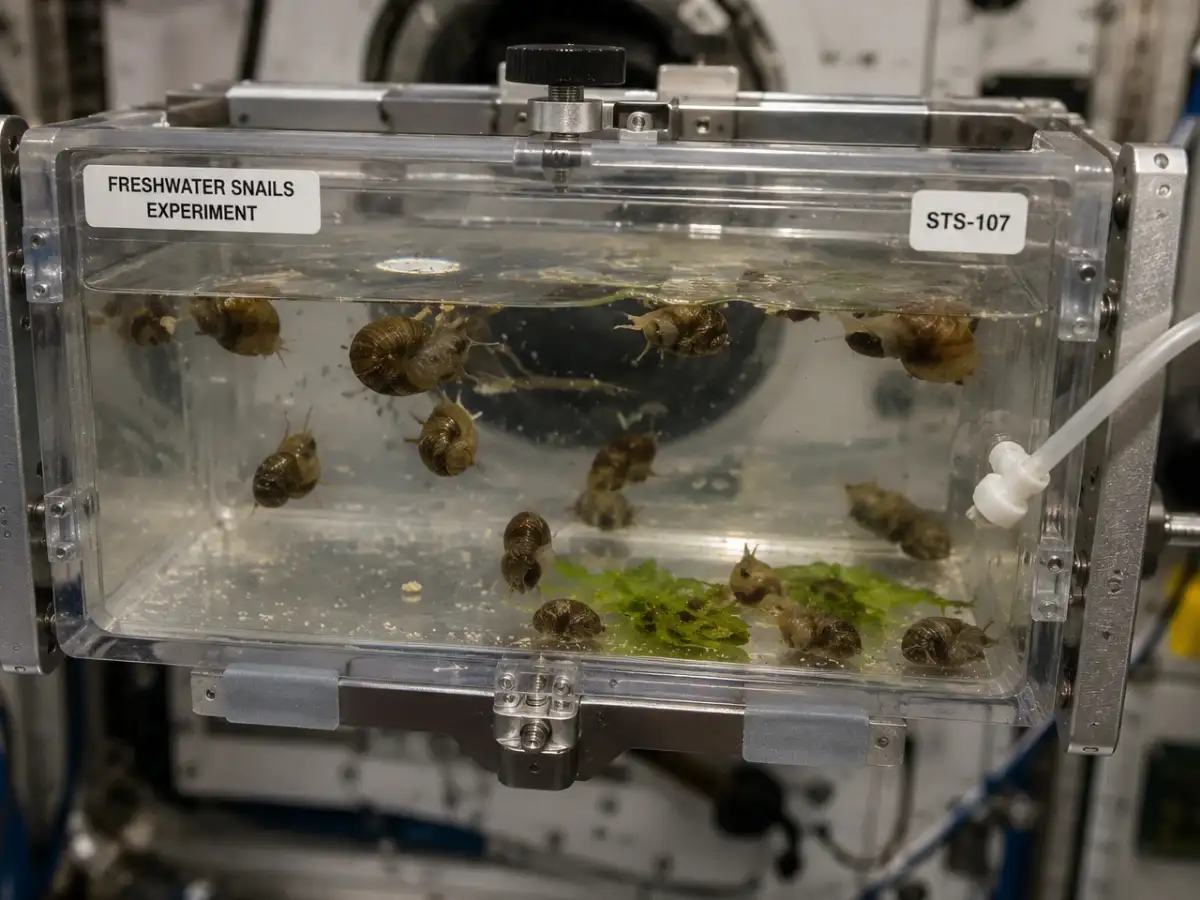
There are times when space seems to conjure tales that sound too incredible to be true, yet are real enough. One of the most interesting studies was conducted by scientists at the University of Texas Health Science Center at San Antonio as part of NASA's Neurolab research and was titled Early Development of Gravity-Sensing Organs in Microgravity . They exposed pond snails to space aboard a Space Shuttle, where the snails mated and their young hatched in microgravity. That was the part that would most interest scientists afterward. Their gravity-sensing stones were roughly one and a half times larger than those of similarly sized snails bred on Earth. This might seem a rather trivial matter at first glance. It isn’t. It concerns a very important function of almost all living things with a sense of balance.
To appreciate why this is important, it is useful to have some idea what these stones do. Almost all animals capable of feeling up and down have these stones in some form. In humans, they lie in the inner ear. In snails, they float in a small sac of liquid called a statocyst. The dense structures, called otoliths or statoconia, rest on minute hairs, and when gravity acts on them, they bend, thus sending a message to the brain about the direction of down. This is an efficient system about which most people think only when they get dizzy on a roller coaster or slip on ice.