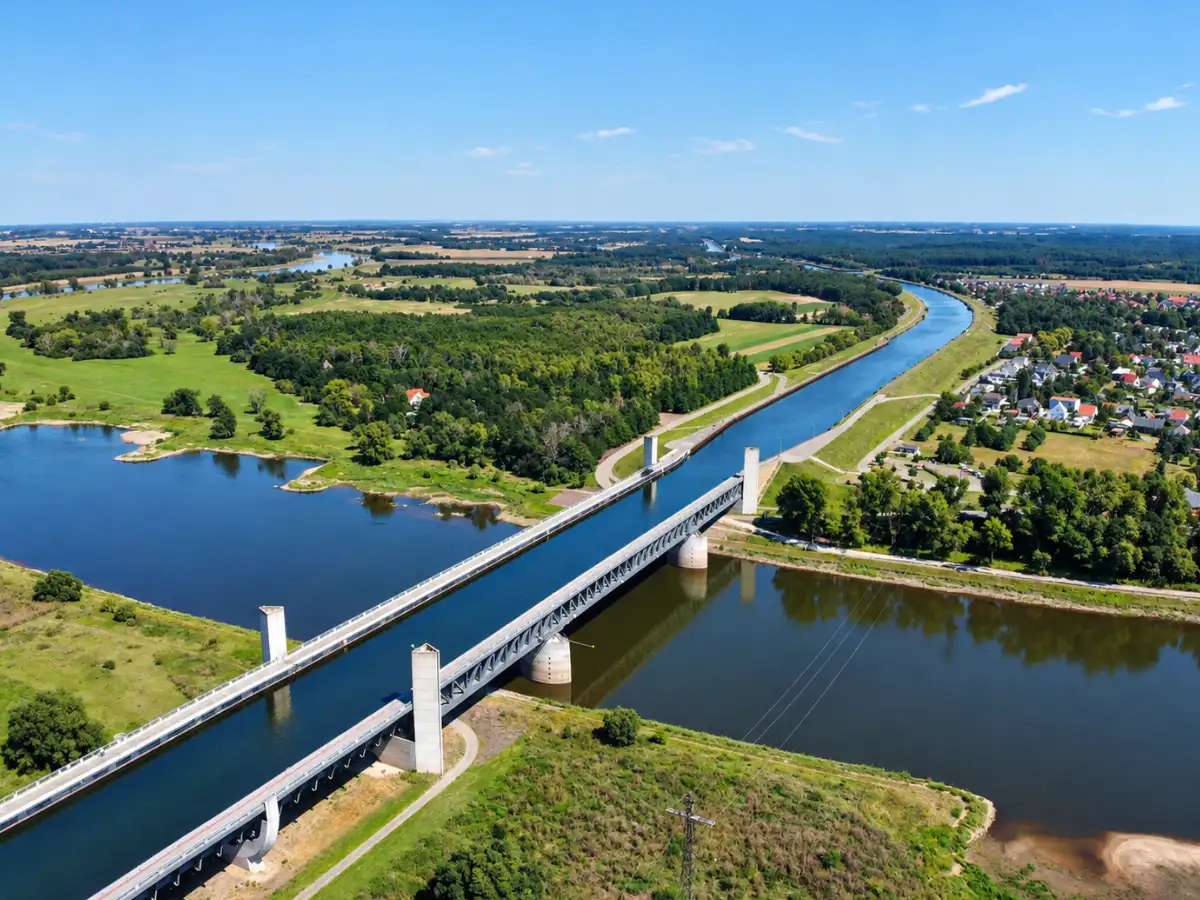
A ship floating along the river, but not on it, sounds like the setup to a conundrum. That's precisely what happens every day near the German city of Magdeburg, where the Magdeburg Water Bridge carries barges and cargo vessels above the Elbe River in a concrete trough of water. The German Federal Waterways and Shipping Administration (GDWS) says the structure is 918 meters (roughly 3,012 feet) long and is Europe's longest navigable canal bridge. The bridge carries artificial waterways over the river, allowing freight traffic to continue uninterrupted.
Why a bridge over a river was even needed

Germany's inland waterways are served by two main routes: the east-west Mittelland Canal and the Elbe-Havel Canal leading to Berlin. However, the Elbe River flows straight through their path, and it's at a lower level than both canals. Before 2003, boats heading for Berlin had to leave the canal, descend to the Elbe via locks, proceed several miles upriver, and then climb back up the canal system. Shallow Elbe waters during dry periods made it impossible for heavily laden barges to make the journey. Vessels were forced to lighten their cargo, or wait for rains before they could proceed. The lack of a direct link between the two waterways had frustrated planners since the early 1900s. According to the city of Magdeburg, construction of a connecting canal began before World War II and stopped in 1942 as the conflict drained resources and the workforce. Until Germany's division, there was little motivation to complete the east-west route, and the half-built piers were left to languish.