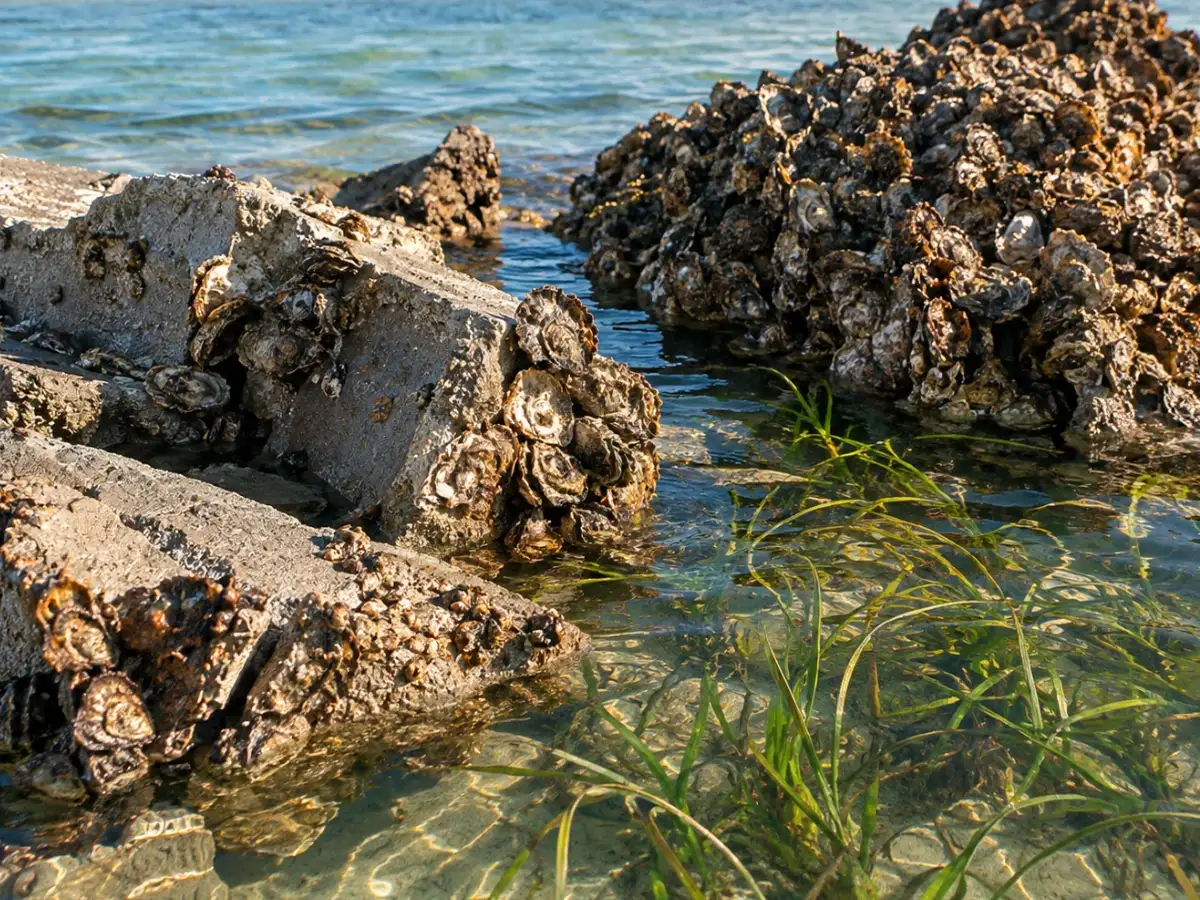
Most people think of concrete rubble as junk, something hauled to a landfill after a road gets resurfaced. Meanwhile, that same rubble became the foundation for a living reef in downtown Pensacola, Florida. According to the Florida DEP, the Northwest Florida Aquatic Preserves program worked in partnership with the city of Pensacola, Escambia County, the EPA Gulf of Mexico Program, the National Fish and Wildlife Foundation, the US Fish and Wildlife Service, NOAA and local volunteers. That reef is still there more than two decades later and it helped restore the habitat the bay lost for generations.
The rubble grew into a reef

Project GreenShores stretches along the urban shoreline of Pensacola Bay, and it's never been a small project. Site 1 alone generated 15 acres of estuarine habitat, including a seven-acre oyster reef and eight acres of salt marsh seeded with 40,000 smooth cordgrass plants. Forty wave attenuators were installed to reduce incoming waves so the young reef and marsh grasses had a better chance to take root instead of washing away. The agency adds that the project was honored with the 2003 Coastal America Partnership Award and the EPA Gulf of Mexico Program's Gulf Guardian Award the following year.
A second phase, which went even further, was built in 2007. DEP reused 25,000 cubic yards of recycled concrete from a decommissioned airfield at Naval Air Station Pensacola to build submerged breakwaters about 600 feet long. These structures were designed to reduce the energy of waves hitting the shoreline and were supposed to become oyster habitat themselves over time as larvae settled and attached to the surface.