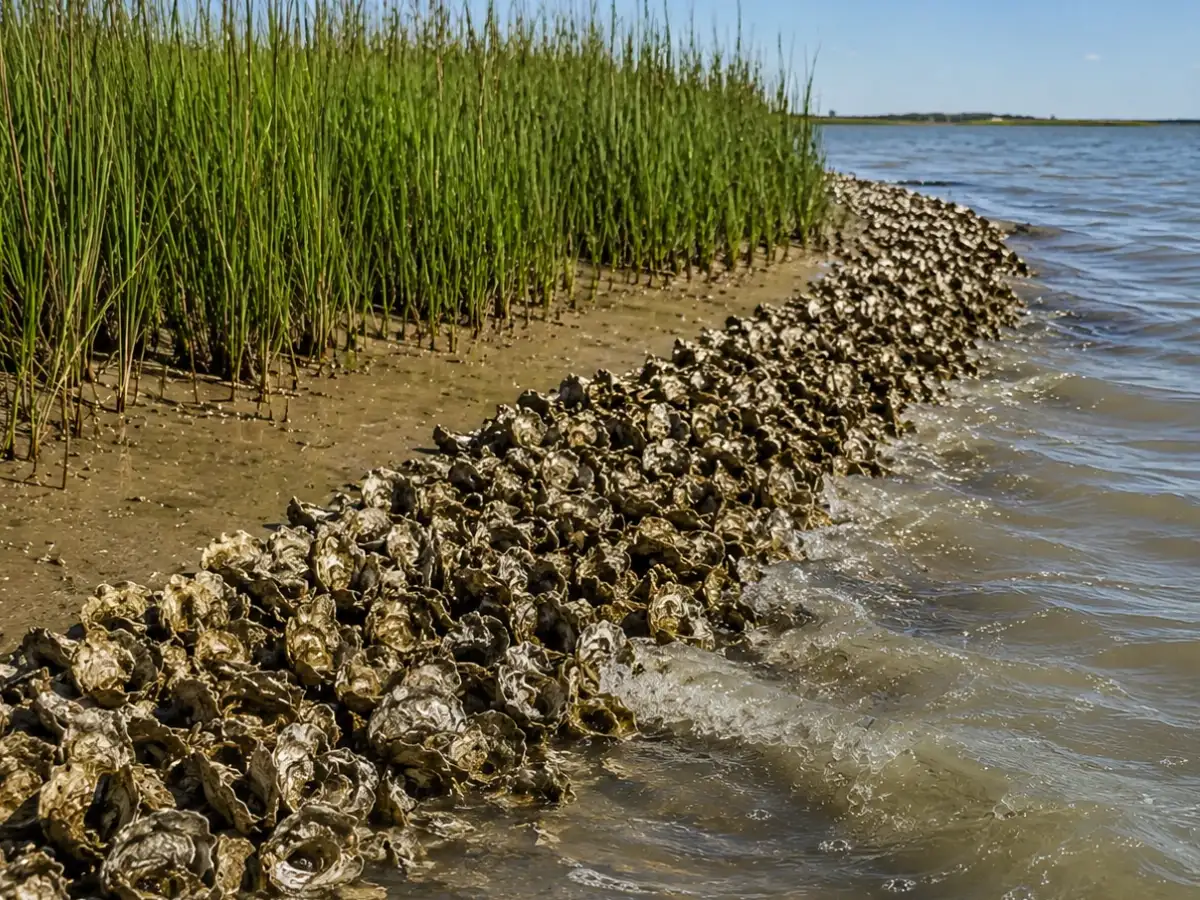
Two decades ago, a strip of beach outside NOAA's marine lab in Beaufort, North Carolina, was slowly disappearing into the water. According to NOAA's Habitat Blueprint page on the living shoreline at Pivers Island, the sandy beach experienced significant erosion during the late 1990s. At that time, the usual fix for the problem would have been either a seawall or a rock revetment. In March 2000, NOAA researchers planted roughly 500 square meters of local cordgrass, Spartina alterniflora, and placed an oyster shell sill at the waterline instead of a granite sill or seawall. It was a test of whether a living shoreline could perform as well as a hardened one.
A greener alternative to concrete walls

Living shorelines are not the same as seawalls. Unlike seawalls, which use concrete barriers to block waves, living shorelines use marsh grass roots to hold soil in place, while an oyster-shell barrier just offshore helps reduce wave energy. The project's construction didn't stop with the initial planting: additional oyster shell was added in the summers of 2000, 2006, and 2007, placed below the marsh's lowest point and along the outer margin of the mud flats so it would not sink into soft sediments. The project was carried out by NOAA and Duke University staff and volunteers, with oyster shell provided and placed by the North Carolina Division of Marine Fisheries. Ultimately, sediment deposition helped the marsh expand seaward, and erosion of the adjacent lawn stopped.