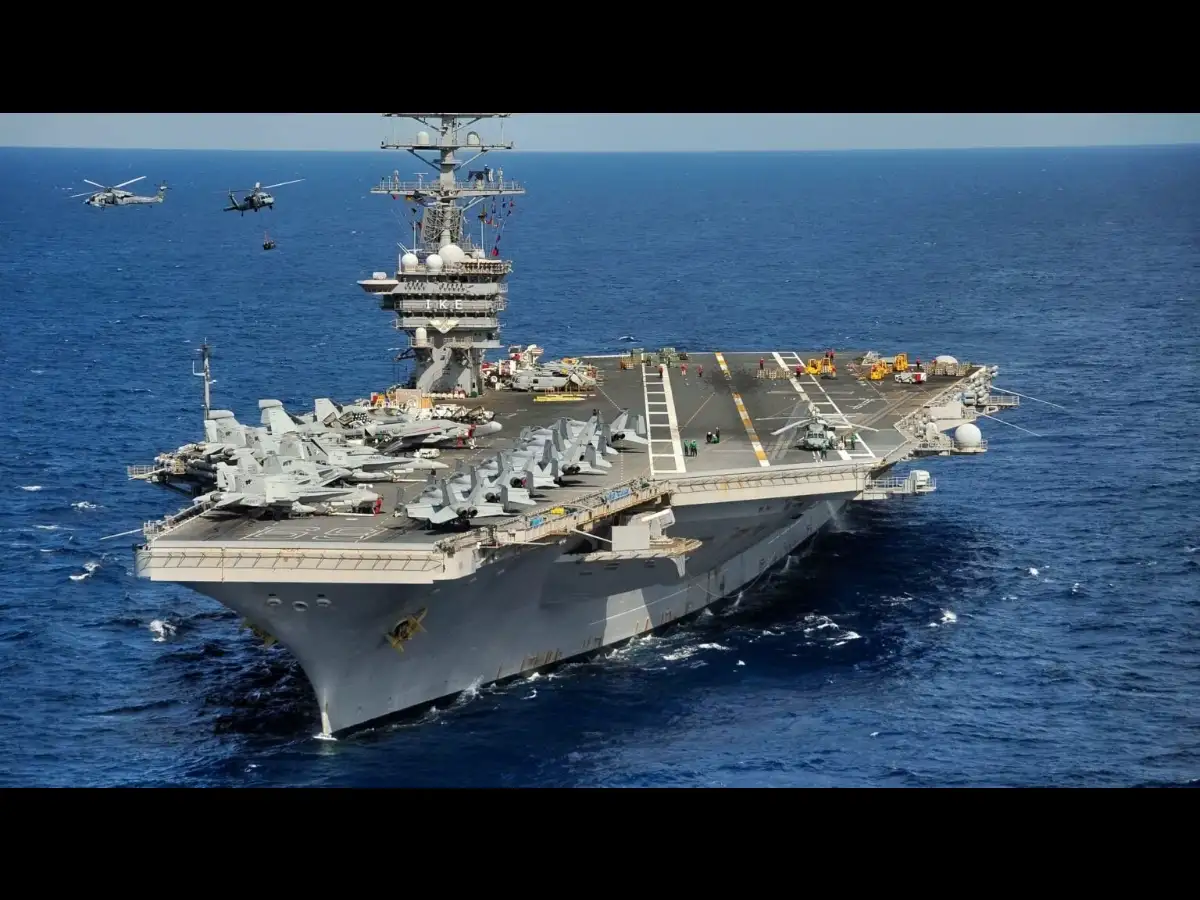
In 1981, an aging Canadian diesel-electric submarine achieved something that sounds almost impossible. The submarine slipped through the defenses of a powerful US Navy carrier strike group and carried out a simulated torpedo attack on the USS Dwight D. Eisenhower, one of America's newest and most advanced aircraft carriers at the time.
The submarine was a British-built Oberon-class boat, lacking the advanced technology found aboard today's underwater vessels. Yet during a major NATO exercise, its ability to remain quiet and undetected allowed it to get close enough to the Nimitz-class supercarrier to score a simulated kill. A nuclear-powered Nimitz-class aircraft carrier costs roughly $5,500,000,000 in today’s money.
The encounter offered a striking reminder that when it comes to submarine warfare, age and technology do not always determine the winner.
The USS Eisenhower was one of the most powerful ships of its era
The USS Dwight D. Eisenhower (CVN-69) was among the newest and most capable American aircraft carriers when the 1981 NATO exercises took place. The carrier was part of major Cold War-era naval operations designed to test how Allied forces would respond to a potential conflict in the North Atlantic and Norwegian Sea.
The exercises involved American, British and Canadian forces, along with large numbers of aircraft and ships. During one phase, the carrier strike groups were expected to move through the North Atlantic and conduct simulated attacks against enemy positions.
ALSO READ: MacKenzie Scott has given away $26.4 billion since her divorce from Jeff Bezos
But the exercise produced an unexpected result. A Canadian Oberon-class submarine reportedly penetrated the escort screen without being detected and carried out a simulated torpedo attack against Eisenhower.
In the language of the exercise, the carrier had been “sunk.”
How an old submarine got close to a nuclear-powered carrier
The Oberon-class was hardly a modern technological marvel by today's standards. These submarines were conventionally powered, relying on diesel-electric propulsion rather than nuclear power. They also lacked the sophisticated air-independent propulsion systems found on some newer submarines.
Yet they had one major advantage: silence.
ALSO READ: Jacob Coxon quits Anthropic with chilling AI warning
The Oberon-class developed a reputation for being exceptionally quiet. That made the submarines difficult to detect, particularly in an era when anti-submarine warfare depended heavily on finding the faint acoustic signatures produced by underwater vessels.
Unlike a nuclear-powered submarine, a diesel-electric boat could also shut down its diesel engines and operate on battery power. That made it possible for the submarine to become extremely difficult to hear while approaching its target.