Get all your news in one place.
100's of premium titles.
One app.
Start reading
The Times of India
The Times of India
World
TOI World Desk

In 1980, an artist used 10 tons of paint to turn 6.5 kilometres of Egypt's Sinai blue, creating a peace monument across a former battlefield

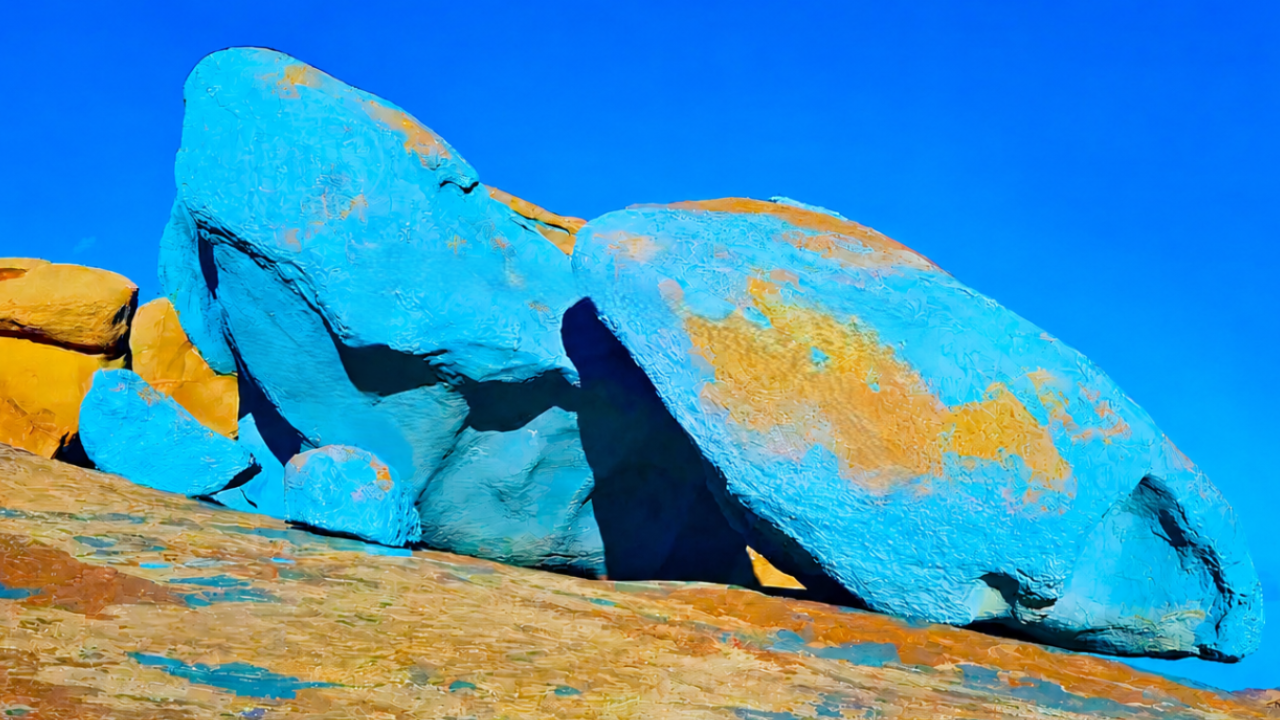
There is a patch of Egypt's Sinai desert where the rocks are not sand-coloured. They are bright, unmistakable blue. According to Atlas Obscura , Belgian-born artist Jean Verame painted these boulders in 1980, right after Egypt and Israel signed a peace treaty that ended decades of war. He used ten tons of blue paint, donated by the United Nations. Today, it is one of the most curious peace memorials in the world.

Get breaking news anytime, anywhere. Download the TOI app now!

A desert that used to be a battlefield

Before it became a canvas, this stretch of Sinai was a war zone. Egypt and Israel had fought several wars over the peninsula, including in 1967 and 1973. Then, in March 1979, everything changed. Per the U.S. Department of State's Office of the Historian , the Camp David Accords, brokered by President Jimmy Carter, led to a formal peace treaty between Egyptian President Anwar Sadat and Israeli Prime Minister Menachem Begin. It was the first peace deal Israel had ever signed with an Arab nation. The negotiations took place at a presidential retreat in Maryland and ended with a signing ceremony on the White House lawn.

Sadat and Begin were awarded the Nobel Peace Prize for their efforts, as the Nobel Prize's official website confirms. Peace treaties are usually marked by paperwork, handshakes and photographs. Verame wanted something bigger. He wanted a monument you could walk into.

A song, a president, and ten tons of paint

Verame first travelled to Sinai in 1978, a year before the treaty was even signed. Reportedly, he was inspired by "Don't It Make My Brown Eyes Blue," the Crystal Gayle song that was a massive hit in the US at the time. It sounds like an odd starting point for a desert art project, but that is exactly how the idea began.

The idea was not easy to turn into reality. Verame spent two years trying to get approval from Egyptian authorities. He eventually got the green light directly from President Sadat, along with ten tons of paint from the United Nations. Working with a team, he coated boulders, some of them as high as nine metres, across a 6.5-kilometre stretch of desert near Saint Catherine, in a section known as the Plateau of Hallaoui. The result was known as the “Line of Peace,” or sometimes the “Sinai Peace Junction.”

Why this matters beyond the photograph

It’s easy to think of this as simply a quirky travel stop, the kind of place that ends up on a bucket-list Instagram reel. But the timing and location tell another story. Verame did not paint some random hillside. He painted a former war zone, at the very moment the region was moving from war to peace. The once heavily militarised Sinai Peninsula became a symbol of what diplomacy could achieve. Verame was marking that colour shift, not just in treaties, by painting it blue.

The project also has a personal, almost stubborn quality. This was not a government-funded monument, built by committee. One artist, on foot, with paint cans, persuading a head of state to let him reimagine a stretch of desert. That scrappy, DIY persistence speaks to a generation that grew up watching indie creators build things from nothing.

A monument you may not be able to visit

The problem is that you can't see it in person right now. The same Atlas Obscura listing notes the site was closed to visitors by Egyptian authorities in April 2018, and has yet to be reopened to the public. The Blue Desert now exists mostly in photographs, old travel blogs and word of mouth, which arguably adds to its mystery.

Verame did not stop with Sinai either. Four years later, in 1984, he took his brushes to Morocco and painted granite boulders in the Anti-Atlas Mountains near Tafraout, but this time in blue, red, violet and white over a much larger area. He also worked later in Chad. Sinai, however, remains his most famous piece, precisely because of what it was built on top of: a former war zone, painted over with the colour of a ceasefire.

The takeaway

The Blue Desert is a 46-year-old reminder that peace signed on paper still needed someone to make it visible. Verame chose paint. It is unconventional, a little theatrical, and people still talk about it today.

Sign up to read this article
Read news from 100's of titles, curated specifically for you.
Already a member? Sign in here
Related Stories
Top stories on inkl right now
One subscription that gives you access to news from hundreds of sites
Already a member? Sign in here
Our Picks
Fourteen days free
Download the app
One app. One membership.
100+ trusted global sources.