Get all your news in one place.
100's of premium titles.
One app.
Start reading
The Economic Times
The Economic Times

In 1972, FHWA used 5 inches of scrubber waste in a parking-area base at Washington's Dulles Airport. 2 years later, wet weather caused the experimental base to soften and be replaced

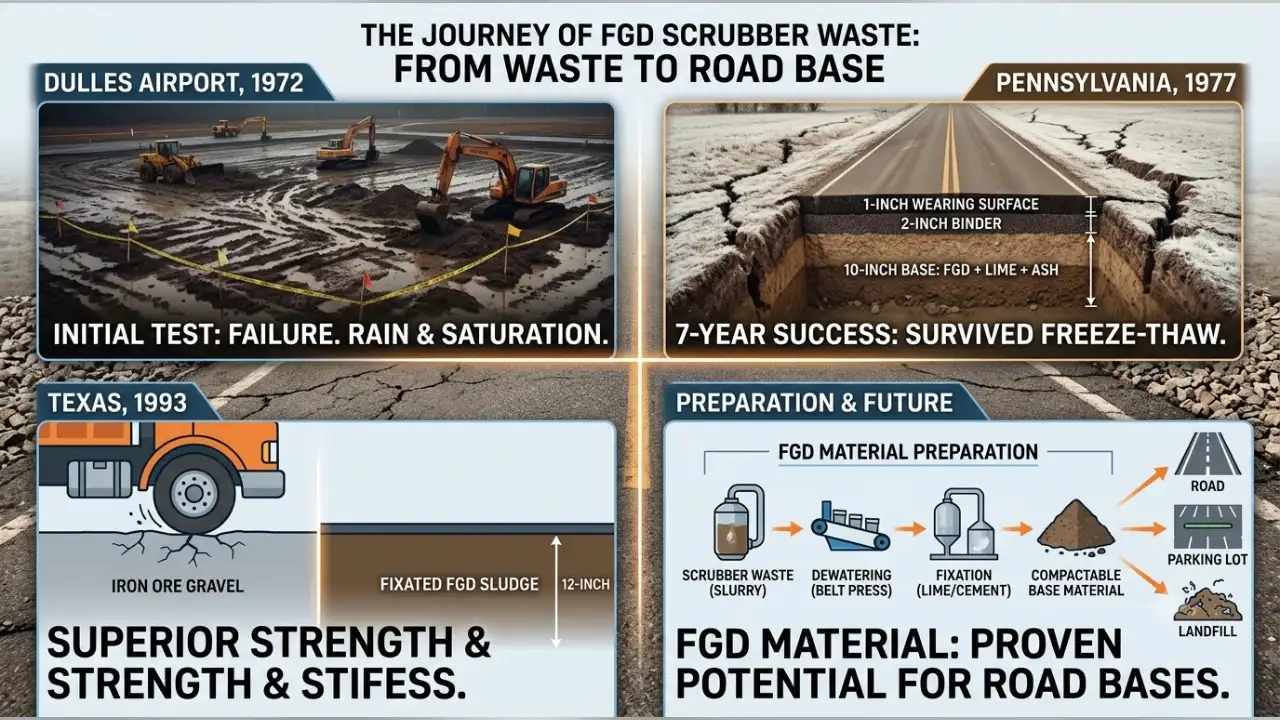
In 1972, the Federal Highway Administration tested five inches of scrubber waste in the base of a parking area at Washington's Dulles Airport. Poor weather and saturated subgrade conditions contributed to the experimental base being removed and replaced.

The material, known as flue gas desulfurization (FGD) scrubber waste, comes from pollution-control equipment and was tested as a possible material for road bases and subbases.

FGD scrubber waste gets an early road-building test

One of the earliest known applications took place during the TRANSPO'72 International Transportation Exposition at Dulles Airport near Washington, D.C. The Federal Highway Administration used part of a new 100-acre parking area for the experiment.

The 5-inch compacted base contained 3% lime, 59% fly ash, 17% bottom ash, 13% crushed limestone and 8% dewatered FGD material.

The test indicated that FGD scrubber waste had potential for highway base construction. However, the section softened and lost density and was eventually removed and replaced.

FGD material was later tested in Florida, Pennsylvania, Texas and Ohio.

READ ALSO: In 1977, Pennsylvania tested an 800-foot road base made with power-plant scrubber sludge; its strength rose from 720 to 1,014 PSI over seven years

Florida projects test scrubber waste in roads and parking lots

Florida had at least 12 projects using FGD material between 1977 and 1989. They included roads, parking lots, a landfill access road, a truck haul road and a heavy steel storage yard.

The bases were 6–12 inches thick, and at least 100,000 tons of fixated FGD material were placed. The performance was described as highly satisfactory.

University of Florida testing also found that a lime-fly ash-dewatered FGD sludge known as "Poz-o-Tec" had better bearing strength than lime rock base.

Pennsylvania road survives severe freeze-thaw conditions

In 1977, an 800-foot section of a state secondary road in southwestern Pennsylvania was built using lime, fly ash, bottom ash and dewatered FGD material.

The base was 10 inches thick and covered with a 2-inch bituminous concrete binder course and a 1-inch wearing surface.

After seven years, the project was considered fully successful. Despite severe freeze-thaw conditions, there were no potholes or broken areas, and periodic coring found the base intact.

Measured unconfined compressive strength increased from 720 psi after one year to 1,014 psi after seven years.

READ ALSO: In 1989, Sting and Trudie Styler backed one rainforest foundation with Chief Raoni. 4 years later, over 12 million acres of Kayapó land gained legal protection in Brazil

Texas test compares FGD material with gravel

In December 1993, Texas A&M University built two FGD test sections, each 18 feet wide, 300 feet long and 12 inches thick.

One section used fixated FGD sludge with self-cementing fly ash, dewatered FGD sludge and coal bottom ash. The other used fixated FGD material blended with Type II Portland cement.

A 300-foot control section made with crushed iron ore gravel was placed between the two test sections.

After two years, both FGD sections had significantly higher strength and stiffness than the control section and were described as showing successful performance to date.

Ohio haul road tests treated FGD material

In June 1995, a 250-foot test section was built as part of a 750-foot haul road at the Gavin power plant in Cheshire, Ohio.

The final base used 40% bottom ash, 60% fixated FGD material and 7% Portland cement. It was covered with three inches of asphalt.

Heavy trucks used the road daily. The test section survived one winter and more than a year without noticeable distress.

READ ALSO: Meet Brigitte Xie, the 4-year-old American piano prodigy who learned Beethoven during lockdown and earned a Carnegie Hall debut, and became the youngest music winner

How scrubber waste is prepared for road construction

FGD material generally needs to be dewatered and stabilized before it can be compacted.

After dewatering, calcium sulfite scrubber material can have a toothpaste-like consistency and contain about 25–50% solids. Belt filter presses or centrifuges can be used to remove water.

The material can then be stabilized with quicklime, Class F fly ash, Class C fly ash or Portland cement. At least 65–70% solids are generally needed for a compactable consistency.

Testing shows FGD material can gain strength

During treatment, moisture content can fall from about 60% in slurry form to around 25% after dewatering and 15–20% after fixation. Permeability can also decline from about 8×10^-5 cm/s in slurry form to as low as 5×10^-8 cm/s after fixation, as per a FHWA report.

Seven-day testing found unconfined compressive strengths of about 200–400 psi for pozzolanic mixtures and 600–900 psi for mixtures using Portland cement or Class C fly ash. Strength can exceed 2,000 psi after a year or more.

READ ALSO: Florida turned scrubber waste into road base in 12 projects by 1989; 100,000 tons earned highly satisfactory ratings, transforming an industrial byproduct into useful road base

Projects show potential for road bases

The demonstrations in Florida, Pennsylvania, Texas and Ohio indicate that fixated FGD scrubber material can be used in road bases and other heavy-duty applications when it is properly prepared and the road is properly built.

Sign up to read this article
Read news from 100's of titles, curated specifically for you.
Already a member? Sign in here
Related Stories
Top stories on inkl right now
One subscription that gives you access to news from hundreds of sites
Already a member? Sign in here
Our Picks
Fourteen days free
Download the app
One app. One membership.
100+ trusted global sources.