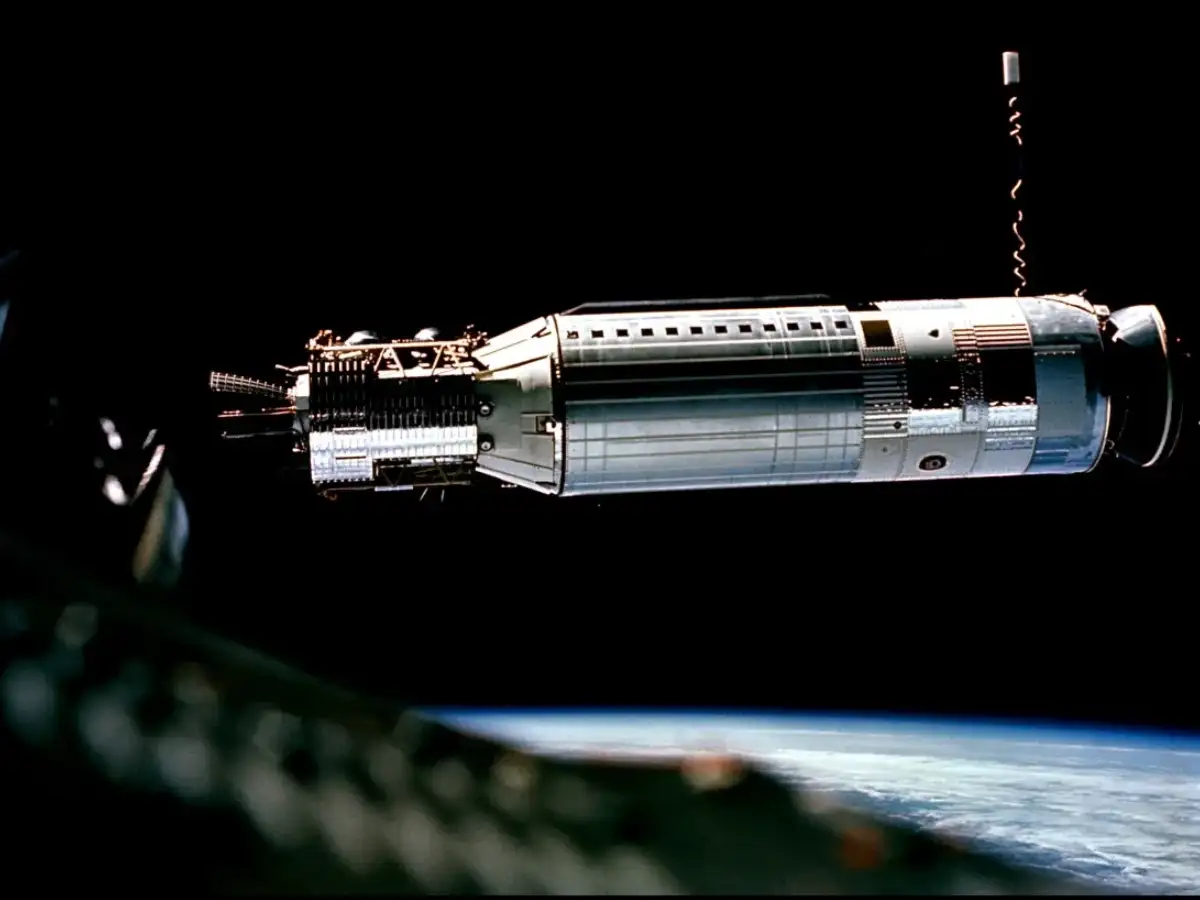
Space missions are often remembered for their dramatic moments, but sometimes the key story is how quickly a mission can change. Gemini VIII went from achieving a major spaceflight milestone to facing a serious in-flight emergency within the same mission. NASA's account describes how Neil Armstrong and David Scott completed the first docking between two spacecraft in Earth orbit before a malfunction sent their joined spacecraft into an uncontrolled roll.
On 16 March 1966, the Agena target vehicle lifted off from Cape Kennedy at 10 a.m. EST on an Atlas rocket. One hour and 41 minutes later, Armstrong and Scott launched aboard Gemini VIII on a Titan II rocket. Their task was to rendezvous with the separately launched Agena and complete the first docking between two spacecraft in orbit.

About three hours and 48 minutes into the mission, Gemini VIII was still 179 miles behind the Agena. Armstrong and Scott had established a solid radar lock and soon spotted the silver target vehicle visually. Armstrong reported seeing it at 76 miles and used visual judgement to control his braking while Scott called out radar range and closing rates. They eventually reached the Agena and held position about 150 feet away.
The docking itself was successful. Armstrong radioed, “We are docked,” and described it as “a real smoothie.” At that point, the mission had achieved a major objective that would become important for later lunar missions.
A successful docking turns into an emergency
Shortly after docking, the Agena began a programmed manoeuvre that was supposed to turn the two spacecraft. Scott noticed that they were moving in the wrong direction and told Armstrong they were in a bank. Armstrong used Gemini's orbital attitude and manoeuvring system, or OAMS, thrusters to stop the movement, but the roll immediately began again. The spacecraft then moved out of communication range with the ground.
Armstrong noticed that the OAMS propellant level had fallen below 30%, suggesting that a Gemini thruster could be malfunctioning. At the time, however, the crew did not know that the problem was in their own spacecraft. They initially suspected the Agena, and Scott pushed the undocking button while Armstrong backed Gemini away.
Instead of settling down, the spacecraft began spinning much faster once the Agena's stabilising mass was gone. Gemini VIII soon reached a rate approaching one revolution per second. The astronauts' vision became blurred as the spacecraft tumbled, making the situation increasingly difficult to control.