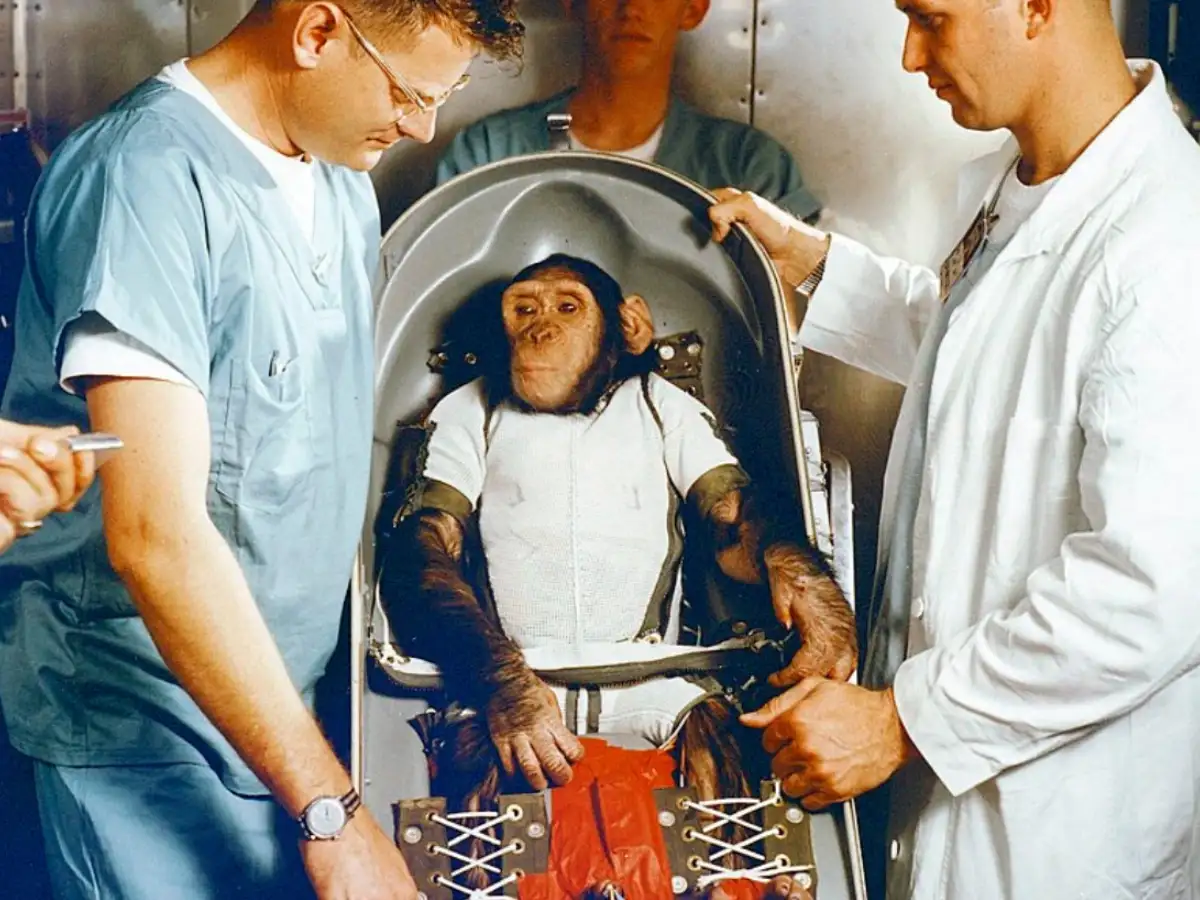
Before an American astronaut left Earth, a chimpanzee had already flown into space. On January 31, 1961, a three-year-old chimpanzee named Ham rode a Mercury-Redstone rocket 157 miles above the Earth and was safely returned after a flight of about sixteen and a half minutes, a mission that took place 65 years ago this year. According to NASA's official history of animals in space, the mission was designed to test whether a chimpanzee could still perform simple, trained tasks correctly during the stress of launch, weightlessness, and re-entry, before any human took that same risk.
Meet the chimp who trained like an astronaut
Ham was born in the wild in French Cameroon in July 1957. NASA's history notes that his actual training began in 1959, when he was transferred to Holloman Air Force Base in New Mexico. His training was demanding. According to a study in the journal Military Medicine titled "HAM, A Space Pioneer," Joseph V. Brady, a behavioral neuroscientist at the Walter Reed Army Institute of Research, worked with NASA to prepare Ham for the mission. That research describes a system of lights and levers, in which Ham was supposed to flip one lever every 20 seconds or so to prevent a mild electric shock to his foot. Smithsonian records add that Ham would receive a reward for a correct response, usually a banana pellet or a drink of water, while a wrong response would result in a light shock. This system let scientists test whether a primate, and later a human, could still perform simple tasks under the stress of spaceflight.