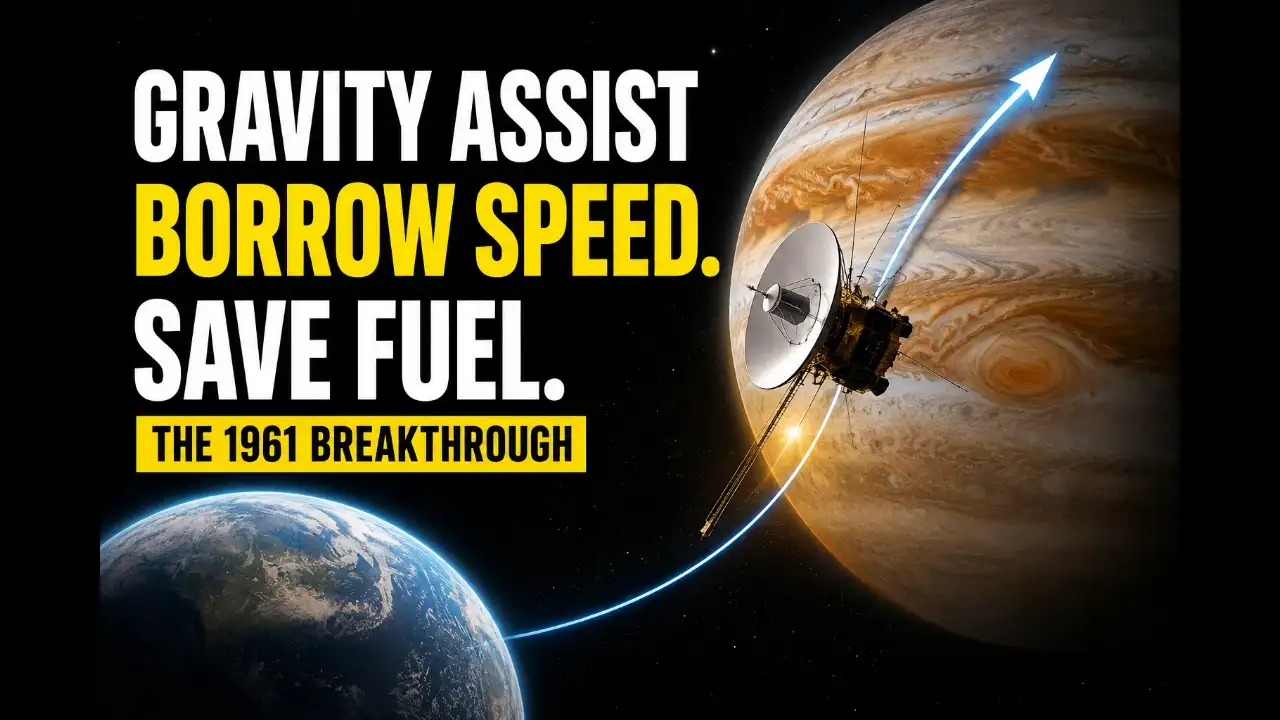
A summer job at NASA’s Jet Propulsion Laboratory in 1961 led a UCLA graduate student into a problem that was much bigger than the assignment on his desk. Michael Minovitch had been asked to study how a spacecraft could travel between two points while falling through the Sun’s gravitational field. It was a difficult trajectory problem, but it was still a defined one. Then he started asking what would happen if a planet’s gravity became part of the journey. That question changed the possibilities for interplanetary travel.
Minovitch worked on the problem outside his assigned duties and developed calculations showing how a spacecraft could make a close planetary flyby and emerge on a very different path around the Sun. The spacecraft would not get energy from nowhere. Instead, it could exchange orbital energy with a moving planet, gaining or losing speed relative to the Sun without firing its engines during the encounter. NASA now describes gravity assists as a basic tool of planetary mission design.