Get all your news in one place.
100's of premium titles.
One app.
Start reading
The Times of India
The Times of India
World
TOI World Desk

In 1960, Oregon released cinnabar moths against toxic tansy ragwort; their caterpillars were later found feeding on native mountain wildflowers

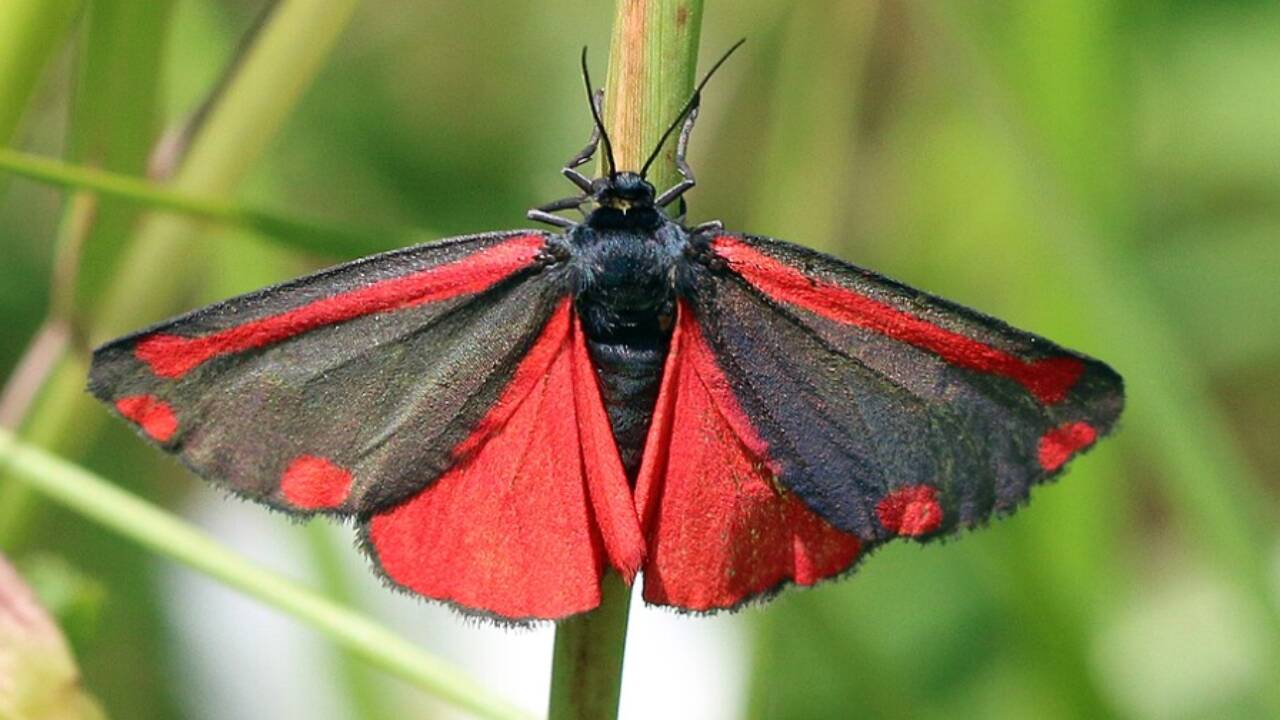
In 1960, Oregon released a small red and black moth into its fields, hoping its caterpillars would devour a toxic, non-native weed poisoning livestock across the state. The plan was effective for decades. More recently, researchers found that the same caterpillars have also been feeding on a native mountain wildflower they were not expected to eat. Tansy ragwort, a plant toxic to horses and cattle, had plagued Oregon farmers and ranchers for decades after arriving from Europe or Asia.

Get breaking news anytime, anywhere. Download the TOI app now!

According to the Oregon Department of Agriculture , the cinnabar moth, Tyria jacobaeae, was introduced into the state in 1960 specifically to control the weed, and it later became the official symbol of the agency's weed-control program. The moth's caterpillars feed on tansy ragwort during late spring and summer and can completely defoliate dense stands of the plant where infestations are heavy. According to Oregon State University's Extension Service, the moth was one of three separate insects, alongside a flea beetle and a seed head fly, introduced between 1960 and 1971 as part of a coordinated biological control effort ordered by the Oregon legislature.

Decades of real success against a genuine problem plant

The programme worked better than many biological control efforts. According to Oregon State University, the combined effect of these three insects brought tansy ragwort largely under control across the state from the mid 1980s through 2005, delivering an estimated 5 million dollars a year in economic benefit to Oregon agriculture. The cinnabar moth specifically has since been released in 25 Oregon counties and become established in 22 of them, according to the Oregon Department of Agriculture, with the flea beetle, later introduced in 1971, proving especially effective at reducing ragwort density in western Oregon by as much as 95 per cent in some areas. For decades, cinnabar moth releases were cited as one of the clearest success stories in weed biocontrol.

An unexpected discovery about what else the caterpillars eat

Researchers noticed the issue only after they looked more closely at what else was growing near tansy ragwort infestations. According to the University of Washington's Elisabeth C. Miller Library , a three-year survey conducted across 25 sites in western Oregon found that cinnabar moth caterpillars have also been feeding on arrowleaf groundsel, a native wildflower found principally in Oregon's mountains and occasionally along the coast. Peter McEvoy, the Oregon State University researcher who led the original search for the moth's biological control agents decades earlier, acknowledged that the cinnabar moth arrived at a time when threats to native plants simply did not receive much public or scientific scrutiny. Scientists had previously assumed the cold mountain habitats where arrowleaf groundsel grows would be too harsh for the cinnabar moth to survive in, an assumption the survey's findings directly contradicted.

Why this still counts as a genuine, if complicated, success

The Oregon Department of Agriculture confirms that investigations are continuing to determine the actual extent of cinnabar moth feeding on native Senecio species, including arrowleaf groundsel and a related plant called Packera pseudaurea, along with what impact natural predators and parasites might have in limiting that unintended feeding. The tradeoff is worth keeping in perspective. The moth remains an effective control for the invasive weed.

The discovery is a cautionary note rather than a full reversal: even a biological control agent chosen decades ago after careful host-specificity testing can still affect species no one expected. Cooperative research between Oregon State University and the state's agriculture department continues today, monitoring exactly how far that unintended feeding actually extends before deciding whether any changes to the programme are warranted. Similar cinnabar moth introductions have since been attempted elsewhere in the Pacific Northwest, including a documented release in Montana's northern Rocky Mountains, where the moth controlled tansy ragwort in forest settings without measurable impacts on local native Senecio populations.

Sign up to read this article
Read news from 100's of titles, curated specifically for you.
Already a member? Sign in here
Related Stories
Top stories on inkl right now
One subscription that gives you access to news from hundreds of sites
Already a member? Sign in here
Our Picks
Fourteen days free
Download the app
One app. One membership.
100+ trusted global sources.