
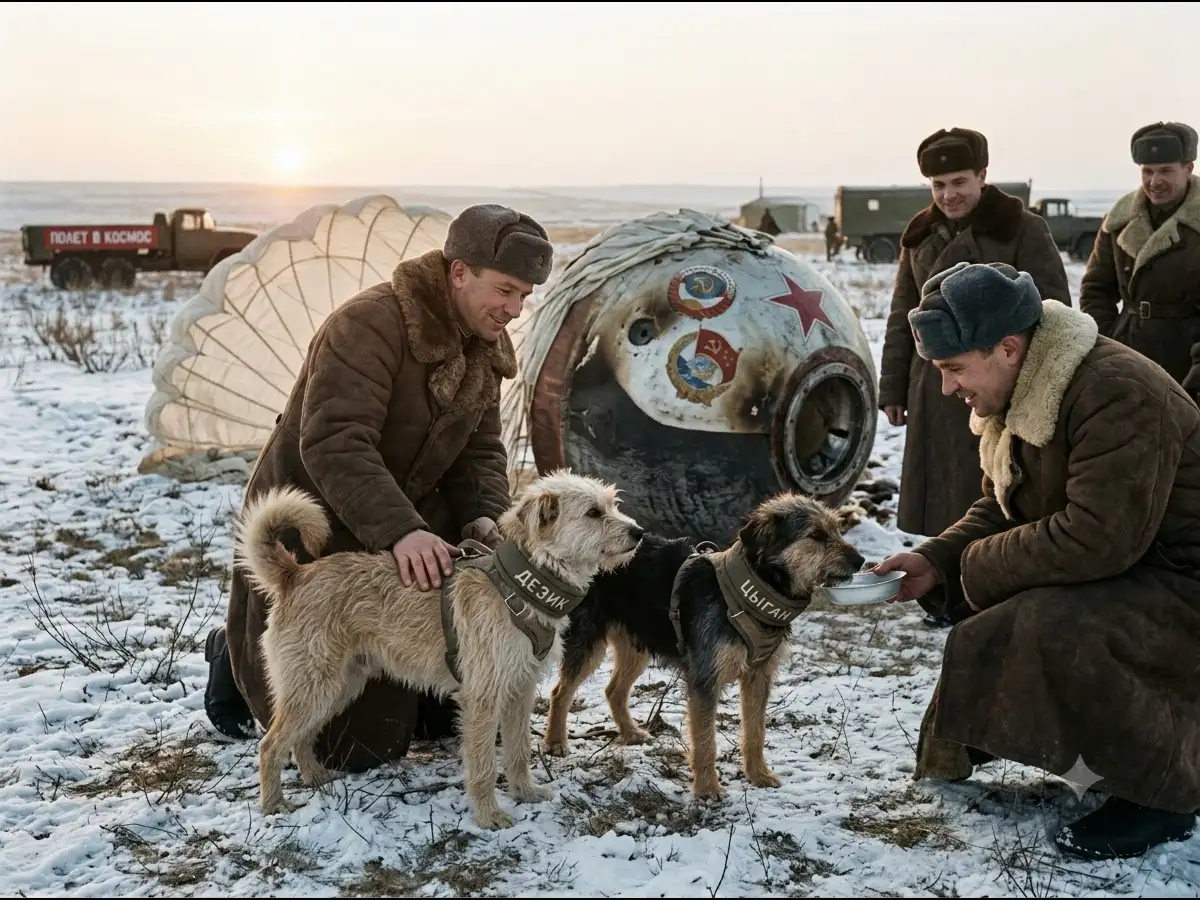
In 1951, two female stray dogs named Dezik and Tsygan became the first mammals to successfully cross the border of space and return alive. Their flight took place on July 22, 1951, from the Kapustin Yar rocket development site in the Soviet Union. The mission was part of Soviet research into the effects of spaceflight on living organisms. Scientists wanted to understand whether an animal could survive the forces of a rocket launch, a period of weightlessness and the return through Earth's atmosphere.
The two dogs flew on an R-1V rocket. The vehicle was a Soviet modification of the German V-2 ballistic missile. The rocket reached a maximum altitude of about 110 kilometers, or 68.3 miles. The flight crossed the 100-kilometer mark. This is commonly used as the Kármán Line, a conditional boundary used to define the beginning of outer space. The dogs experienced about four minutes of weightlessness. The complete journey lasted about 15 minutes, from launch until the capsule reached the ground.













