Get all your news in one place.
100's of premium titles.
One app.
Start reading
The Times of India
The Times of India
World
TOI World Desk

In 1948, a sculptor blasted 10 tons from a South Dakota mountain; decades later, his family continues carving his Crazy Horse Memorial

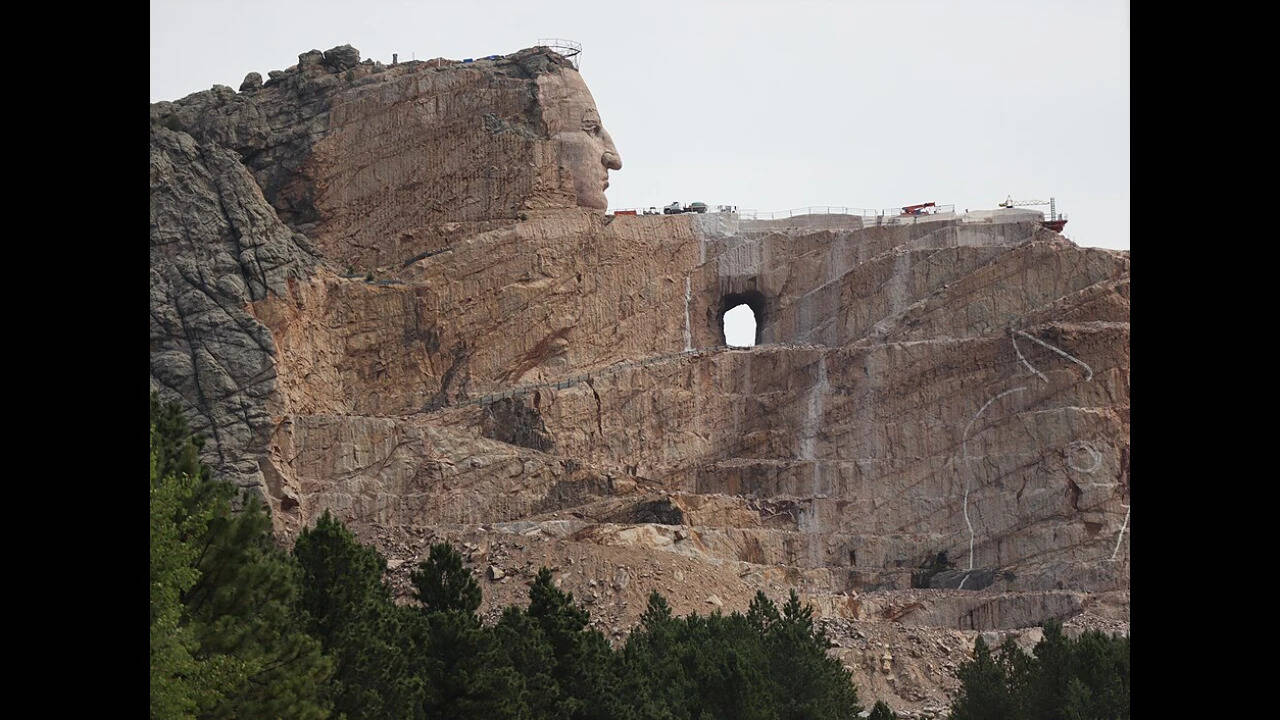
On June 3, 1948, a single blast of dynamite removed 10 tons of granite from Thunderhead Mountain in South Dakota’s Black Hills. It was a modest beginning for a project that would eventually require millions of tons of rock to be drilled, blasted, and cleared away. Nearly eight decades later, the mountain is still being carved into the likeness of Crazy Horse, the Oglala Lakota warrior, and the work has passed from one generation of the Ziolkowski family to the next.

Get breaking news anytime, anywhere. Download the TOI app now!

According to official records from the Crazy Horse Memorial , Lakota Chief Henry Standing Bear wanted a monument that would honour Native Americans and preserve their history and culture in the Black Hills. He approached sculptor Korczak Ziolkowski after learning about his work at Mount Rushmore and his award-winning marble portrait of Polish statesman Ignacy Jan Paderewski, which won first prize at the 1939 New York World’s Fair. Standing Bear wrote to Ziolkowski in November 1939, and the two later met at Pine Ridge. Ziolkowski eventually accepted the invitation after serving in the Second World War.

From an idea to a mountain-sized challenge

Crazy Horse Memorial also notes that Ziolkowski arrived in the Black Hills in 1947 and selected Thunderhead Mountain for the project. The scale was daunting. Rather than simply placing a sculpture on the landscape, he planned to transform the mountain itself. The completed carving is designed to show Crazy Horse riding a horse, with one arm extended toward the lands associated with his people. It is planned to measure 641 feet long and 563 feet high, making it vastly larger than nearby Mount Rushmore.

Before serious carving could begin, Ziolkowski had to create much of the infrastructure himself. He built roads, constructed a home and workshop, and made a wooden staircase of 741 steps to reach the upper sections of the mountain. His equipment was basic and frequently broke down. The first blast in 1948 marked more than the removal of 10 tons of granite. It marked the point at which an ambitious idea became a physical, decades-long undertaking. Five survivors of the Battle of the Little Bighorn were among those present for the dedication and first blast.

The choice of Crazy Horse was significant. He was an Oglala Lakota leader who became associated with resistance to the expansion of the United States into Lakota lands. Yet there was an immediate practical difficulty: Crazy Horse had never allowed himself to be photographed. The sculptor therefore could not work from a confirmed portrait. Instead, Ziolkowski and those who knew the warrior relied on descriptions and accounts to create what the memorial describes as a likeness based on his features and appearance.

The dream survives its creator

As noted by The Washington Post in 1996, Ziolkowski died in 1982 at the age of 74 after 34 years of work on the mountain. His widow, Ruth, and most of their children then carried forward his vision. By that time, seven of his 10 children were working at the memorial, taking on different responsibilities, including drilling, blasting, engineering, road maintenance and administration. The family’s continued involvement ensured that the project did not end with its creator’s death.

Ruth also made an important decision about what should come next. Rather than simply continuing with the sequence her husband had followed, she reviewed the measurements and shifted the main carving effort towards Crazy Horse’s face. That decision helped bring a recognisable part of the monument into view. In 1998, 16 years after Ziolkowski’s death, the face was dedicated. Work on the sculpture has continued in stages since then. The left hand was completed in 2024, marking another milestone in the carving, and attention has now shifted towards the horse’s head. The memorial’s current leadership estimates that carving the horse’s head could take roughly another decade. Although several major sections have now been completed, the monument as a whole remains unfinished, and there is still no fixed completion date for the entire sculpture.

A monument measured in generations

The project has always rejected the idea that it should be completed quickly. Ziolkowski had understood from the beginning that he was undertaking work far beyond one lifetime. The family has continued that philosophy, relying largely on visitor income, donations, and private support rather than federal funding. More than $250 million in private funds has been spent on the project so far, according to a 2026 CBS report.

The unfinished Crazy Horse sculpture overlooks a landscape that has changed over the years. The statue itself is still incomplete; that incompleteness is central to its history. It started as a single sculptor’s dream and has become a family project spanning many lifetimes.

Sign up to read this article
Read news from 100's of titles, curated specifically for you.
Already a member? Sign in here
Related Stories
Top stories on inkl right now
One subscription that gives you access to news from hundreds of sites
Already a member? Sign in here
Our Picks
Fourteen days free
Download the app
One app. One membership.
100+ trusted global sources.