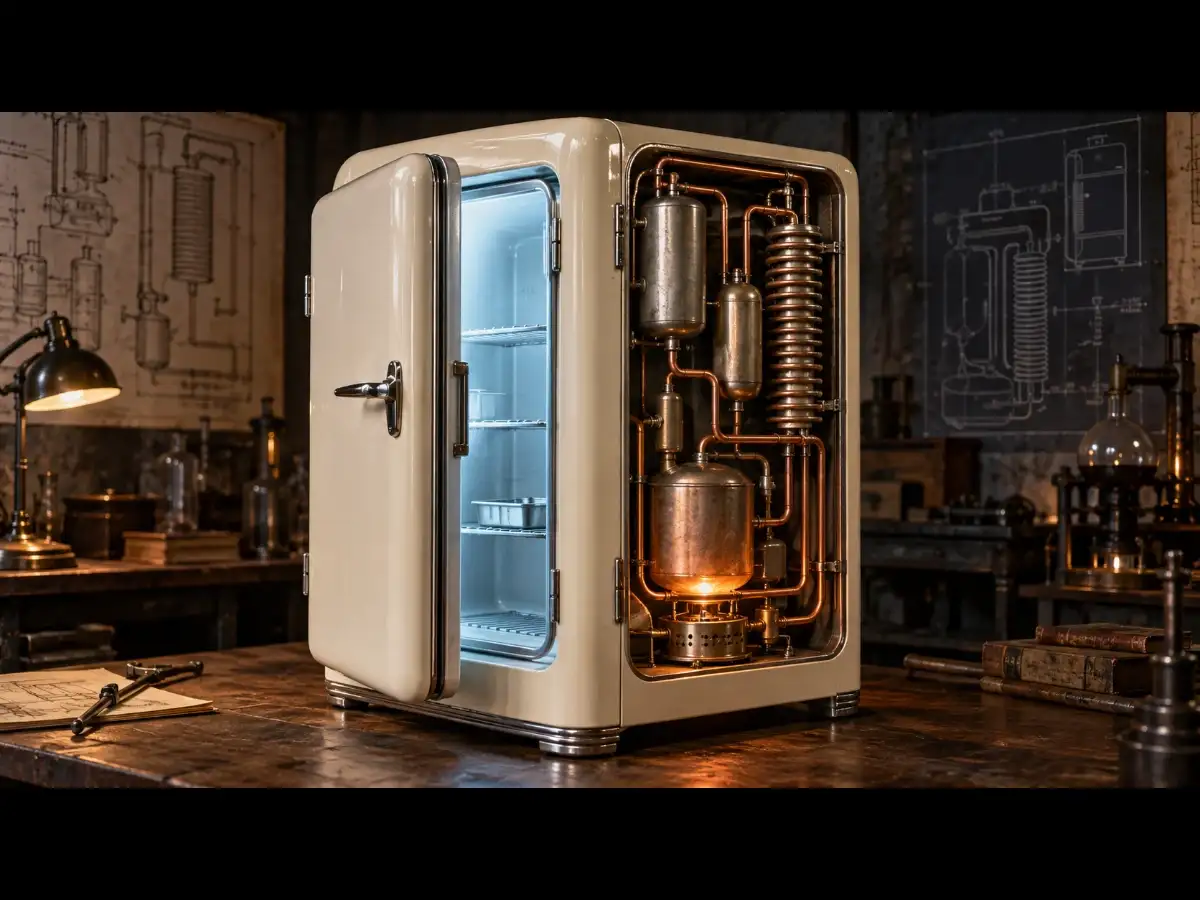
A refrigerator usually works quietly in the background, keeping food cold while electricity powers the machinery hidden behind it. But nearly a century ago, Albert Einstein and physicist Leo Szilard imagined a very different way to make cold. Their refrigerator had no electric motor, no pump and no compressor. Instead, it relied on a carefully arranged cycle involving ammonia, butane, water and heat, as per a report by Wired.
The idea was strikingly simple in principle. Heat went into one part of the system, while another part became cold. Yet despite the involvement of one of the most famous physicists in history, the refrigerator never became a commercial product.

So what happened to Einstein and Szilard's unusual refrigerator?
How did Albert Einstein's refrigerator work?
The basic principle described in the patent was based on an absorption refrigeration cycle. Liquid butane was placed inside an evaporator, the part of the system located in the chamber that needed to be cooled. Ammonia gas was introduced into the evaporator alongside the butane.
The presence of ammonia reduced the partial pressure of the butane. That allowed the butane to evaporate. As it changed from liquid to gas, it absorbed heat from its surroundings, producing the cooling effect. The resulting mixture of butane vapor and ammonia then moved into a condenser.
There, the gases came into contact with water. Ammonia is highly soluble in water, while butane is comparatively insoluble. The ammonia therefore dissolved into the water, separating it from the butane.
The butane could then condense back into liquid form. Because liquid butane was lighter than the ammonia-water solution, the two liquids separated, with the butane floating above the solution.
The liquid butane then returned to the evaporator, ready to begin the cycle again.