Get all your news in one place.
100's of premium titles.
One app.
Start reading
The Times of India
The Times of India
World
TOI World Desk

In 1921, a vampire-like sea lamprey appeared above Niagara Falls; by the late 1930s, it had spread through the Great Lakes and devastated native lake trout

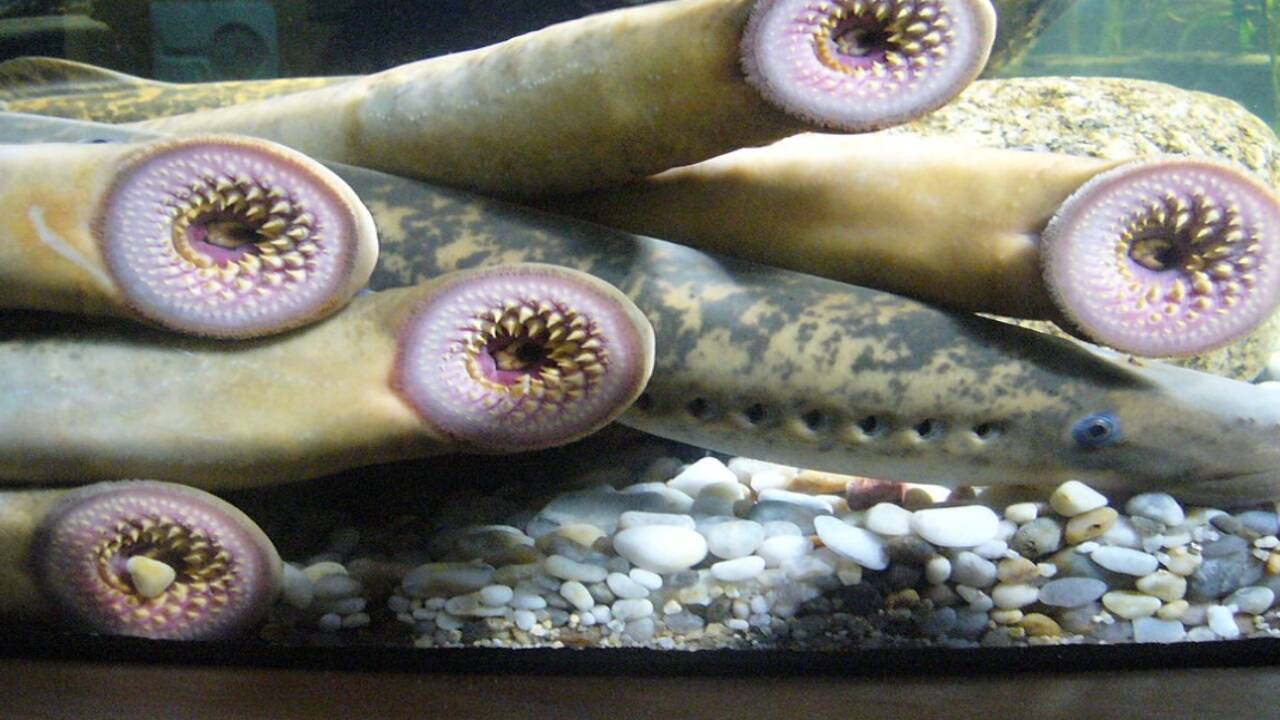
On November 8, 1921, a commercial fisherman pulling nets near Merlin, Ontario, on Lake Erie noticed something unusual attached to one of his lake whitefish: a writhing, eel-like creature with a circular, tooth-lined mouth clamped onto the fish's side. It was a sea lamprey, a parasitic species native to the Atlantic Ocean that did not belong in Lake Erie. Within 17 years, it would spread through all the Great Lakes.

Get breaking news anytime, anywhere. Download the TOI app now!

A natural barrier bypassed by a shipping canal

Sea lampreys had been recorded in Lake Ontario as far back as 1835, but Niagara Falls had served as an impassable wall, keeping the parasite confined to a single lake. According to the Great Lakes Fishery Commission , that changed after improvements to the Welland Canal, a shipping channel built to let vessels bypass Niagara Falls and move between Lake Ontario and Lake Erie. Once the canal was deepened in the early twentieth century, sea lampreys used it to bypass the falls, likely traveling on ship hulls or on migratory fish. Following that initial 1921 sighting, the lamprey's advance across the rest of the lake system was rapid. According to the International Joint Commission , the parasite reached Lake Michigan by 1936, Lake Huron by 1937, and Lake Superior soon after, completing its takeover of the entire Great Lakes basin within less than two decades of that first Lake Erie sighting.

The Great Lakes proved to be ideal habitat for the invader. Sea lampreys need clean, gravel-bottomed streams to spawn and soft sediment for their larvae to burrow into and grow for several years before maturing, both of which the Great Lakes tributaries offered in abundance. National Park Service documentation shows that a single female can lay as many as 100,000 eggs, and with no natural predators in the region to keep the population in check, sea lamprey numbers climbed largely unchecked through the 1930s and 1940s.

A fishery collapse that took decades to reverse

According to the US National Park Service , lake trout, whitefish, and ciscoes may have made up the backbone of a commercial fishery that once harvested about 15 million pounds of lake trout from the upper Great Lakes every year before the invasion. By the late 1940s, as sea lamprey populations exploded, that fishery began to unravel. Each lamprey can drain the blood and body fluids of up to 40 pounds of fish over its parasitic lifetime, and only about one in seven fish survives an attack. By the early 1960s, the annual lake trout catch had collapsed to roughly 300,000 pounds, barely 2 percent of what it had been before the lamprey's arrival. At the height of the infestation, as many as 85 percent of surviving fish carried visible lamprey wounds.

Fishing communities that had depended on lake trout and whitefish for generations saw their catches disappear within a few short decades, taking many related jobs down with them. Boats that once returned loaded with lake trout came back with holds full of lamprey-scarred fish that processors and buyers would not accept, and entire towns built around commercial fishing on Lakes Huron and Michigan watched their local economies contract within a single generation.

The crisis eventually pushed the United States and Canada to form the Great Lakes Fishery Commission in 1955, a binational body created specifically to bring the sea lamprey under control. Its ongoing lampricide and barrier program is often cited as a major large-scale effort to control an invasive vertebrate across an entire ecosystem, though it requires continuous funding and monitoring since the lamprey has never been fully eradicated from the lakes it invaded. More than roughly 100 years after that first lamprey was pulled from a whitefish near Merlin, Ontario, the program still treats hundreds of tributary streams every year to kill lamprey larvae before they mature, a permanent, costly reminder of how a single canal upgrade reshaped an entire freshwater ecosystem.

Sign up to read this article
Read news from 100's of titles, curated specifically for you.
Already a member? Sign in here
Related Stories
Top stories on inkl right now
One subscription that gives you access to news from hundreds of sites
Already a member? Sign in here
Our Picks
Fourteen days free
Download the app
One app. One membership.
100+ trusted global sources.