Get all your news in one place.
100's of premium titles.
One app.
Start reading
The Economic Times
The Economic Times
Shreya Biswas

In 1912, Wilfrid Voynich bought a mysterious manuscript written in an unknown script. 114 years later, its text remains undeciphered despite decades of study

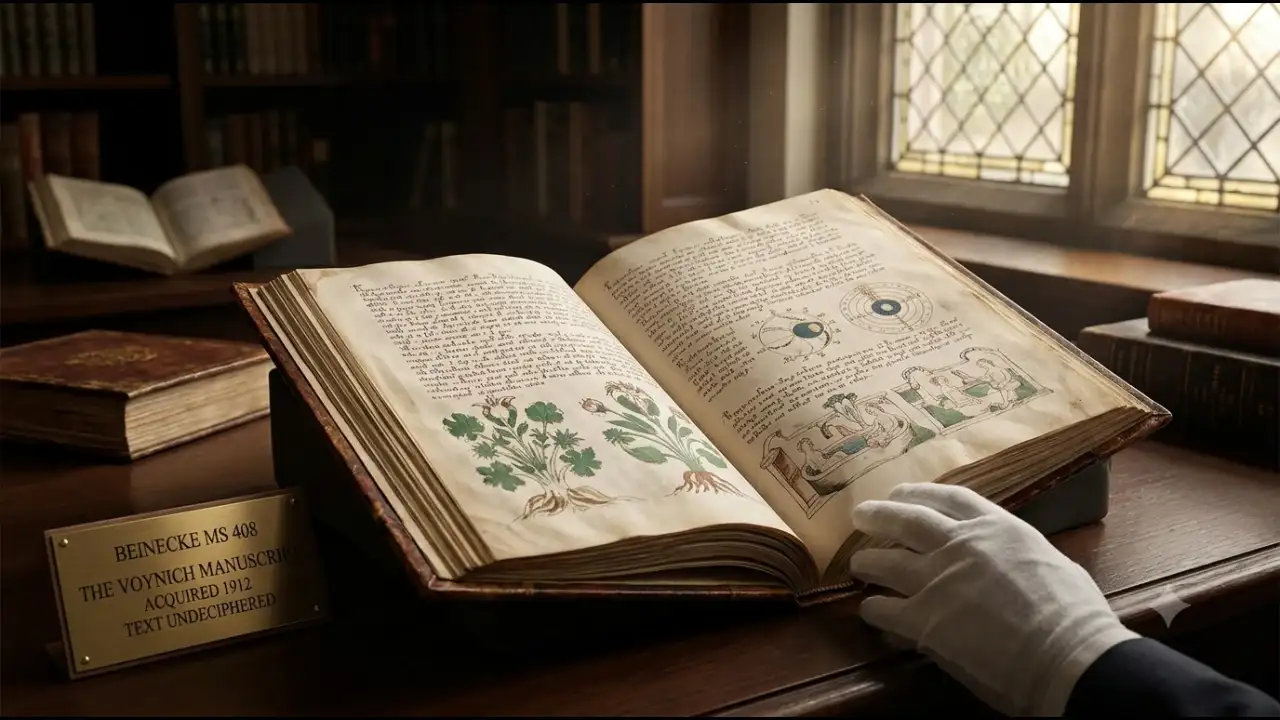
In 1912, Polish-American antiquarian bookseller Wilfrid M. Voynich purchased a mysterious manuscript from the Jesuit College at Frascati near Rome. Written in an unidentified script by an unknown author, the manuscript has remained undececiphered for more than a century.

Today, the Voynich Manuscript, formally known as Beinecke MS 408, is held by Yale University’s Beinecke Rare Book and Manuscript Library. Yale says cryptographic approaches have failed to decipher the text, if it is indeed encoded.
Wilfrid Voynich Purchased the Manuscript in 1912

In 1912, Wilfrid M. Voynich purchased the manuscript from the Jesuit College at Frascati near Rome. Yale says the manuscript and its meaning had been debated since its appearance on the rare-book market that year.

Before Voynich acquired it, the manuscript had passed through several owners. Yale identifies Holy Roman Emperor Rudolph II as its first confirmed owner. Rudolph II purchased it for 600 gold ducats and believed it was the work of Roger Bacon. Yale describes the association with Bacon as speculation.

The manuscript later entered the library of pharmacist Jacobus Horčicky de Tepenec and, by 1637, that of alchemist Georgius Barschius. Barschius bequeathed it to Johannes Marcus Marci of Cronland, who sent it to Jesuit scholar Athanasius Kircher in 1666.

After Voynich’s death, the manuscript passed to his wife, Ethel, who willed it to Anne Nill, a friend and assistant of the Voynich family. Nill sold it to New York bookseller H. P. Kraus in 1961. Kraus gave the manuscript to Yale’s Beinecke Library eight years later, in 1969.

READ ALSO: A painting bought for £2,090 at auction looked ordinary. Experts later identified it as a lost Helen McNicoll masterpiece valued at £300,000

What Is the Voynich Manuscript

Yale describes the Voynich Manuscript as having been produced in Central Europe at the end of the 15th or during the 16th century. Scientific testing suggests that its materials are consistent with manuscripts produced in the 15th century.

The manuscript is written in an unidentified script, and its author is unknown. Its illustrations are divided into six distinct sections covering plant specimens; astronomical and astrological drawings; bathing scenes; cosmological medallions; pharmaceutical drawings of herbs and roots; and unillustrated text, possibly recipes, with star-like flowers marking individual entries.

Why Has the Text Remained Undeciphered

The manuscript’s text remains undeciphered. Yale says cryptographic approaches have failed to decipher the writing, while noting that it is not certain whether the text is encoded at all.

A 2025 Yale News article said the manuscript has resisted translation for more than a century. Yale linguist Claire Bowern explained that researchers can still study features such as word patterns even though they do not know what the words mean.

Paleographic research has also identified five people who collaborated on writing the book.

READ ALSO: In 2000, artist Kimberly Wurster restored 1 Montana mining property for wildlife and trout. 20 years later, it supported elk breeding grounds and trout spawning habitat

Yale Preserves the Manuscript

Because of the manuscript’s fragility, the number of research requests and Yale’s responsibility to preserve it, access to the original manuscript is restricted. Yale has made high-resolution images of the entire manuscript available for research through its digital library.

Since Yale acquired the manuscript in 1969, it has left the Beinecke Library only once. It was taken to the Folger Shakespeare Library for the 2014–15 exhibition “Decoding the Renaissance: 500 Years of Codes and Ciphers.”

114 Years After Its Purchase, the Text Remains Undeciphered

In 2026, it has been 114 years since Wilfrid Voynich purchased the manuscript from the Jesuit College at Frascati near Rome.

More than a century after its appearance on the rare-book market, the manuscript remains written in an unidentified script by an unknown author, and its text remains undeciphered. Researchers continue to study its writing and other features, but no decipherment has been established.

READ ALSO: Words to live by: 'Every weird thing about you is...' - Kesha's inspiring quote on life lessons about being yourself, self-acceptance and why you must embrace what makes you different

Sign up to read this article
Read news from 100's of titles, curated specifically for you.
Already a member? Sign in here
Related Stories
Top stories on inkl right now
One subscription that gives you access to news from hundreds of sites
Already a member? Sign in here
Our Picks
Fourteen days free
Download the app
One app. One membership.
100+ trusted global sources.